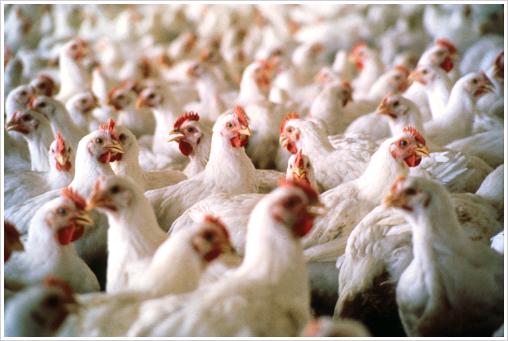
Free-range-chickens.
THE OBJECTIVES OF BIOSECURITY
• To prevent the introduction of infectious agents into free range layer farms
• To prevent the spread of disease between farms and between sheds on a farm
• To improve the standard of farming and the public perception of food producing enterprises
• To minimise the potential disease risk to humans from eggs.
HOW ARE DISEASES SPREAD?
There are many ways that diseases can spread to farms. Some of the more likely methods of disease transmission are:
• movement of birds and equipment – particularly second-hand packing material, such as egg fillers – between farms;
• movement of people between farms;
• movement of infected poultry products (e.g. eggs);
• windborne transmission;
• rodents (e.g. rats, mice);
• contaminated water supply;
• wild bird access to birds;
• insects;
• other birds or animals on the farm.
Basic practical precautions go a long way toward preventing the entry of most diseases onto the farm. Indeed, there are some diseases for which these precautions may be insufficient to prevent entry; however, the fact that burglars can get in through the roof does not stop most households from placing locks on doors and windows, especially if the cost associated with these measures is negligible compared with the trauma and loss associated with burglary. So, while in some cases a disease can enter the farm through means that cannot be easily controlled by a practical level of biosecurity, this should not stop a farm from taking basic practical precautions.
BASIC BIOSECURITY
THE FARM.
Keep the farm clean and free of debris, particularly around the shed area and egg room.
Stockpiles of poultry manure should not be kept in these areas. This is important for public perception as well as minimising the presence of ‘hiding spots’ for rodents and insects, and maximising the ability of the sun (UV light) to ‘disinfect’ the shed surrounds.
The area leading to the shed should have appropriate signs to stop customers wandering into the shed. An alarm system should be installed, to alert the owner/manager that customers have entered the farm area.
Because free range chickens require free access to the outdoors, bird-proofing the shed is practically impossible. Contact with wild birds – particularly wild water birds – can be minimised by making the free range enterprise less attractive to them; e.g. by placing feeders inside the shed, rather than in the open range where wild birds will have easier access. Placement of bird netting in critical feeding areas may also reduce the risk. The netting should allow the entry of chickens but limit entry by wild birds.
The shed should be waterproof, as damp areas in the shed and wet feed in the troughs may attract flies, and will also provide a suitable environment for bacterial and fungal multiplication.
 Adequate facilities for the disposal of dead birds should be in place, using methods that comply with environmental guidelines.
The feed-mill/preparation area should be as bird-proof and animal-proof as possible, to prevent contamination of feed.
Unnecessary large bodies of water around the shed should be avoided, as they may attract wild waterfowl to the vicinity. Access of free range chickens to dams and creeks should be curtailed by fencing off these areas.
The water supply to the shed (e.g. for drinking and fogging) should be either mains water, good quality bore water, or be treated by an appropriate method such as chlorination, UV irradiation or ozonisation.
New litter (shavings) for deep litter during the growth phase of day old and pullet rearing should be accessed from known, reputable sources, and stored in a bird-proof location.
Only new egg fillers or cleaned plastic egg fillers should be used. Customers should be discouraged from returning empty egg fillers to the farm.
Movement of eggs between farms should be avoided if possible.
Eggs sourced from another farm (e.g. to make up for a temporary shortage, or for other reasons) should be kept in a separate section of the farm or in the egg storage area.
Soft-shell, cracked or unusable eggs should not be dumped in or outside the shed. They should be buried, composted or removed from the farm as part of the dead bird pick-up, or by other suitable arrangements.
OPERATIONAL STANDARDS.
Vaccination.
An effective vaccination program appropriate to the diseases found in the area is one of the most important aspects of biosecurity, regardless of any other biosecurity measures taken at farm level. Vaccination against endemic diseases – such as Marek’s disease, infectious laryngotracheitis (ILT), infectious coryza, mycoplasma, fowl pox, infectious bronchitis, avian encephalomyelitis and egg drop syndrome 76 – should be considered as routine farm practice. Vaccination of chickens against Newcastle disease is compulsory in NSW.
Vaccination by an outside crew can carry a significant risk if not done with appropriate biosecurity precautions. Professional vaccination crews should have their own biosecurity code, which should be examined by the farmer prior to the visit. It is essential that vaccination crews do not visit more than one farm on the same day, and that all their equipment is sanitised before the next ‘job’. Vaccination crew personnel should sign the visitors’ book and declaration (E.G. below.)
LAYER FARM ENTRY PERMIT
Authorisation for: _________________________________________________________
Date of entry: _____________________________________________________________
Terms and conditions of entry to layer sheds.
Visitors:
• have not been in contact with any avian species or untreated poultry manure within the last 24 hours.
• agree to wear the protective clothing required, or their own unused clothing.
• agree to wear the protective boots or overshoes provided.
• agree to sanitise their hands in the facility provided.
I agree to the terms and conditions of entry stated above.
Object of visit: ____________________________________________________________
_________________________________________________________________________
_________________________________________________________________________
Name________________________________ Signature___________________________
Author.
George Arzey and Ian Littleton.