Minimal Activity: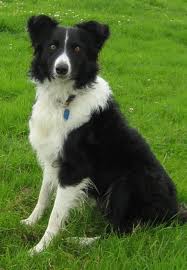
This is the term used for the dog to do the job that needs to be done without wasting energy and wasting time. Most dogs you will find do use to much energy and therefore lose productivity.
A good dog should know how make the tedious tasks of herding easy for itself if trained correctly, when the dog feels that the job in progress and they are in control they are able to stop moving around so much. Most dogs when they get the sheep under control don’t remain still and calm, the sheep recognize this and start to go lose again, this in term in the end makes more work for the dog.
They do the same thing when balancing sheep - instead of holding the exact point of balance they are itching to do something, so they move off the point of balance and create more work. Be careful not to confuse minimal activity with steadiness. You can have a steady dog that lacks minimal activity -
Without this the dog cannot have real ‘distance’ which can be defined as a dog that isn’t always boring into sheep, and isn’t always drawn by the sheep. It is different to a dog who simply works wide, mostly out of weakness or excessive ‘break’.
Also if the dog lacks minimal activity the dog cannot have real ‘balance’ which can be defined as the ability of a dog to work on the point of balance, in order to move and control sheep in a straight line. It is a trait in it’s own right, but is influenced by other traits.
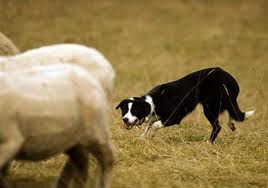
Controlled force:
‘Force’ is the ability of a dog to move sheep or cattle. The three major sheep bred dogs (collies) lack force and authoority when moving sheep (stock) and in return a lot of them are not useful for practical work.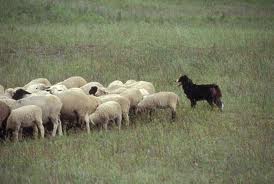
On the other hand many kelpies force in the wrong place and in a frizzy, erratic manner, and many of them are always pushing into stock and lack of distance and balance, and so you cannot allow them to work on their own. You have to be continually stopping them or calling then off sheep (stock) to let the stock draw along quietly, and you hesitate sending them to Shepard a wing or straighten the mob because they will rush around close and create more problems than they fix. This is one reason why a lot of farmers carry their dogs on the bike and work the stock themselves, and only let the dog off when absolutely necessary. However if your lucky enough the best Kelpies are fairly good.
At it’s most basic the forcing instinct is seen in the dog that, when confronted by unmoving stock, takes that as it’s cue to move in towards them to get them moving again. Many dogs, when stock turn and face them, begin showing more eye. Then, when the stock move off, they follow. Instead, the dog should force when the sheep stop and face it, and back off when they move.
Strength is different to force, although it is an important aspect of it. Strength is put simply as a lack of fear. The strong dog is not afraid of the stocksuch as cows with calves at foot. real force is a combination of the desire to force and strength.
ets tough and stock are really difficult and test them out, they really can’t keep up and have nothing.


