Anticipation:
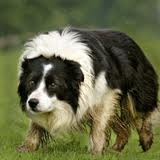
Working dog using eye to control herd.
Anticipation when working is related to ‘break’, break in all it’s forms is basically a dog that breaks out wide as it begins to move around sheep in one form or another and in one situation or another, instead of going straighter towards and around them.This perhaps one term that is more confusing than any other, because it has various forms depending on the bloodline. There is an infinite variety in the ways dogs move around sheep, and the various situations in which they may, or may not, use one form or another of break.So from a breeding point of view it is no good saying that you want to breed dogs with break, unless you define exactly what sort of break you want.
So now with break explained lets get back to anticipation, not all dogs with break have it. It is hard to explain the difference between a dog just breaking wide and one showing this ‘anticipating ‘, or ‘repositioning’ break, but there is a difference.
This type of dog will learn (if it’s instincts are right) to anticipate where sheep usually break around a hillside or head down a wrong road, and will be there before the sheep to prevent it, but will also be superior in less obvious ways, this ability is one aspect of ‘casting break’. Casting break is the dog’s ability to break out when it see’s sheep further on - even if they are hundreds of metre’s away - in order to muster scattered sheep. The good dog always keeps out on it’s own side of all sheep it can see, and never crosses between sheep.
For consistant levels of exceptional intelligence, the UK dogs leave all others in the dust. They have the mindset to pick up things quickly, due to their nature of their trails. That been said, farmers and trainers alike would rather have a dog of brilliant natural ability and only average intelligence, to a dog of a lesser natural ability and a superior intelligence, but of course if your lucky enough it is good to have brilliant natural ability and also superior intelligence but that is hard to find especially outside the UK.
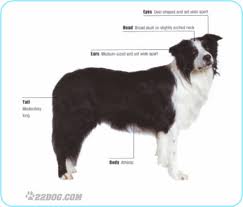
Working sheepdog
Steadiness:
Steadiness is a quality that is rated very highly with a working dog. It is mainly a result of calmness, which comes under the category of
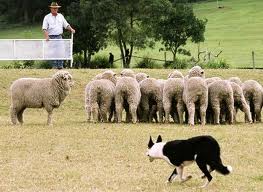
Working dog using the break technique around a herd of sheep.
temperament. A good sheep dog should only use energy when it needs to, reserving it’s energy for moments when in herding that the dog has to use speed and agility.
A working dog that expels too much energy takes stock too quickly, doesn’t think about what it is doing, therefore in term the dog is harder to control and picks up bumps and bruises by knocking itself about.
However do not mistake steadiness with ‘doughiness’. The doughy dog is not very useful. Even though a steady dog should just poke along, it should do it in a free moving manner and be able to speed up when a dog is required to. A good analogy is to consider how honey flows (doughy), or how water flows (free moving), and relate that to how a dog moves and works.
‘Stickiness’ is different to doughiness - a sticy dog may be free moving when it moves, but then sticks due to too much ‘eye’, eye is the power of a dog to control (or move) sheep, simply by looking at them. In fact, eye is simply the outward manifestation of concentration and caution. This is also coupled with weakness. A doughy dog may not be sticky, but will always move using doughy movements
Also be careful not to be fooled into thinking that the dog is steady when it’s steadiness is simply due to poor conformation and poor movement, or in fact excessive eye.


