Shearing and Care of the Fleece
The following practices will improve the quality and increase the value of the wool clip. The manufacturer (purchaser) makes use of the wool only and not the foreign material that may be present in the fleece. Therefore, the quality of fleece is based on its clean wool content. With the exception of lanolin, everything else is waste material. Consequently, it is in the interest of the wool producer to keep debris to a minimum by all practical means, as careful preparation of the fleece will result in higher returns.
1. Consider culling ewes with black fibres and kemp in fleeces and use good-fleeced rams (not at the expense of strong growth and reproductive traits)
2. Use feed racks and feed roughages carefully to prevent seeds, straw and chaff getting into fleeces. Keep sheep away from burrs, if possible.
3. Do not use tar, paint, linseed oil, oil crankcase oil, etc. for marking or branding sheep. Use only watersoluble
branding fluids, approved for use with livestock.
4. Shear sheep on a clean floor.
5. Avoid “second cuts” in the wool (first cut isn’t close enough to the skin, so a second pass with the
clippers is required).
6. Keep fleece all in one piece if possible.
7. Do not shear when fleeces are wet or damp.
8. Spread the fleece skin-side down on a slatted or wire-topped table.
9. Face and leg pieces should be separated from the fleece. For the black-faced breeds in particular, these areas usually contain black or grey fibres that are particularly objectionable to the manufacturer, as they cannot be used in white or pastel-coloured goods.
10. All parts of the fleece that have burrs, chaff or straw, should be removed and packed separately.
11. All dirt and manure encrusted fleece (tag) should be separated and packed separately. Damp tag rolled up in a fleece discolours and damages the surrounding wool.
12. When the low-grade wool has been removed, the most valuable portion is now ready to be tied. One side of the fleece should be folded into the centre one-third of the way and then the other side should be folded in to cover the first fold. The fleece should then be rolled tightly from the britch (hind-end) to shoulder to expose the best portion for inspection when graded (see diagram on previous page). Tie fleece with paper twine or with a strand of wool, if paper twine is not available. Never use binder twine for tying wool. Strands of twine are a major source of wool contamination.
13. Black and brown fleeces should be kept separate from the white fleeces. The tags and skirting should be packed separately.
14. Pack wool in clean sacks or bags immediately after shearing in large wool-bags. The upper portion of these bags should be soaked to prevent slippage while being filled, and also should have a handful of tags tied in each bottom corner to facilitate handling of the bags when they are filled. The bag should be mounted on sacking stand with the upper end supported by a ring that holds it open. The fleeces should then be placed in the bag and tramped in firmly. Tight packing permits maximum loading of shipping cars and facilitates handling. When filled, the bag should be released from the ring and sewn with a bag needle and cotton twine. One bag will hold approximately 25 fleeces or over 200 pounds.
15. Storing the packed wool is an important consideration if it is not to be shipped to market immediately. Wool can be held in storage for relatively long periods of time if kept dry and protected from insects. Market wool annually if you can’t ensure that the wool will be kept clear of insects and moisture. Holding wool over may result in loss from shrinkage in weight, discolouration and moth damage.
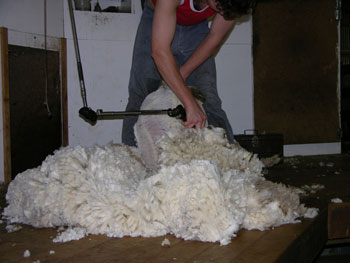
Shearing a Merino
Shearing a Merino
Wool Fibres:
Wool growth is a continuous process and, except for the ‘hair’ breeds, sheep must be shorn periodically. The wool fibre is divided into three sections: the root, the shaft and the tip. The tip of a fibre on a lamb’s fleece is pointed, while the tip from a mature fleece is flat, because of previous shearing. Sheep breed has a significant bearing on the characteristics of the wool fibre. Representative breeds of various wool grades are shown below. Individual sheep of the same breed may have wool that varies either one grade finer or one grade coarser than the breed average.
Fine - Rambouillet, Merino
Fine-medium - Columbia, Romnelet, Targhee
Medium - Southdown, Corriedale
Low-medium - Hampshire, Suffolk, Shropshire, Dorset
Low-quarter - Leicester, Lincoln
Carpet Wool - Scottish Blackface
Specialty - Icelandic, Shetland (often highly valued-contact breeders for marketing information)
‘Hair’ sheep - Katahdin, Dorper (these breeds do not require shearing, as the fibres are shed)
Within different breeds, the rate and uniformity of wool growth is very dependent on the sheep’s nutritional status. A sheep on a high plane of nutrition grows wool with a thicker fibre than a sheep on a poor ration. Increasing protein in a ration, for example, can increase the weight of the fleece from 3 lbs to 9 lbs or more. Animals on a sub-maintenance ration will produce a weak fibred and light fleece clip. The diameter within a given fibre can vary as much as 5 microns due to changes in nutrition and the environment. A break or tender spot in the fibre may occur due to a drop in feed quality or an increase in production demands (e.g. ewes in early lactation). Fibre dimension may also be compromised when the animal is stressed (e.g. illness). Studies have also indicated that exposure to short day length results in smaller fibre diameter.
Wool Grading and Classification
To facilitate its sale, wool is classified and graded to determining its value and use. In Canada, wool is sorted based on its origin (Western or Eastern), and then graded for texture, length, and fibre strength.

Different grades of wool
Wool Grades
Different grades of wool
Texture, length and strength of fibre determine the grade of the fleece. The size of crimp or wave in the fibre varies with grade, e.g. crimp is barely discernible in fine fleeces while easily seen in coarse fleeces. Different grades of wool have different uses, e.g. fine and1/2 staple used to make worsted cloth, 3/8 and 1/4 staple used to make blankets, coarse staple used to make carpets and rugs. The term staple denotes fleeces of fibre length of more than two inches. Clothing fleeces are those having a fibre length of less than two inches. Range Wool is from range flocks predominantly in Western Canada. The breeds of sheep producing the finer grades of wool predominate. Wool is heavier with natural grease or oil. The following grades are found:
Fine - 22/23 Micron Wool, 2.5” to 3” Staple Length
Half - 22/24 Micron Wool, 2.5” to 3.5” Staple Length
Range 3/8 - 26/27 Micron Wool, 3” to 3.5” Staple Length
Range 1/4 - 30/31 Micron Wool, 3” to 4” Staple Length
Western Domestic from small flocks in Western Canada. The medium grades of wool predominate and
there is less grease. The following grades are found:
Domestic 3/8 - 31/32 Micron Wool, 3” to 3.5” Staple Length
Domestic 1/4 - 33/34 Micron Wool, 3” to 4” Staple Length
Eastern Domestic is from sheep flocks in Eastern Canada. Medium grades predominate.
Domestic 3/8 - 32/33 Micron, 3” to 4” Staple Length
Domestic 1/4 - 33/34 Micron, 3” to 4” Staple Length
Misc. Grades
Lot A - Black or Brown fleeces
Lot B - White Fleeces Containing Black Fibres
Lot C - Grey Fleeces
Low 1/4 - Coarse - 34/40 Micron Wool Staple Length 4.5” to 10”
Separating Offsorts
S.B.O. - Sorted by owner, S.A.G. - Sorted at grading, Micron - Microscopic measurement of fibre diameter, One micron = Thousandth part of a millimetre.
Wool Classification
Manufacturers buy wool on a clean or soured basis after all dirt, grease, etc. has been removed. The amount of clean wool is estimated, or determined on actual core test or scouring results. Classification of wool is estimating the amount of clean wool in any given fleece by means of subjective measurement i.e. Bright, Semi-Bright, Dark. The amount of clean wool in a fleece depends on the breed of sheep, geographic and climatic conditions and general care of sheep and fleece.
Wool
Rejects In Fleeces
Wool
Chaff: This probably makes up the greater percentage of Canadian wool rejects. This is due to the long feeding period in Canada, and where hay is thrown out on the ground or into feeders with a percentage landing on the backs on the sheep. The top half of a sloping hay feeder should be closed in with plywood to avoid a sifting of chaff on the necks and shoulders of sheep while feeding. It is advantageous to place the feed in the feed bunks and then allow the sheep to enter the feed area. Fence feeders prevent excess amounts of chaff getting into the wool.
Tags: Heavy manure tags and sweat locks should be removed. Soft manure can cause heavy manure tags and sheep out on lush grass or wormy sheep tend to be the worst offenders.
Kempy: Some sheep have hair growth well up the leg to give a mixture of hair and wool which degrades the fleece as it lacks strength and will not take dyes the same as wool.
Burry Wool: The wool contains burrs, which are difficult to remove from the wool.
Black Grey or Brown: Coloured fibres or patches of coloured wool in the fleece. These degrade the wool as the fleece cannot be dyed uniform and can only be dyed a dark colour.
Cotted Fleeces: These are fleeces in which the fibres have become matted or felted together while on the sheep. The condition is usually caused by sickness and lack of yoke to protect the fleece. Soft cotts: only a small length of the fibre affected. Hard cotts: most of the fibre length matted tightly.
Second Cuts: Short pieces of wool produced by cutting the staple twice in shearing.
Stained Wool: Wool that has been stained mainly by urine which cannot be scoured completely white.
Rebates and Deductions
Wool handling Rebate: is a refund based on a pre-determined rate for wool slips that are well packaged and prepared by the producer. Criteria as follows:
1. Minimum shipment 200 pounds.
2. All offsorts, dark fleeces etc., separated from main grades.
3. High percentage of bright wools.
4. Well packed sacks to reduce freight costs.
Scrutiny Fee: is a charge based on a pre-determined rate for extremely poorly prepared wool clips that require additional time and effort to grade and process, i.e. fleeces tied with baler twine or containing other contaminations.
Freight Rebate: an additional rebate for exceptionally well packed woolsacks
Supplies, Sacks and Twine: refers to purchases made of these items and charged on account. At the time of wool settlement any outstanding amount is transferred to the wool account.
Author: Bob Shopland, Alberta Sheep and Wool Commission
(Modified by OSMA)


