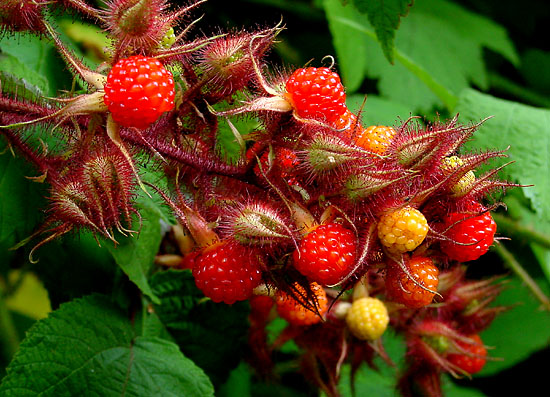
Wineberry Photo by Wouter Hagens
Botanical Name: Rubus phoenicolasius.
Family (Rosaceae)
Origin: Japan, Korea and China
Background
Wineberry, or wine raspberry, is a spiny shrub that was introduced into the United States in 1890 as breeding stock for new Rubus (raspberry genus) cultivars and still used today by berry breeders. It is prized for its delicious edible raspberry-like berries that are produced in abundance in summer.
Distribution and Habitat
Wineberry is found from New England and eastern Canada to North Carolina and west to Michigan and Tennessee. It occurs along forest, field, stream and wetland edges and in open woods, preferring moist habitats.
Ecological Threat
Wineberry forms dense shady thickets that displace native plants and significantly alter habitat structure.
Description and Biology
Plant: multi-stemmed shrub with spiny stems densely covered with reddish, glandular hairs, also on flowering stems and buds.
Leaves: alternate, divided into three leaflets with toothed margins, terminal leaflet largest; undersides conspicuously white.
Flowers, fruits and seeds: flowers with five white petals occur in springtime; bright red edible berries produced in early summer.
Spreads: by seed that is consumed and dispersed by birds and mammals (including humans) and by vegetative means when new plants grow from the tips of canes that touch the ground and new plants sprout from root buds.
Prevention and Control
Do not plant wineberry. It can be controlled through mechanical means or by treating the canes with a systemic herbicide like glyphosate or triclopyr (see Control Options).
Native Alternatives
Native blackberries and non-invading cultivated raspberry would be good alternatives.