History:
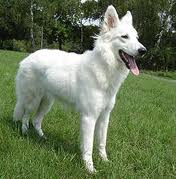
White Swiss Shepherd
In German Shepherd Dogs the recessive gene for white coat hair was cast in the breed gene pool by the late 19th and early 20th century breeding program that developed and expanded the German Shepherd Dog breed in Germany. A white herding dog named Greif was the grandfather of Horand von Grafrath, the dog acknowledged as the foundation of all contemporary German Shepherd Dog bloodlines.
Information provided in early books on the German Shepherd Dog make mention of Greif and other white German herding dogs, with upright ears and a general body description that resembles modern German Shepherd Dogs, shown in Europe as early as 1882. The early 20th century German Shepherd breeding program extensively line bred and inbred “color coat” dogs that carried Greif’s recessive gene for “white coats” to refine and expand the population of early German Shepherd Dogs. White coats were made a disqualification in the German Shepherd Dog Club of Germany breed standard in 1933 after the breed club came under the control of the German Nazi party that took over all aspects of German society in February 1933 when Hitler declared a state of emergency. The German breed standard remained unchanged as German breeders repopulated the breed in the years after the conclusion of WWII.
Appearance:
The White Shepherd is a direct descendant of the German Shepherd Dog and the two breeds share common roots and are similar in appearance. However, the White Shepherd evolved from a continuous selection for a working companion dog with that exclusive color, beauty and elegance as seen both standing and in motion. His high degree of intelligence and sense of loyalty have allowed him to become one of the most versatile working dogs (as well as pets) known to man.
The White Shepherd, as recognized by UKC, is a medium-sized, well-balanced, muscular dog, slightly longer than tall, with a medium length, pure white coat, erect ears, and a low-set natural tail that normally reaches to the hock and is carried in a slight curve like a saber. The White Shepherd is solid without bulkiness and should be shown in lean, hard physical condition. The outline of the White Shepherd is made up of smooth curves rather than angles. When trotting, the White Shepherd moves with a long, efficient stride that is driven by a powerful forward thrust from the hindquarters. The rear leg, moving forward, swings under the foreleg and touches down in the place where the forefoot left an
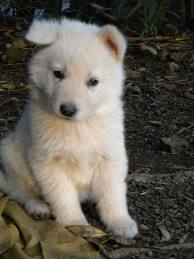
White Swiss Shepherd Puppy.
imprint. Gender differences are readily apparent.
The White Shepherd has a weather-resistant double coat. The outer coat is dense, straight, harsh, and close lying. The undercoat is short, thick, and fine in texture. At the neck, the coat may be slightly longer and heavier, particularly in males. Ideal coat color is a pure white. Colors ranging from a very light cream to a light biscuit tan are acceptable but not preferred.
- It is a disqualification for dogs to have noses not predominantly black.
- The tail is set on low in a natural extension of the sloping croup. The tail extends at least to the hock joint and usually below.
The appearance standard for United Kennel Club registered dogs is very similar to but not exactly the same as for other separate breed lines such as the AWSA-registered White Shepherd or the FCI internationally recognized Berger Blanc Suisse (White Swiss Shepherd Dog). While all of the existing breed lines have a common genetic heritage with the white-coated members of the German Shepherd Dog breed, they are each separately registered with their respective clubs or registries which also maintain the individual breed appearance standards.
Temperament:
The White Shepherd has a distinct personality marked by self-confidence. The breed is poised, but when the situation demands, it is eager, alert and ready to serve in any capacity. White Shepherds demonstrate both herding and protective instincts. With those he knows, the White Shepherd is open and friendly. With strangers, he is observant and may be somewhat aloof but not apprehensive. They enjoy running, playing fetch or any activity with their human family. This is a joyful, active, intelligent and easy to train working dog with the ability to adapt and integrate to all kinds of social events and situations.Timidity in a mature dog or aggressive behavior is not typical of this breed.
White Shepherds are very loyal and tend to be especially protective of the young of various species. With their playful and curious personalities, they make wonderful companions although some do have the tendency toward being quite vocal by exhibiting whining, grunting, and moaning.
Activities:
The White Shepherd can compete in dog agility trials, obedience, Rally obedience, Schutzhund, showmanship, flyball, tracking, and herding
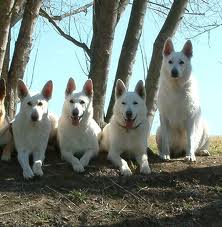
Pack of White Swiss Shepherd.
events. Herding instincts and trainability can be measured at noncompetitive herding tests. White Shepherds that exhibit basic herding instincts can be trained to compete in herding trials.
Genetics:
There are many misconceptions about white-coat German Shepherd Dogs and the gene that expresses for their coat color. Clarence C. Little’s The Inheritance of Coat Color in Dogs hypothesized that dilution or partial albinism ce, ca and cch alleles of the so called (C) gene caused the cream and white coat color variants in domestic dogs. Little’s hypothesized partial albinism explanation for cream and white colored coats has been applied across most domestic dog breeds, including white coat dogs from German Shepherd breed lines, since Little first published his book.
However, comparative analysis of the dog genome and specific breed DNA sequences now shows that Little’s hypothesized gene (C) color dilution explanation for cream and white colored coats is most likely not a relevant determinant of cream and white coats known to commonly occur in many dog breeds. Little’s 1957-era partial albinism dilution explanation, as applied to explain domestic dog white and cream coat colors, can be replaced by the findings of modern genetic research.
Research has shown that a recessive e allele at the Extension (E) gene is at least partially responsible for cream and white coat color. The (E) gene, now identified as the Melanocortin 1 receptor (MC1R) gene, is one of the two genes known to code for alleles that are absolutely fundamental to the formation of all German Shepherd Dog colored coat variations. When the recessive allele is inherited from each breeding pair parent, the e/e genotype offspring of certain breeds, including white coat dogs from German Shepherd breed lines, always have cream or white colored coats.