The environments and the resources available to raise beef cattle are as varied as the breeds themselves (Table 1). Notice the tremendous variability in the available breeds. Another factor to consider is the large degree of variability that exists within a breed. Breeding decisions involve individual animals, not breed averages, so selection of the right individuals within a breed is critical. Breed differences like these can be blamed for product inconsistency, but they can also be exploited to produce adapted animals and a consistent product.
Great variation in the seed stock and commercial cow–calf sectors of the industry is important to ensure you are positioned to match biological types of cows to environments and resources. The challenge is to design effective crossbreeding systems that allow for diversity in the cow-calf sector and that deliver consistency of end product.
A number of factors must be considered when choosing breeds to use in a crossbreeding system. Among these are:
- individual breeding goals
- environment
- quantity and quality of feeds available
- cost and availability of good seed stock
- how breeds will complement each other in the crossing program;
- market-specific breed combinations may command market premiums.
Table 1: Breeds Grouped into Biological Types for Four Criteria (a,b)
a From Cundiff et al., 1993 BIF Proceeding.
b Increasing number of X’s indicate relatively higher values.
Ideal Mix Of Biological Types
Scientists involved in breed evaluation research generally agree a mix of British and Continental breeding of about 50/50 for the cow herd would be optimal for most of North America, excluding the subtropical areas. Limited feed resources indicates a higher percentage of British breeding. Where abundant feed resources are available and/or maximum lean yield is desired, a higher percentage of Continental breeding is recommended. To maximize heterosis, do not over use any one particular breed.
Summary
Crossbreeding can increase productivity in the cow herd by 20%–25% over a comparable straight breeding program, due to heterosis. Heterosis improves performance in key traits that are of low heritability. This increase can be achieved without increasing cow size and maintenance requirements. Crossbreeding can also produce benefits from complementarity.
Crossbreeding is an effective method of improving efficiency of production in commercial cow–calf herds. However, study the crossbreeding systems available and weigh the advantages and disadvantages before deciding which one suits your environment and production resources. While it is important to use crossbred cows, it is even more important that these crossbred cows match your production environment and feed resources.
Focusing on end-product targets is the next step but should only take place when the cow type is optimized for the production environment. To maximize the benefits of crossbreeding, a strong selection system must be utilized to identify breeding animals with superior genetic merit for heritable, economically important traits. Poor selection of breeds or bulls within a breed, will have a lasting impact on the crossbreeding program.
Levels of Expected Heterosis for Various Mating Systems
Levels of Expected Heterosis for Various Mating Systems (Rotate Sire Breed Every 4 Years)
Levels of Expected Heterosis for Various Mating Systems (Rotating F1 Bulls)
Levels of Expected Heterosis for Various Mating systems (Composites)
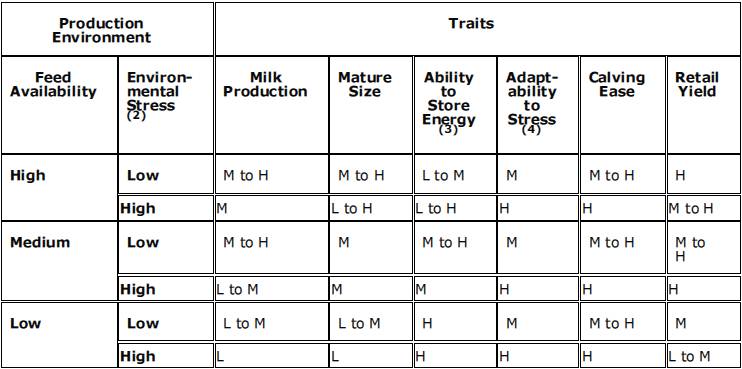
Matching Genetic Potential for Different Traits in Varying Production Environments(1)
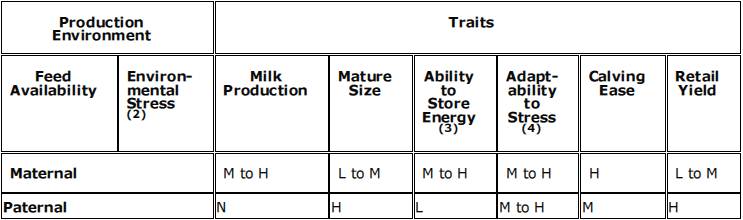
Matching genetic Potential for Different Traits in Varying Production Environments(1) (Breed Role in Terminal Crossbreeding System)
(1) L = Low; M = Medium; H = High; N=None
(2) Heat, cold, parasites, disease, mud, altitude, etc.
(3) Ability to store fat and regulate energy requirements with changing (seasonal) availability of feed.
(4) Physiologic tolerance to heat, cold, internal and external parasites, disease, mud and other stress.
* adapted from Beef Improvement Federation. 1996. Guidelines for Uniform Beef Improvement Programs.


