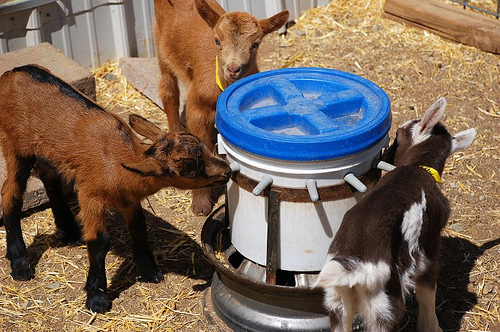
.
This is another critical time in the goat flock, when goats have to be granted a degree of priority if they are to be worth keeping at all.
At this time, in summer, there is always the risk of feed shortage, especially if browse forms a major part of the goat diet, since adult goats (and cattle if present) are likely to have foraged beyond the reach of the kids.
A weaning paddock which can be closed up while the kids are still on the does, is therefore desirable, and it should be completely goat-proof in order to ensure that the bond between kids and does is effectively broken.
It is estimated that growth rate of young goats between weaning and 6-7 months’ of age is about 80 percent of the rate achieved prior to weaning. But
weight-gain throughout their life is affected by a number of factors. A kid can drink up to 15 percent of its own bodyweight daily in milk after about 3-4 weeks’ of age, but feral does’ milk production tends to peak at about 5-6 weeks, and some are virtually dry by 4 months. Kids of such does are therefore underfed, and do not reach early growth potential. The validity of introducing a milking strain into meat goats is therefore fairly obvious.
Weaning weight is critical, since between 3 and 6 months’ of age, when kids’ growth rates decline, it is the heavier kids which will maintain the best growth rates. Feral kids should therefore be at least 10 kg liveweight before being taken off their dams, even though they may be getting only a small ration of milk.
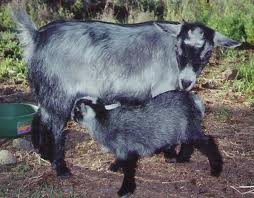
.
Buck kids will grow faster than doe kids, but by 4 months’ of age well-grown buck kids will become sexually active and, in autumn, may well cease to take much interest in eating, and so cease to put on weight.
For this reason buck kids will outstrip wethers in weight-gain up to 4-5 months, but thereafter the position will be reversed. However, because bucks are, on average, bigger than wethers at 4 months, and because early growth rate has such a marked effect on ultimate size, wethers may never quite catch up with bucks.
Castrating bucks is, however, probably worth adopting in order to reduce the tendency of bucks to wander, and the risk of unplanned matings.
Wethers probably also have a slightly better dressing-out percentage than the 50 percent average for `fattened’ goats, and around 45 percent for farmed ferals.
An alternative is cryptorchidism, where the elastrator ring is placed on the purse beneath the testicles, which are thus pushed up into the body cavity. This stops viable sperm production, without loss of male body characteristics.
..
..