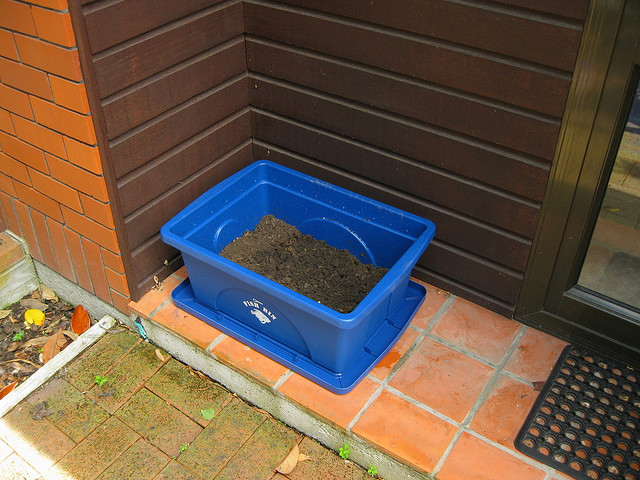
Earthworm Bed Attribution Tim Musson
Virtually the only other thing which can go wrong with farming worms is to forget to water them. A light misting spray for one or two minutes even/ hour depending on the time of year is plenty, You will find it easiest if you buy a cheap water timer and then adjust the frequency and time of spraying according to the wetness of the bed. One of the microspray kits available at any nursery is ideal and inexpensive.
The moisture in your worm bed should be maintained at 30 to 40 per cent, i.e. a handful of bedding squeezed firmly in your fist should produce just one or two drops. This provides sufficient :moisture to replace the 20 per rem lost by the worms each day and is enough to maintain a high rate of breeding.
Worms need somewhere to go to, not only to escape extremes of weather, but also if you forget to water them or perhaps you go on holiday, and someone else forgets. If your beds are set directly on the ground, your worms will be comfortable and safe (but look out for tree roots). They will be able to retreat into the it below to stay with the moisture as the bed dries out. They will return when you recommence feeding and/or watering.
The worms’ characteristic of retreating when the moisture fails has been utilised for harvesting castings, although not in Australia. It is often called the Israeli method and is used at the Kibbutz Nitzanirn on a large commercial scale, There the fields are perhaps a hectare each, laser levelled with banked sides Feedlot manure is laid in rows to a depth of about 200 mm and the field is flooded. Below the soil surface are the worms which, because of the flooding, are forced to come to the surface, where they start eating the manure, producing castings. Gradually, the level of water is lowered forcing the worms to retreat as the strong sun dries the exposed castings. Eventually, the worms are forced once again into the soil below what was manure and is now castings. A machine is used to harvest the castings, the manure is relaid, the field reflooded and the cycle recommences. This is a very cost-efficient production method, particularly if the water used can be sewage, which is treated as it passes through the worms. However, the system could only be developed because a total absence of rain meant that the cycle was not interrupted by nature.
You can use this method only if you are a large commercial producer in a very low rainfall area and harvest your beds regularly and at brief intervals. You need a very dense population of worms so that the feed is eaten rapidly.
 Bed Covers
Worms respond well if their beds are covered with carpet underfelt or old hessian bags. In smaller systems, I strongly recommend it. However, in larger systems where beds can be 20 or more metres long and 4 metres wide, loaded and harvested with a front-end loader, this becomes impractical. Over the years, the birds around our house have come to know where they can get a good feed. Until recently the feeding birds presented no problem, but the word has spread and now, if we leave a bed uncovered, the early morning birds will eat it out very quickly.
Learn by Experience
You must always use your time to the best advantage and weigh up the benefits derived from your work, or your management practices, against the time taken. Above all, don’t just take what you read here as gospel. Although it works well for most people, it may not be exactly right for your conditions. In the course of my lectures, I frequently learn a simpler and better way of doing things from my students. Watch, investigate and learn as much as possible from your worms in your own location and under your conditions. Observe how they react to different foods and take a dose look at the castings produced from each type you try. You may find, as I did, that there are better feeds, or feeds more suitable to you and your worms, conveniently available
Worms are forgiving creatures and will tolerate a surprisingly large amount of abuse while you are learning their likes and dislikes, Just be careful and don’t overdo it.



