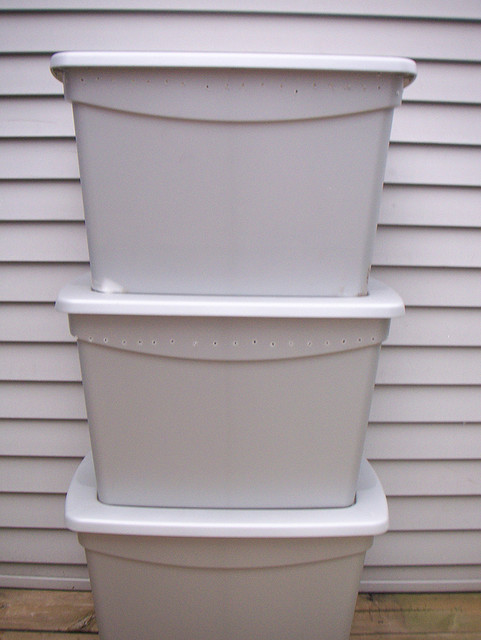
3 Bin Composter Attribution kafka4prez
The Sovadec Institute of Environmental Technology,Montelimar, France, has a commercial waste disposal unit solely driven by worms, handling 35,000 kilos of domestic garbage every day. The system was commissioned in September 1991 and performed so successfully, the capacity was doubled within six months of opening.
The worms are confined in baskets, 5 in square and 4 m deep. The garbage, with contaminants removed (glass, plastics, metals), is first composted in a cellular system and then fed onto the top of the baskets. Castings are removed from the bottom in a continuous process. About 20,000 kilos of castings are produced daily and these go to manufacture a variety of potting mixes, germinating mixes and soil conditioners . The system also produces organic vegetables and cut flowers in an extensive greenhouse system.
However, although worm-driven garbage disposal systems have been tried in many parts of the world, many times, this is the first which has developed a proven record of success. The key to its success has been the planning, execution and management of the system and the credit goes to Dr Marcel Boucher, a world authority on earthworms. The lesson here is to be super-cautious of anybody who claims it is simple and has been done before. It is not; it has not.
The Neverfill Composter
Worms convert kitchen and garden waste rapidly into valuable vermicast with no effort by the householder- There is no need to turn the heap repeatedly with a fork. This is a market largely neglected until recently, but which is so vast and is growing so rapidly that many existing growers have run out of stock.
A family of four, producing an average of 374 kilos of organic waste per head per year on an average suburban block, would actually need only about 5000 worms to process this waste, On that basis, a starting population of 1000 worms, bearing in mind how rapidly they multiply, is sensible and affordable. It is an interesting characteristic of earthworms that, despite their ability to multiply rapidly, once the population is matched to the feeding rate the numbers will stabilise unless some are removed.
There is an inexpensive and highly effective home waste converter called “The Earthworm Composter “available from Earthworm Systems at Maryborough in Victoria. It takes advantage of the nature of commercial worms which is always to eat upwards and is very easy to use. You simply put your organics in at the top (ideally, woody prunings should be passed through a mulcher first) and take your castings out from the bottom and, being made of treated pine, the timber carries the manufacturer’s guarantee for twenty years. Not only is the Earthworm Composter rodent-proof, but it is functional,neat and an attractive piece of garden furniture. It can be placed in the shade or semi-shade. Replacing your compost heap, it renders a valuable community service and saves you money at the same time by reducing your need to buy fertilisers for your garden. It is often called the Neverfill’ because, in fact, it is very difficult to fill under normal circumstances. After a weekend’s gardening, our Earthworm Composter is often filled to overflowing on a Sunday night, but by the following weekend the level has fallen to only about two-thirds of its volume through the action of the worms. This, together with the constant removal of vermicast for the garden, means that there is always space for more organic waste.
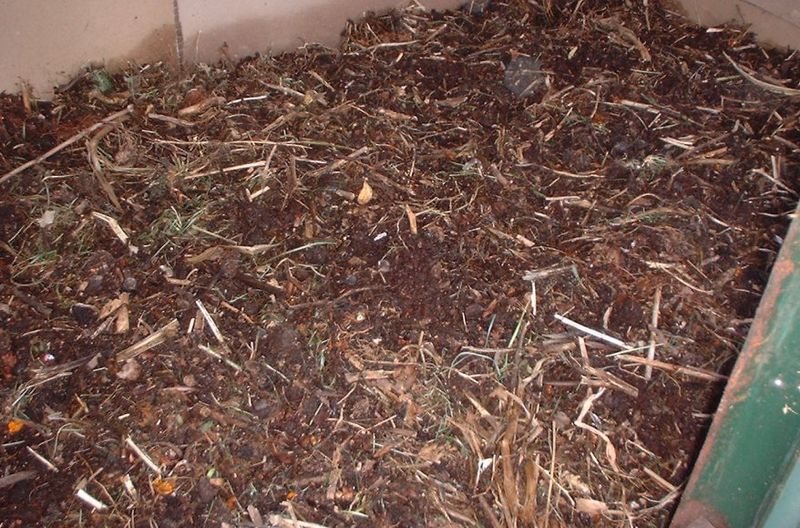
Earthworm Bin
There is also a smaller model designed especially for flat-dwellers and available from the same company.
There are, of course, a number of earthworm composters available.. Shop around! This book tells you the kind of environment you must provide to keep your worms happy. Remember it must be flood proof, rodent proof and not get too hot. For this it needs to stand clear of the ground. You will also want to check that you can extract the castings easily. It should be sufficiently large to take all your organic waste. A family of four with an ordinary suburban garden would find a capacity of over 330 litres suitable.
The worms will be supplied in a container with enough food to last for two or three weeks. Feed them all the organic waste from your kitchen and garden, especially cooked scraps. Your uncooked vegetable scraps have to soften in the bin before the worms can eat them. They will eat meat as well as vegetable leftovers so you will have no need to put any organic waste in the dustbin. There is no need to give your worms any supplementary food like manures. Their numbers will increase according to the amount of food you give them and they will stop reproducing or even shrink in size if less food is available.
The worms in an Earthworm Composter require virtually no care beyond the addition of organic waste.Even if left for lengthy periods without attention, because it is enclosed the contents dry out very slowly and the worms remain safe for perhaps three months. Should the contents begin to dry, the worms have the ability to shrink in size and to estivate — that is to say, to put themselves into a state of suspended animation until conditions return to their liking.
An Earthworm can also handle dog doings and kitty litter, although there is an alternative to dog poo the Pooperator, a Friendly Earth product also available from Earth worm Systems.
Landfill has to be stopped and we can all make a real contribution to its end by constructive use of our ‘misplaced resource’, by seeing that kitchen scraps, newspaper, cardboard, lawn clippings — all the organic waste produced in a household — goes to feed a culture of worms in an odourless, hygienic, vermicast producing worm composter. The castings can then be used on the garden or vegetable patch, so that what was formerly a source of pollution will become a tangible benefit to the individual, and so, to the community



