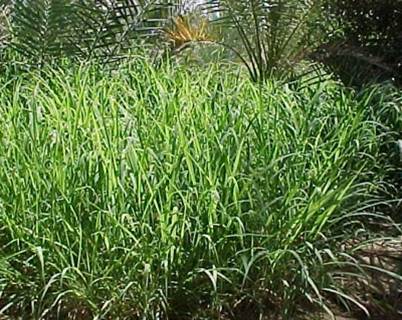
Rhodes Grass
Paspalum (Paspalum dilatatum)
Rhodes Grass
Paspalum is a spring/summer growing perennial, which if well managed also, provides grazing through into autumn. Paspalum has moderate frost tolerance, and is suited to a wide range of environments, including; salinity, water logging, acidity and variable soil fertility.
It is very tolerant to overgrazing. Paspalum often colonises valley floors providing valuable green feed over the summer period. During the summer, paspalum requires heavy grazing or slashing to prevent rank growth. Seed heads can be infected with ergot (a cause of a stock health disorder), which can poison livestock.
Kikuyu (Pennisetum clandestinum)
Kikuyu is a prostrate spring/summer/autumn growing perennial that requires high fertility and well-drained soils for optimum production. Under favourable conditions kikuyu runners spread rapidly, making it a very suitable species for erosion control and stabilising earthworks. Keeping Kikuyu short during summer helps to maintain feed quality and high feed volumes. In mixed pastures, close grazing is also necessary to avoid suppressing clovers. Nitrogenous fertiliser will increase production levels during the summer growing season. Annual ryegrass and oats are often drilled into kikuyu pastures to provide feed during colder times of the year.
Rhodes Grass (Chloris gayana)
Rhodes grass is another spring/summer/autumn growing perennial. Rhodes grass is suited to a range of soils from light textured sandy loams to medium clay soils, has some degree of salt tolerance, and is moderately drought tolerant.
It is also relatively easy to establish and extremely useful for erosion control and stabilising earthworks. Hence, it is widely used in mine rehabilitation. Rhodes grass can also be used in pastures as an alternative to paspalum, subject to careful management. It must be kept short to maintain feed quality and palatability, but may not persist under heavy grassing. The variety Callide has higher feed value and is preferred for grazing.
Introduced legumes
Lucerne (Medicago sativa)
Lucerne is the most productive legume for arable, fertile areas of the Hunter Valley, especially in cropping rotations. Lucerne suits deep, fertile soils with a pH (CaCl2) level of between 6 and 7.5. Lucerne is a true perennial, that is relatively easy to establish and will persist for several years, with careful grazing management and reasonable seasonal conditions.
Select varieties based on winter growth rating, insect and disease resistance characteristics. The most successful varieties are those with resistance to spotted alfalfa aphid and blue green aphid. Good resistance to Phytophthora root rot and at least moderate resistance to anthracnose are essential, particularly on poorly drained soils.
Winter dormant lucerne varieties have not performed well in grazing systems, in part because of inferior seedling vigour, but they have performed well for irrigated hay production. Semi-dormant and winter-active varieties are very adaptable as all purpose varieties. Highly winter active varieties are very useful for short-term pastures between cereal crops. However, under extensive grazing management and moderate to high stock pressure, winter active varieties are less persistent than semi-dormant varieties.