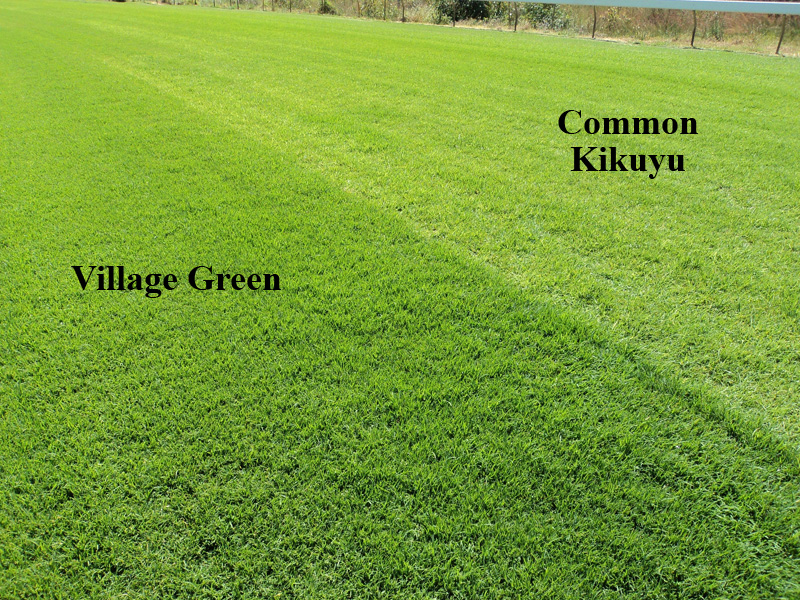
 Village Green - Kikuyu
Village Green details: Village Green is a warm season variety that likes winter. No other warm season turf variety has such high winter activity like Village Green. Whilst couch goes into dormancy over winter and common kikuyu slows down, Village Green is actively growing. This active growth during winter makes it an ideal turf variety for winter sports such as AFL, rugby, soccer or horse racing. Even under frosty conditions Village Green sends down roots and keeps repairing itself. No more necessary expensive over-seeding with ryegrass or accepting brown as being normal during winter. Village Green will perform well throughout Summer, Autumn and Spring, however, it will be mostly dormant during Winter. Village Green is a better option for the Melbourne (Australia) climate. It is dark green in colour & will stay greener throughout winter. It is a nicer looking turf as it is able to be mowed lower without scalping & damaging your turf. It is a creeping lawn that is fast growing and can be very aggressive & invasive if not kept under control.
General Characteristics:
- Root System: Village Green has a massive root system, it is measured to have 50% more roots per volume of soil than common Kikuyu. This gives it an exceptional ability to stay green even under low water and fertiliser environments. Because of Village Green’s high winter activity you can establish turf in winter when there is plenty of moisture in the soil, now you can plant during winter and save water.
- Water: In most cases around Australia this means that you will need very little irrigation. Other warm season grasses need to be established in the spring when more water is required. Facing an ever drying climate Village Green is a safer choice.
- Weeds/Wear: Winter Green has the weeds and wear covered. The success of Village Green has all to do with the science, this grass is focused on features that ultimately deliver high performance sports fields and public open space. These features include: Thick stolons that store carbohydrates to feed new shoots that are continually being developed under high wear. Short internodes that produce more shoots per square meter of turf, delivering a fine/dense cover that smothers weeds and cushions impact. Thick rhizomes that give strength and ability to recover from drought and very heavy wear. Weeds including seed from common kikuyu don’t have a chance to establish in Village Green’s dense cover. This lawn is ideal for high traffic & digging dogs as it is able self repair quickly. Weeds including seed from common kikuyu don’t have a chance to establish in Village Green’s dense cover.
- Sterility: Sterility limits the spread. Village Green is male sterile – this means it doesn’t produce male flowers or seed. Gone is the unsightly carpet of white seed heads often seen across a field of common kikuyu and gone is the risk of spread into garden beds.
- Discolouring: There can be some winter discolouring. This discolouring can be overcome by oversewing with Ryegrass seed through the winter months if desired. The seed will provide good winter colour and wear. Alternatively you can use a protective colour coating,this will give the appearance of green through the Winter months as well as provide some frost protection.
- Availability: This lawn is generally available from October through to March.
Maintenance/Preparation and Care for Village Green
- Soil Preparation: To prepare the area for your instant lawn you need to have a smooth base free of any grass matter. If you have topsoil of suitable quality and depth of at least 75mm or more, all you need do is remove all grass and debris on the site. If your depth of topsoil is inadequate you may need to import some topsoil. Allow about 20mm below paths and driveways for the thickness of the turf.
- Turf Laying: Apply your provided lawn starter and begin laying your turf. It is also a good idea, (but not mandatory), to use a Winter Establishment Pack on your topsoil. This will improve water penetration and helps retain moisture. Start laying the turf along a straight edge, such as a driveway or footpath, furthest from the stack of turf. Therefore it won’t be necessary to walk over any freshly laid lawn. The QWELTS should be laid in a brickwork pattern, ensuring all edges are butted and pushed together but not overlapping. The turf can be trimmed with a sharp knife to conform with paths and garden edges, etc. It is vital that once you lay your Village Green that you top dress it with white washed sand (approximately 1m3 to 100 square meters). You may also roll your turf after top dressing to achieve maximum soil contact.
- Instillation Watering: It is essential that watering of your lawn commence immediately upon installation. A thorough soaking of the turf is required. For larger installations, watering should commence as sections are completed. It is vital that the turf is kept moist until root growth is established. This can be checked by lifting a small corner of a QWELT, to ensure that water has thoroughly soaked the turf and sub soil. Once root growth has commenced, watering can begin to be spaced. Village Green can be watered at any time of the day even in extreme heat.
- Fertilising: Because Village Green is a creeping type grass it loves the Summer, however, won’t do as well in the Winter. Village Green will prosper with a high nitrogen slow release fertiliser applied once a year in Autumn. Fertilising in Winter is ineffective, therefore applying fertiliser in Autumn will help to shorten the dorminancy period.
- Mowing: The first mow can be undertaken as required. During cooler months they require little or no mowing. During the warmer times mowing may be necessary every week, however this will vary depending on how much you water and fertilise it and the weather conditions. Village Green should be maintained at about 30mm, but the lower you mow your lawn the more often you will need to mow as you need consistency when mowing low.
- Dethatching: Once your lawn is established it requires less water than some other varieties. However once your lawn has been installed for one - two years it can become thick and spongy and will need dethatching. This can be done using a dethatching machine (which can be hired), or simply put your mower on a lower setting. For best results this should be done in spring. Once you have dethatched give it a good fertilise and water.


