Selective tyre pulping
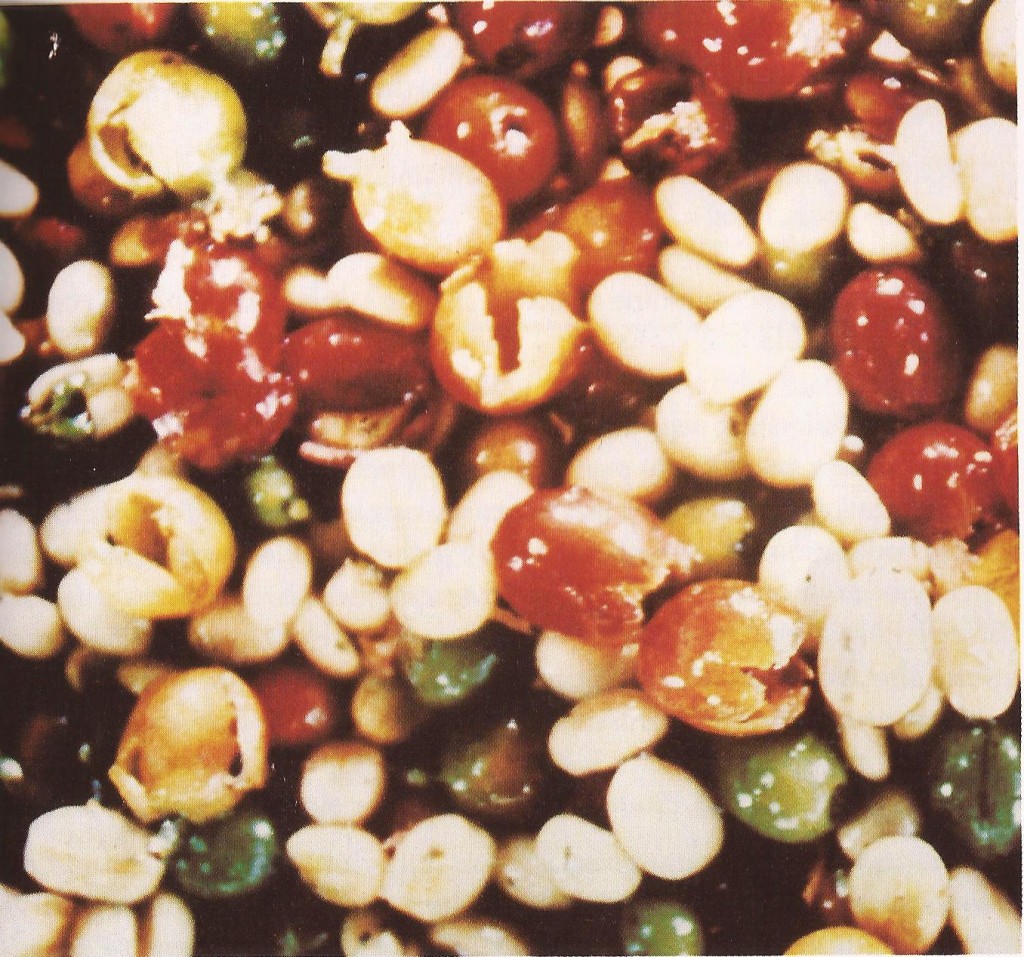
Machine-harvested coffee after selective pulping, showing pulped prime bean, empty pulps and intact immature cherry
Selective tyre pulping is the key element of the Walkamin processing system. The principle of the pulper is based on the relationship between the force it takes to rupture the cherry and cherry maturity. As cherries mature, mucilage develops around the bean and the pulp softens; less force is needed to rupture the cherry and expel the bean. As overmature cherries dehydrate, they become harder and, like immature cherry, do not pulp easily. Consequently, prime cherry has a lower pulping force than immature or dehydrated cherry. The tyre pulper exploits this relationship.
Size-graded cherry is delivered between an upper rotating drum and a soft pneumatic tyre. The tyre also acts against a second (lower) rotating drum so that two opportunities for pulping are possible. The tyre pressure is adjusted to manipulate the threshold at which pulping occurs. Pulping time is regulated by increasing the contact area between the tyre and drums. This is achieved by adjusting the distance between the tyre and drum axles. Reducing this distance deforms the tyre carcass against the drum and results in a larger contact area. Relative speed differences between the tyre and drums help roll the cherry through the contact area and improve prime cherry pulping. The principle is well-suited to commercial adaptation and as such has an Australian patent.
The large and medium size grades are selectively tyre pulped directly pulping force depending on the size and maturity of cherry. It is usual to use more aggressive settings when pulping medium grade cherry since it typically contains a larger proportion of semi-dry cherry which requires a stronger pulping force.
The tyre pulper is highly selective so the level of immature cherry is not a constraint, but with high levels of immature cherry (>30%) it may be necessary to reduce the feed rate to ensure thorough pulping of prime cherry.
The tyre pulper does not separate bean and pulp. Material leaving the pulper is a mix of fully pulped prime bean, pulp, partially pulped prime cherry (with bean still retained within the ruptured cherry) and intact immature cherry (see photo right).
Separation of pulped product (cherry separator and hydrocyclone)
The mixture produced by the tyre pulper can be separated by using the size difference between the smaller pulped prime bean and the larger intact immature cherry. This is achieved in the cherry separator.
The pulped mixture enters a cylindrical cage constructed of spirally wound steel. The aperture size between the coils (pitch) is such that prime bean can pass between the coils and intact immature cherry is retained within the cage. The pulp, bean and immature cherry are worked along the cage by a rotating drum with attached paddles and the spiral structure of the cage. The paddles and water wash the prime bean and pulp through the cage. The mechanical action also frees any bean retained within ruptured cherry. Immature cherry emerges from the outlet end of the cage.
Because cherry is size graded before pulping and separation, a specific cage aperture size can be selected to achieve a high degree of separation. No prime bean is rejected with immature cherry and no immature cherry is included with prime bean. The construction and action of the separator means that immature cherry is not smashed or broken by the machine, thus ensuring maximum quality of prime bean.
The next operation is to separate the pulp from the prime bean. Conventional pulpers are effective for pulping prime cherry and separating pulp, but perform poorly when pulp is already separated from the bean. A hydrocyclone has been developed which uses whirling water to separate bean and pulp by exploiting their different behaviour in water.
The pulp and prime bean are first delivered to a buffer tank where floaters may be removed. The pulp and prime bean are then pumped to the hydrocyclone at a pressure and velocity determined by the cyclone specification. The internal dynamics of the cyclone are complex but its operation is extremely simple. The pulp is removed from the top of the cyclone together with most of the water. The prime bean and a small quantity of water exit at the bottom of the cyclone. The pulp passes over a de-watering screen which enables recycling of water in the system.
Fermentation
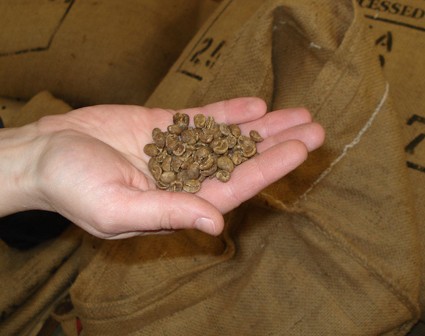
Decaffeinated coffee is comprised of at least 3% caffeine however 5-10 cups of Decaf contain about the equivalent in caffeine as 2-3 cups of ordinary coffee do
Fermentation of prime bean from machine-harvested coffee is the same process as for hand-picked and conventionally processed coffee.
Other processing considerations
Processing of immature cherry
Large and medium immature cherry rejected by the separator after selective tyre pulping generally produce poor quality coffee. However, markets may exist for this product (e.g. decaffeinated coffee) and this material can be dry-processed with minimal input. In addition, drying conditions and urgency are less critical. Recovery of immature cherry from the small grade is not warranted since it is grossly immature.
Processing of overmature cherry
Processing of small overmature cherry that is dry separated by size grading has been discussed. Overmature cherry which is separated by flotation of the medium size grade is usually semi-wet, with the beans still moveable within the cherry, and partially fermented. Floating immature cherry will also be included with this product, but usually the proportion will be low. Wet processing is the most desirable treatment for this product as it simplifies subsequent processing procedures and produces good quality coffee. Typically, however, it will not pulp directly in the selective tyre pulper and requires a period of soaking (usually 12 hours) during which time it rehydrates sufficiently to allow effective pulping.
Processing different size grades
Processing each of the three size grades depends on the scale of operation and resulting maturity composition of each grade. In addition to processing the large grade for prime cherry recovery, the amount of prime cherry in the medium grade will almost always justify recovery. Typically, even smaller scale machine-harvesting and processing operations will require the implementation of float separation, pulping and separation system designed specifically for medium cherry. Depending on product qualities and uniformity it is usual to combine prime bean from the large and medium grades after the cherry separator. The proportion of prime cherry in the small grade will always be low, and usually its separate recovery by selective pulping will not be justified.
Hybrid System
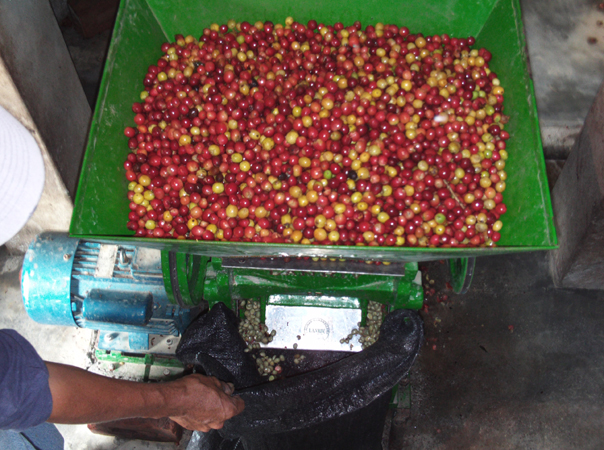
Coffee cherry pulper
In some plantations, maturity synchronisation at the time of harvest may be relatively high, with consistently less than 10% immature cherry in the machine-harvested sample. Under these circumstances, it may be more appropriate to use elements of the Walkamin processing system described above as a ‘front end’ to a conventional processing system. The conventional system must be capable of extracting immature cherry (such systems are discussed later). This strategy will increase the conventional system’s ability to extract immature cherry and will be cheaper than implementing a full system (especially if existing processing equipment can be used).
Since there will not be large quantities of overmature product, separation can be achieved by flotation. If necessary, the floaters can be recovered by dry-processing. Sinkers are size graded in order to:
- remove small immature cherry from the larger grades and improve the ratio of prime to immature cherry
- provide uniform size grades.
Larger grades are selectively pulped in the tyre pulper and then passed through conventional pulping equipment for separation. The conventional equipment can be operated less aggressively because prime cherry has already been pulped. In essence it only separates the prime bean, intact immature cherry and pulp. Its ability to extract immature cherry is improved because
- pre-pulping the cherry means that the pulper is not required to do this task so pulper settings can be less critical, reducing the chance of damage to immature cherry or nipping of prime beans (by the pulper disc/drum).
- pre-pulping of cherry increases the capacity of the pulper; residence time in the pulping chamber is reduced which lowers the risk of breaking immature cherries.
Again, the sizes chosen for size grading depend on typical cherry sizes on the plantation. Two or three grades are sufficient. The upper limit of the small grade should remove small immature cherry which is the same size as pulped prime bean. As in the Walkamin system, small immature cherry attached to clusters will contaminate quality if it is allowed to pass through the system.
Source
Craig Lemin