 National variations:
In Britain, Ireland, Australia, India, Spain, Argentina, and Germany the word “tractor” usually means “farm tractor”, and the use of the word “tractor” to mean other types of vehicles is familiar to the vehicle trade but unfamiliar to much of the general public. In Canada and the US the word may also refer to the road tractor portion of a tractor trailer truck.
Farm tractor applications:
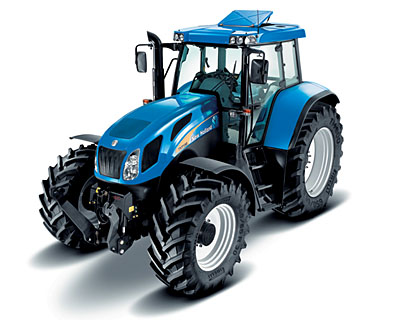
The most common use of the term “tractor” is for the vehicles used on farms. The farm tractor is used for pulling or pushing agricultural machinery or trailers, for plowing, tilling, disking, harrowing, planting, and similar tasks. A variety of specialty farm tractors have been developed for particular uses. These include “row crop” tractors with adjustable tread width to allow the tractor to pass down rows of corn, tomatoes or other crops without crushing the plants, “wheatland” or “standard” tractors with non-adjustable fixed wheels and a lower center of gravity for plowing and other heavy field work for broadcast crops, and “high crop” tractors with adjustable tread and increased ground clearance, often used in the cultivation of cotton and other high-growing row crop plant operations, and “utility tractors”, typically smaller tractors with a low center of gravity and short turning radius, used for general purposes around the farmstead. Many utility tractors are used for non-farm grading, landscape maintenance and excavation purposes, particularly with loaders, backhoes, pallet forks and similar devices. Small garden or lawn tractors designed for suburban and semi-rural gardening and landscape maintenance also exist in a variety of configurations. Some farm-type tractors are found elsewhere than on farms: with large universities’ gardening departments, in public parks, or for highway workman use with blowtorch cylinders strapped to its sides and a pneumatic drill air compressor permanently fastened over its power take-off. These are often fitted with grass (turf) tyres which are less damaging to soft surfaces than agricultural tires.
Precision agriculture:
Space technology has been incorporated into agriculture in the form of GPS devices, and robust on-board computers installed as optional features on farm tractors. These technologies are used in modern, precision farming techniques. The spin-offs from the space race have actually facilitated automation in plowing and the use of autosteer systems drone on tractors that are manned but only steered at the end of a row, the idea being to neither overlap and use more fuel nor leave streaks when performing jobs such as cultivating.
Engineering tractors:
The durability and engine power of tractors made them very suitable for engineering tasks. Tractors can be fitted with engineering tools such as dozer blade, bucket, hoe, ripper, and so on. The most common attachments for the front of a tractor are dozer blade or a bucket. When attached with engineering tools the tractor is called an engineering vehicle.
A bulldozer is a track-type tractor attached with blade in the front and a rope-winch behind. Bulldozers are very powerful tractors and have excellent ground-hold, as their main tasks are to push or drag things. Bulldozers have been further modified over time to evolve into new machines which are capable of working in ways that the original bulldozer can not. One example is that loader tractors were created by removing the blade and substituting a large volume bucket and hydraulic arms which can raise and lower the bucket, thus making it useful for scooping up earth, rock and similar loose material to load it into trucks.
A front-loader or loader is a tractor with an engineering tool which consists of two hydraulic powered arms on either side of the front engine compartment and a tilting implement. This is usually a wide open box called a bucket but other common attachments are a pallet fork and a bale grappler. Other modifications to the original bulldozer include making the machine smaller to let it operate in small work areas where movement is limited. There are also tiny wheeled loaders, officially called Skid-steer loaders but nicknamed “Bobcat” after the original manufacturer, which are particularly suited for small excavation projects in confined areas.
Backhoe loader:
The most common variation of the classic farm tractor is the hoe, also called a hoe-loader. As the name implies, it has a loader assembly on the front and a backhoe on the back. Backhoes attach to a 3 point hitch on farm or industrial tractors. Industrial tractors are often heavier in construction particularly with regards to the use of steel grill for protection from rocks and the use of construction tires. When the backhoe is permanently attached, the machine usually has a seat that can swivel to the rear to face the hoe controls. Removable backhoe attachments almost always have a separate seat on the attachment.
Backhoe-loaders are very common and can be used for a wide variety of tasks: construction, small demolitions, light transportation of building materials, powering building equipment, digging holes,loading trucks, breaking asphalt and paving roads. Some buckets have a retractable bottom, enabling them to empty their load more quickly and efficiently. Buckets with retractable bottoms are also often used for grading and scratching off sand. The front assembly may be a removable attachment or permanently mounted. Often the bucket can be replaced with other devices or tools. Their relatively small frame and precise control make backhoe-loaders very useful and common in urban engineering projects such as construction and repairs in areas too small for larger equipment. Their versatility and compact size makes them one of the most popular urban construction vehicles.
In the UK, the word “JCB” is sometimes used colloquially as a genericized trademark for any such type of engineering vehicle. The term JCB now appears in the Oxford English Dictionary, although it is still legally a trademark of J. C. Bamford Ltd. The term “digger” is also commonly used.
Compact Utility Tractor:
A Compact Utility Tractor, also called a CUT is a smaller version of an agricultural tractor but designed primarily for landscaping and estate management type tasks rather than for planting and harvesting on a commercial scale. Typical CUTs range in from 20 to 50 horsepower (15-37 kW) with available power take off (PTO) horsepower ranging from 15 to 45 hp (11-34 kW). CUTs are often equipped with both a mid-mounted PTO and a standard rear PTO, especially those below 40 horsepower (30 kW). The mid-mount PTO shaft typically rotates at/near 2000 rpms and is typically used to power such implements as mid-mount finish mower, a front mounted snow blower or front mounted rotary broom. The rear PTO is standardized at 540 rpms for the North American markets, but in some parts of the world a dual 540/1000 rpm PTO is standard and implements are available for either standard in those markets.
One of the most common attachment for a Compact Utility Tractor is the front end loader or FEL. Like the larger agricultural tractors, a CUT will have an adjustable three-point hitch that is hydraulically controlled. Typically a CUT will have four wheel drive, or more correctly 4 wheel assist. Modern Compact Utility Tractors often feature a Hydrostatic transmission, but many variants of gear drive transmissions are also offered from low priced simple gear transmissions to synchronized transmissions to advanced glide-shift transmissions. All modern CUTs feature a government mandated roll over protection structure (ROPS) just like agricultural tractors. The most well known brands in North America include Kubota, John Deere Tractor, New Holland Ag, Case-Farmall and Massey-Ferguson. Although less common, compact backhoes are often attached to compact utility tractors.
Compact Utility Tractors require special smaller implements than full size agricultural tractors. Very common implements include the box blade, the grader blade, the landscape rake, the post hole digger (or post hole auger), the rotary cutter (also called a slasher or a brush hog), a mid or rear mount finish mower, broadcast seeder, subsoiler and the rototiller (also rotary tiller). In northern climates, a rear mounted snow blower is very common, on smaller CUTs some models are available with front mounted snow blowers that are powered by a mid-PTO shaft. There are many more implement brands than there are tractor brands offering CUT owners a wide selection of choice.
For small scale farming or large scale gardening, there are some planting and harvesting implements sized for CUTs. One and two row planting units are commonly available as are cultivators, sprayers and different types of seeders (slit, rotary and drop).
Row-crop tractor:
A row-crop tractor is a tractor tailored specifically to the growing of row crops (crops grown in rows, as in truck farming), and most especially to cultivating. Cultivating can take place anytime from soon after the crop plants have sprouted until soon before they are harvested. Several rounds of cultivating may be done over the season. A row-crop tractor essentially brings together a farm tractor and its cultivator into one machine, in the same way that motive power has been combined into other machinery (for example, horseless carriages combined the motive power into transport vehicles; self-propelled guns combined the artillery tractor and its gun into one machine).
The earliest win from introducing tractors to mechanize agriculture was in reducing the heavy efforts of plowing and harrowing before planting, which could often be (almost literally) backbreaking tasks for humans and draft animals. Early tractors were used mainly to alleviate this drudgery. But they tended to be very big and heavy, so they were not well suited to getting into a field of already-planted row crops to do weed control. Row-crop tractors—light, affordable, and reliable—corrected this flaw.
Row crop itself refers to any farm crop that is cultivated in rows. The United States Environmental Protection Agency (EPA) defines ‘row crop’ as an “Agricultural crop planted, usually with mechanical planting devices, in individual rows that are spaced to permit machine traffic during the early parts of the growing season”
The Canadian agricultural equipment manufacturer Versatile makes row-crop tractors that are 250 and 280 horsepower (190 and 210 kW); powered by an 8.3 liter Cummins Diesel engine.
Garden tractors:
Garden Tractors (also called Mini Tractors) are small, light and simple tractors designed for use in domestic gardens. Garden Tractors are usually designed primarily for cutting grass, being fitted with horizontal rotary cutting decks. Visually, the distinction between a garden tractor and a ride-on lawnmower is often hard to make - generally Garden Tractors are more sturdily built, with stronger frames, axles and transmissions rated for ground-engaging applications. Garden Tractors are generally capable of mounting other implements such as harrows, cultivators/rotavators, sweepers, rollers and dozer-blades. Like ride-on mowers, Garden Tractors generally have a vertical-crankshaft engine with a belt-drive to a transaxle-type transmission (usually of 4- or 5-speeds, although some may also have two-speed reduction gearboxes or a hydrostatic drive). However, Wheel Horse (now part of Toro) garden tractors have horizontal-crankshaft engines with belt-drive, whilst Allen/Gutbrod tractors had an automotive-type clutch and gearbox. The engines are generally a 1- or 2-cylinder petrol (gasoline) engine, although diesel engine models are also available, especially in Europe.
In the U.S., the term riding lawn mower today often is used to refer to mid or rear engined machines. Front-engined tractor layout machines designed primarily for cutting grass and light towing are called lawn tractors; and heavier duty tractors of the same overall size, often shaft driven, are called garden tractors. The primary differences between a lawn tractor and a garden tractor are the transmission torque handling capability, frame durability, the rear wheels (garden tractors almost always have multiple mounting bolts, while most lawn tractors have a single bolt or clip on the hub), and the ability to attach ground engaging equipment such as plows or disk-harrows. Craftsman, MTD, Snapper, and other major mowing equipment manufacturers use these terms.
As well as dedicated manufacturers, many makers of agricultural tractors have made (or continue to make) ranges of garden tractors, such as Case, Massey-Ferguson, International Harvester and John Deere.
Two-wheel tractors:
Although most people think first of four-wheel vehicles when they think of tractors, a tractor may have one or more axles. The key benefit is the power itself, which only takes one axle to provide. Single-axle tractors, more often called two-wheel tractors or walk-behind tractors, have had many users ever since the beginning of internal combustion engine tractors. They tend to be small and affordable. This was especially true before the 1960s, when a walk-behind tractor could often be more affordable than a two-axle tractor of comparable power. Today’s compact utility tractors and advanced garden tractors may negate most of that market advantage, but two-wheel tractors still enjoy a loyal following, especially where an already-paid-for two-wheel tractor is financially superior to a compact or garden tractor that would have to be purchased. Regions where two-wheel tractors are especially prevalent today include India, China, and Southeast Asia.
Orchard tractors:
Tractors tailored to use in fruit orchards typically have features suited to passing under tree branches with impunity. These include a lower overall profile; reduced tree-branch-snagging risk (via underslung exhaust pipes rather than smoke-stack-style exhaust, and large sheetmetal cowlings and fairings that allow branches to deflect and slide off rather than catch); spark arrestors on the exhaust tips; and often wire cages to protect the operator from snags.
.


