Thinking About Buying a Dairy Goat?
Thinking of buying a dairy goat or if you have a dairy goat and are thinking of joining the dairy goat society of australia here are some questions to think about.
How many kinds of dairy goats are there? There are only 6 pure breeds in Australia, Saanen (pronounced Sar-nen), Toggenburg, British Alpine, Anglo Nubian and Australian Melaan. and Australain Brown.In addition there are many cross-breds.
Which is the best breed? A good strain of any pure breeds, preferable registered animals should give good results.
What is a registered animal? A registered dairy goat is one registered in the Herd Book of the Dairy Goat Society of Australia Ltd. This records the breeding of the goat. Only financial members of the DGSA are able to register dairy goats.
What is the advantage of registered goats? The purity and breeding is guaranteed and having been bred pure and selected for milk production, the chances of obtaining good production are increased. The resale value of registered dairy goats is much higher (at least 10 times higher) and there is strong demand for export quality registered dairy goats from many overseas nations. Australian Dairy Goats are very popular, but they need to be registered for sale overseas.
What is a cross bred goat? A crossbred goat is not pure in breeding, but is a cross between two distinct purebred types e.g. between Saanen and Toggenburg goats.
What is an appendix (grade) goat? An animal one of whose parents may be a “scrub”, crossbred, a miss-marked pure bred or unregistered.
How does the appendix (upgrading) register work? The D.G.S.A does not have a closed Herd Book. An appendix ‘D’ doe is one
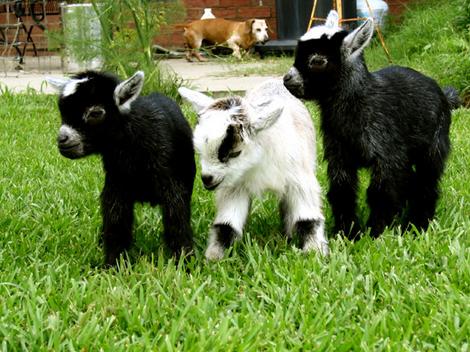
Goat Kids
which conforms to a breed type and may be registered as such provided the application to register is accompanied by an inspection certificate signed by a branch inspector or approved by your branch committee.
A daughter from an App. D doe may be registered App. C provided her sire is a registered buck of the same breed.
A daughter from an App. C doe may be registered App. B provided her sire is a registered buck of the same breed.
A daughter from an App.B doe may be registered App. A provided her sire is a registered buck of the same breed.
A daughter or son from an App A doe may be registered Herd Book (pure bred) provided the sire is a registered buck of the same breed. Male and female progeny from a Herd Book doe may be registered provided the sire is a registered buck of the same bred. Male progeny from appendix D, C and B does cannot be registered in the bred section of the herd book.
May I register a dairy goat if it has a disqualification? No. All breeds have a breed standard and included in the breed standard disqualification’s are listed. Whether the goat is to be registered App. D or herd book, female or male if it has a disqualification it may not be registered.
What is a disqualification? Disqualifications are listed and illustrated in the ‘Breed Standards Book’ published by the D.G.S.A. some are applicable to individual breeds and some applicable to all breeds. An example which is applicable to all breeds is extra or supernumerary teats in does or bucks, undescended or one testicle in bucks.
What is a Breed Standard? All pedigree animals (e.g. dogs, horses, cattle) have a breed standard. This standard exemplifies the ideal animal of its breed.
What is an identification recorded goat? Identification recorded is one which is unable to be registered in the breed sections but which may be of value for upgrading and/or commercial purposes.
What is an experimental recorded goat? An experimental recorded goat is one which is not eligible for registration in the breed
Dairy Goats Grazing
sections and is being used to create a new breed.
Can bucks be kept from identification or experimental recorded doe? Yes, they may but if they are used over a purebred or appendix does any female progeny will be down graded to ‘D’ plus any male progeny from the same mating cannot be registered in the herd book bred section. Registration certificates are marked Identification or Experimental.
Can I show all registered or recorded goats? Purebred (Herd book) and appendix does compete on equal terms in the show ring, however identification and experimental goats are not shown.
With whom are the goats registered? The Dairy Goat Society of Australia Ltd., P.O. Box 9048,Traralgon,Vic 3844
What is the membership fee of the D.G.S.A.? Yearly (2008) subscription is $77.00 incl. GST plus a once only prefix of $16.50 incl. GST. Membership applications are sent to The Federal Secretary at the above address.
How can I tell if a goat if registered? By visual inspection of the ears or with a scanner- all registered must be permanently identified soon after birth with a tattoo i.e. a number and the owners registered tattoo in the ears, or a microchip in the scutiform cartilage of the left ear. Tattoos or microchip numbers can be checked with the Federal Secretary of the D.G.S.A.
Is tattooing or micro-chipping difficult? No. Full instructions can be obtained when you are ready to tattoo. Your D.G.S.A. branch may supply a tattoo outfit on loan for a small fee. Microchips with application needle are available from your branch secretary.
Is a horned goat eligible for registration? Both horned does and bucks are eligible for registration, but the keeping of a horned buck is strongly discouraged on safety and other grounds, unless disbudded.
Can horns be removed? Yes, surgically by a veterinarian or by disbudding as a kid. It is usual for all kids (unless polled), born at a stud to be disbudded within a few days of birth. A kid that is going to grow horns, will usually have a distinct curl in the hair over the horn button when born; a distinct bump may also be felt at birth or within a day or two.
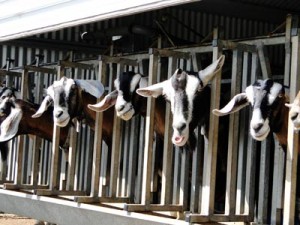
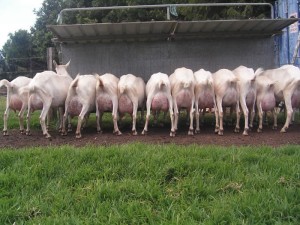
Goats lined up ready to Be Milked
A hot iron or electric calf disbudder is used for disbudding. The use of chemicals for disbudding (e.g. caustic sticks) is strongly discouraged. Within minutes of disbudding the kid should be suckling or playing happily. If correctly done, the horns will not grow ‘Scurs’ (horn stubs) or if they do Scurs will cause no trouble.
It is highly desirable that newcomers have the job done by an experienced breeder and learn how to do it under supervision. The trouble is worthwhile to avoid the dangers of horns to other goats and their keepers.
What are the good points of a doe? The same remarks as to general appearance apply equally to all kinds of dairy goats. The distinguishing differences are in particular breed characteristics, e.g. the Saanen is white or cream, the Toggenburg may be any shade between light fawn and dark chocolate with white makings on face, legs, rump, escutcheon and tail.
The British Alpine is black, with similar white makings to the Toggenburg. The Anglo Nubian may be any colour or combination e.g. colours and is distinguished by its large pendulous ears and distinct Roman nose. All may be horned or hornless.
When selecting a goat look for the points indicated on page ? at the same time being careful to avoid the following faults.
” Cow hocks (tendency for hocks to touch each other).
” Weak pasterns, they should be strong.
” Long pendulous udder with teats close to the ground.
” Udder protruding from the hindquarters unduly or split udder i.e. showing cavity between the two halves.
” Teats which will be difficult to milk.
Are there any laws on goat keeping? Local councils can lay down by-laws regarding goat keeping. Intending goat keepers should consult their local council. South Australia has strict state laws regarding the control of goats. Your state Dept. of Agriculture or Primary Industries will advise if there are state laws regarding the control of goats. They will also advise regarding controls on the movement of goats between states and/or districts.
How can I tether a goat? Although tethering is the least suitable and an undesirable form of keeping a goat it can be done. Use a
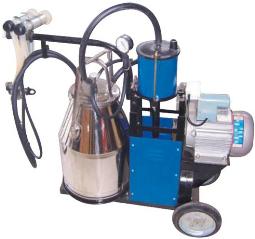
Mobile Milking Unit for Goats
collar with a small loose ring and attach a rope or light chain to it with a swivel snap hook. The other end should also have a swivel and be attached to a ring, which is placed over a stake in the ground or preferably, attached to a long wire, which is fixed at each end. Keep snap hooks grit and rust free so they can easily released.
Make sure that she cannot become tangled in vegetation. Shelter and water must be accessible. It is unwise to tether a goat unsupervised, they are vulnerable to dog attack, they can become tangled in ropes or chains and goats have strangled themselves on tethers. Tethers should only be temporary, until yards are built or to use your goat to remove unwanted vegetation.
How long will a goat milk?A goat will milk from 7 to 12 months or longer, depending on her quality and when she is bred. Milking should continue for the first 2 to 3 months of the doe’s 5 month pregnancy, then she should be dried off to give her a 2 months spell. Some does will start to dry up once mated other heavy milkers take longer to dry off than the average doe.
When buying a goat for the first time, it is best to go to a reputable breeder (see the links page and for sale section of this website), or get a knowledgeable goat keeper to go with you to see the animal you are considering. Many agricultural shows and the Ekka are good places to start looking. Here you will met keen breeders who will be only too happy to share their experiences and joy of owing dairy goats.
Some may even have stock for sale, or allow you to visit their herds and learn more about dairy goats. Always choose the breed you are most happy with, that promises to give the amount of milk you require and the best animal you can afford.
..
..