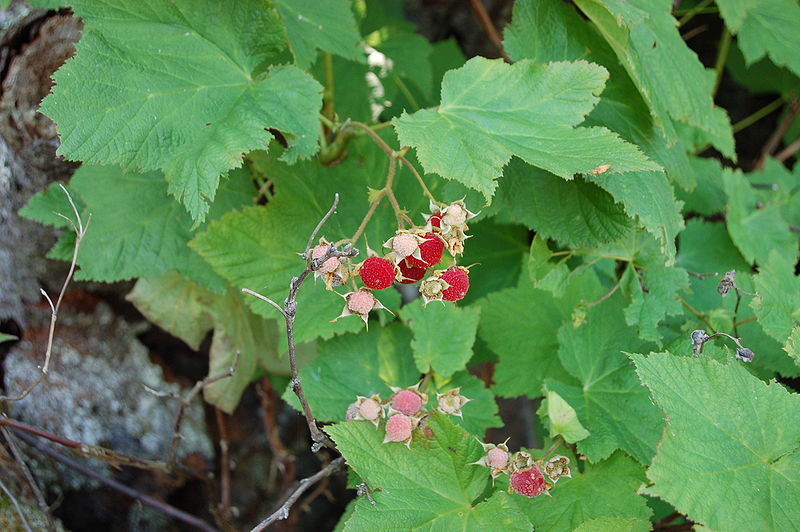
Thimbleberry Photo by Jim Dexter on Wikimedia Commons
Botanical Name: Rubus parviflorus thimbleberry
Family: ROSACEAE
General Description.—Thimbleberry, also known as western thimbleberry, salmonberry, mountain sorrel, and western thimble raspberry, is a spineless, deciduous shrub 0.5 to 2.5 m in height. Twigs and new stems are green and glandular; old stems are covered with tan, papery, shredding bark. Stems support relatively few branches.
Clonal groups of plants are usually represented by several to many somewhat dispersed stems that have arisen from rhizomes (underground stems). Leaves, which have a maple-leaf appearance, are simple, alternate, and palmately veined with three to seven lobes and have entire to serrate margins.
The yellow-green to dark-green blades are 4.5 to 15 cm long and 5.5 to 20 cm broad and are supported by long petioles. Perfect, white flowers 2 to 4 cm broad are grouped in terminal corymbs of 2 to 7 flowers. The fruits, which are aggregates of tiny drupes, are hemispherical, thin, somewhat dry, fragile, and dark pink to bright red, and detach easily from the central core (torus), which has five sepals at its base. The hard seeds are 1.5 to 2.5 mm long (Abrams 1944, Rook 1998, Welsh 1974)
Range.—Thimbleberry occurs from Alaska to western Ontario, from Michigan westward, and south through California, Arizona, New Mexico, and northern Mexico (Natural Resources Conservation Service 2003, Welsh 1974, Welsh and others 1987). It is also reported in Massachusetts, probably as a naturalized population. There are two recognized varieties of thimbleburry, var. parviflorus, accounting for virtually all of the range, and var. velutinus (Hook. & Arn.) Greene, which is densely hairy on the underside of leaves, found in California (Abrams 1944, Natural Resources Conservation Service 2003).
Ecology.—Thimbleberry grows on most types of moist soils, including skeletal soils. The species is most common in cool, moist sites, particularly on north slopes. Thimbleberry also occurs on dry, exposed ridges in high-elevation areas. It grows from near sea level to 2,900 m in elevation in Wyoming (Tirmenstein 1989). Thimbleberry is moderately shade tolerant. Although it is most abundant and grows and fruits best in 60 to 100 percent sunlight, the species persists in the understory of closed stands (Tirmenstein 1989). It occurs both as scattered individual plants and as large continuous stands. Habitat includes burned sites, logged areas, avalanche tracks, roadsides, natural shrublands, hardwood forest understories, understories of low to moderate basal area conifer forests, and river overflow terraces and shorelines.
It is a part of a large number of different plant communities. Thimbleberry is resistant to fire, readily resprouting from rhizomes. In fact, the species generally benefits from all kinds of disturbance. It usually appears during the first year after disturbance and often dominates the understories of logged areas within 5 years. Moderate to light thimbleberry stands can serve as a good protective cover for conifer seedlings. In recreational sites, the species showed relatively low resistance to trampling (Tirmenstein 1989).
Reproduction.—Thimbleberry generally blooms in June and July. Its fruits mature in July and August (Borialforest.org 2003). However, at the extremes of its range, it may bloom anywhere from May to September and fruit between late June through September (Tirmenstein 1989). The flowers are insect pollinated. Good fruit and seed crops are usually produced every year except in high-elevation areas where production may be unreliable (Tirmenstein 1989). The seeds are dispersed by birds and mammals that eat the fruits, and by gravity. The seeds accumulate in the soil and duff to form a seed bank and germinate in great numbers following fire and other disturbances that remove the forest canopy (Rook 1998). After establishment by seeds, stands thicken through sprouts from rhizomes (Rook 1998).
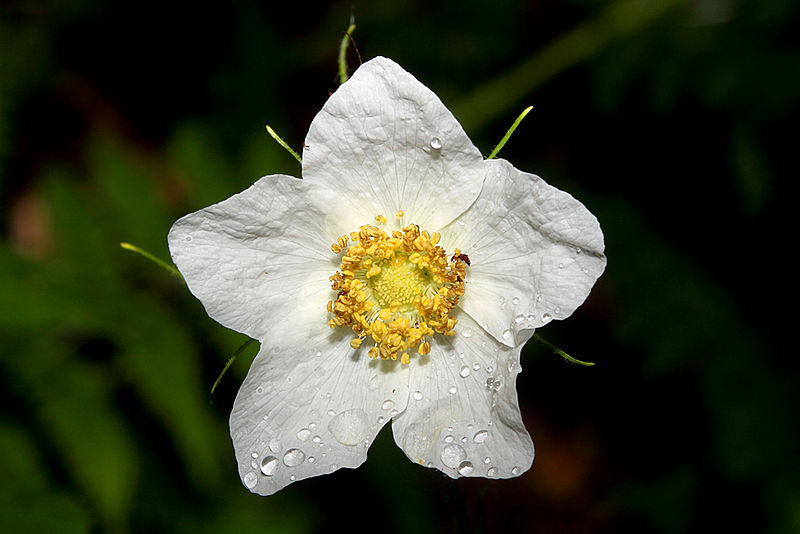
Thimbleberry flower Photo by Alan Vernon
Growth and Management.—The stems (or canes) live for 2 or 3 years. In the first year, canes grow in height and develop only leaves. During the second and third years height growth continues and flowers and fruits are produced. The canes then die and are replaced by others that sprout from rhizomes. Maximum height of current canes is reached within 10 years after establishment (Tirmenstein 1989). Seeds must be collected by hand and should be cleaned of adhering fruit.
Seeds may be sown in the fall for spring germination or may be warm (20 to 30 °C for 90 days) and cold stratified (2 to 5 °C for 90 days) for spring sowing. Also, scarifying with H2SO4 prior to the cold stratification may enhance germination. Tests have given maximum germination estimates of 62 percent (Tirmenstein 1989). Hardwood cuttings can be easily rooted. New plants can also be started from rhizome cuttings and plant divisions. Wildlings survive well but are slow to become established (Washington State University Cooperative Extension 2003). Occasionally, it is desirable to release conifer seedlings in and under thimbleberry thickets or to make way for other, more palatable forage species. The species is moderately susceptible to herbicides. Picloram, 2,4-D, and glyphosate have been effective in appropriate applications (Tirmenstein 1989).
Benefits.—Thimbleberry is an important shrub of the understory and forest openings. It helps protect the soil and adds to the beauty of the forest. The species is occasionally planted as an ornamental for its fragrant flowers and brilliant orange to maroon fall foliage (Borialforest.org 2003, Rook 1998). It is also occasionally planted in conservation plantings in disturbed areas. Thimbleberry is relatively low in energy and protein (4 to 8 percent), and is little used by cattle and horses and is only fair forage for sheep. It is sometimes important for deer, elk, and other wild ungulates during the summer while the leaves are still present. Rodents consume bark, buds, and foliage to a limited extent.
On the other hand, the fruits are an important food item for numerous wild mammals and birds. Thickets of thimbleberry are also important escape, resting, and reproductive cover for many species of wildlife (Tirmenstein 1989). Fruits are certainly edible to humans but reports vary greatly on their palatability (Clark 1976, Welsh 1974). The author has eaten them for years and finds them inferior to cultivated raspberries (Rubus idaeus L.) but well worth the trouble of picking while hiking in the forest. The fruits are made into an excellent jelly and were once dried for later use by Native Americans.
The tender young shoots are juicy and sweet and can be boiled or eaten fresh. The leaves are sometimes made into herb teas (Borialforest.org 2003, Washington State Department of Transportation 2003). Native Americans applied poultices of leaves to burns and wounds and took decoctions of roots as a tonic, for vomiting, and certain internal disorders (Moerman 1986).
Note: References available from source website.
Author: John K. Francis, Research Forester, U.S. Department of Agriculture, Forest Service, International Institute of Tropical Forestry, Jardín Botánico Sur, 1201 Calle Ceiba, San Juan, PR 00926-1119, in cooperation with the University of Puerto Rico, Río Piedras, PR 00936-4984



