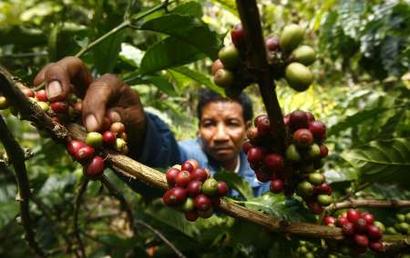
A Indonesian farmer picks robusta coffee fruit. Indonesia is the world's second-largest robusta producer after Vietnam.
History of Robusta Coffee
Botanic Name Coffea canephora
Robusta coffee has its origins in central and western sub-Saharan Africa. It is a species of flowering plant in the Rubiaceae family. Though widely known as Coffea robusta, the plant is scientifically identified as Coffea canephora, which has two main varieties - Robusta and Nganda and grows indigenously in Western and Central Africa. It was not recognized as a species of Coffea until the 19th century, about a hundred years after Coffea arabica.French colonists introduced Vietnam to Robusta in the late 19th century. In recent years Vietnam, which produces mostly Robusta, has surpassed Brazil, (where it is often called conillon) India, and Indonesia to become the world’s single largest exporter of Robusta coffee. Brazil is still the biggest producer of coffee in the world, producing one-third of the world’s coffee, though 80% of that is Coffea arabica.
Plant Characteristics
The plant has a shallow root system and grows as a robust tree or shrub to about 10 metres, normally reaching 4.5 - 6.5m in altitudes of 0 - 800m. Robusta requires rainfall of 2,200 - 3000mm and a temperature of 18 - 36C. In comparison Arabica grows 2.5 - 4.5m, requires an altitude of 600 - 2,200m, rainfall of 1200 - 2,200mm and temperature of 15C - 24C.
Robusta flowers irregularly, taking about 10–11 months for cherries to ripen, producing oval shaped beans. The Robusta plant has a greater crop yield than that of Coffea arabica and contains more caffeine - 2.7% compared to Arabica’s 1.5%. With regard to Caffeine and CGA content: both caffeine and CGA have been documented as potential insect deterrents and chemisterilants. As it is less susceptible to pests and disease, Robusta requires much less herbicide and pesticide than Arabica. Robusta cherries require less care since they remain on the tree after they ripen. Robusta has half the chromosomes at 22 than Arabica that has 44. Robusta isn’t self-pollinating, meaning the plant will have more mutations and variations throughout its life cycle than Arabica will.
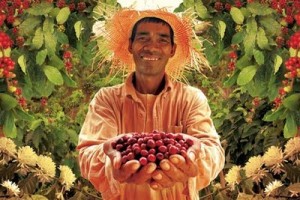
"I am really glad I had the chance to study coffee farming with Nescafé,” says Filipino farmer Edgar. “Knowledge is a seed I am more than happy to share with everyone.”
Robusta Coffee
Once roasted, robusta tends to deliver a distinctive earthy flavour, usually with more bitterness than arabica. This powerful flavour can be desirable in a blend to give it perceived “strength” and “finish”, noticeably in Italian coffee culture. In France, blends with around 70% robusta and 30% arabica are marketed as “traditional” coffee. Usually, coffee brewed from these blends or from straight robusta is mixed in even parts with hot milk in a cup or bowl before drinking.
In fairness, although most robusta coffee is of a lower grade and inferior to Arabica, there is a premium crop that is the top of the line for robusta beans. Premium robusta is primarily used in specialty espresso blends, and is never found in canned coffee. Though it only constitutes 5-15% of the blend, it is used because these beans add body to the taste and make a nice creama in the shot of espresso. This additional body distinguishes the blend in a cappuccino or latte.Premium robusta should only be used for espresso and not other brewing methods.
While not separate varieties of bean, unusual and very expensive robustas are the Indonesian Kopi Luwak and the Philippine “Kape Alamid”. The beans are collected from the droppings of the Common Palm Civet, whose digestive processes give it a distinctive flavor.
Source
National Geographic (Mar 1981), Nestle Philippines coffee farming projects.