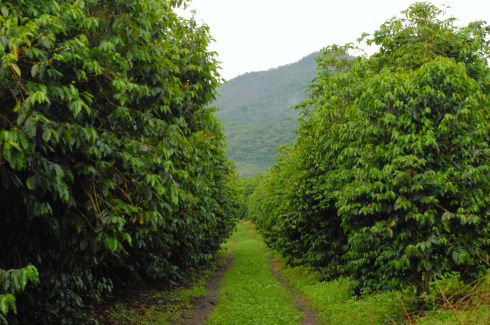
Mundo Novo coffee growing in North Queensland
Mundo Novo, is a natural hybrid that originated and remains prevalent in Brazil. It was first documented in the 1940′s (no exact date known) in Brazil by the Agronomico of Campinas. Mundo Novo’s type is Sumatra (typica)/ Red Bourbon. The predominant colour is red, with large rounded cherries. Mundo Novo grows best at altitudes of 800 metres or above.
Mundo novo is particularly suited to the Brazil climate, and is well liked by the coffee farmer for it’s very high yield, it’s resistance to pest and disease and its ability to be planted very densely. This is also complimented by the height that the coffee plant can grow. The plant yields around about 30% more than the bourbon varietal, why it occupies around 40% of the coffee growing areas of Brazil. Varietal characteristics are: sweet, thick mouthfeel and low acidicity. Leaf characteristics are large, an intermediate between Typica and Bourbon.
The Acaia genotype was derived by selection from progenies of the Mundo Novo germplasm which arose from the natural hybridization between Sumatra and Bourbon cultivars.
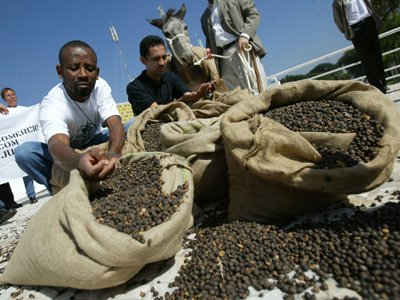
Brazil harvested approximately 285 billion cups of coffee in 2010
High yields have been said to lower quality, however Mundo Novo does regally make appearances in the Brazil cup of Excellence program.
Research
In 1982-83 Queensland DPI researcher Ted Winston planted more than 70 cultivars (arabica and robusta) along with promising local lines at Kamerunga Research Station near Cairns in Northern Queensland. A second trial was planted in 1983 in the shallow granitic soils of the Atherton Tablelands at Walkamin. In the mid 1980s this evaluation program was extended into northern New South Wales where 18 of the most promising cultivars from North Queensland and locally adapted selections were planted. The program in both states was designed to evaluate the cultivars in a range of microclimates and on differing soil types, also to simulate a machine-harvest planting, with trees one metre apart and rows four metres apart forming hedgerows (2500 plant/ha), with grass cover in the inter-rows. All plants were grown in full sun and trained to a single stem. The Queensland trials were irrigated. Cultivars were assessed on their commercial yield over three to five years, including total cherry yield, cherry to dry green bean ratio, bean size and appearance, cupping quality and suitability for machine harvesting. Time of maturity, ripening pattern on the tree, resistance to pests and diseases, plant adaptability and growth rates were also evaluated. All trials were harvested by hand every three to four weeks to determine yield progress and maturity pattern or profile, information vital for machine harvesting. In later years the trials were machine harvested.
Australian Research Findings for Mundo Novo
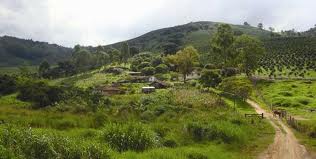
Mundo Novo coffee plantation in Brazil
A comparison of mean coffee yields (kg green bean/ha) at three North Queensland locations was conducted, trees were three years old at harvest. At the Walkamin location (1990-2) Mundo Novo produced the highest yield of the cultivars trialed producing 3512kg green bean/ha. At Kamerunga (1985-8) the yield was 3215 kg green bean/ha being surpassed in yield (of “most promising” trialed) by only Catuai Rojo (4063), Catimor (3252) and SL 6 (3216). At Mareeba (1985-8) Mundo Novo also produced the highest yield at 2019 kg green bean/ha surpassing yield rate of the next highest contenders Catuai Amarillo (1740) and Catimor (1708).
Yields from 19 cultivars evaluated in northern New South Wales (mean of 3 locations) revealed Mundo Novo produced 2,500 green bean/ha, only being surpassed in yield by the highest K7 (approx 2800), SL14 (approx 2750), Arusha and Condong Range Bourbon at around 2600kg green bean/ha.
Source
Has Been Coffee, David Peasley and Ted Winston