Fully washed and dried SL28, SL34 and K7 Arabica coffee beans
This attractive shrub is gaining in popularity as both a commercial and home orchard crop. It bears a prolific crop of red berries from 2 - 3 years of age that is ample to make a delicious and easily-processed home made coffee. K7 is a tall cultivar resistant to both ‘Berry Disease’ and ‘Coffee Rust’. K7 was developed and recommended for growing in the Northern Rivers Area by NSW Agriculture Department after extensive trials at Alstonville NSW. An open spreading variety, it is a reliable cropper, producing large flavour-filled beans; it is also the recommended variety for those who intend to harvest mechanically.
K7 is an Arabica coffee, a Kenyan selection of French Mission Bourbon was selected at Legelet Estate in Muhoroni, Kenya. Selection was based on cupping trials.
Australian Coffee Research
In 1982-83 Queensland DPI researcher Ted Winston planted more than 70 cultivars (arabica and robusta) along with promising local lines at Kamerunga Research Station near Cairns in Northern Queensland. A second trial was planted in 1983 in the shallow granitic soils of the Atherton Tablelands at Walkamin. In the mid 1980s this evaluation program was extended into northern New South Wales where 18 of the most promising cultivars from North Queensland and locally adapted selections were planted.
 The program in both states was designed to evaluate the cultivars in a range of microclimates and on differing soil types, also to simulate a machine-harvest planting, with trees one metre apart and rows four metres apart forming hedgerows (2500 plant/ha), with grass cover in the inter-rows. All plants were grown in full sun and trained to a single stem. The Queensland trials were irrigated. Cultivars were assessed on their commercial yield over three to five years, including total cherry yield, cherry to dry green bean ratio, bean size and appearance, cupping quality and suitability for machine harvesting. Time of maturity, ripening pattern on the tree, resistance to pests and diseases, plant adaptability and growth rates were also evaluated. All trials were harvested by hand every three to four weeks to determine yield progress and maturity pattern or profile, information vital for machine harvesting. In later years the trials were machine harvested.
Australian Research Findings
Variation in maturity pattern of cultivar K7 over five years in northern New South Wales:
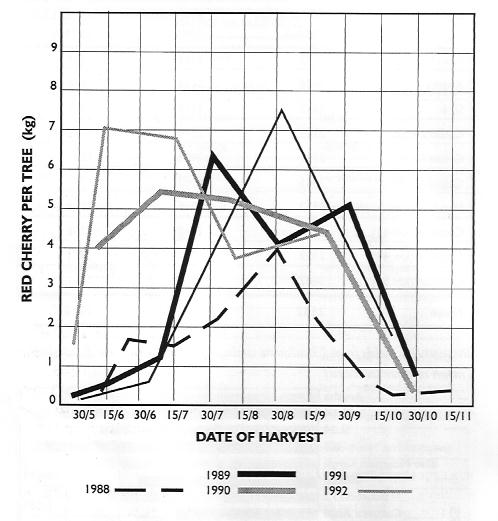
 The timing of Spring and early Summer rains or irrigation determines the timing of flowering and degree of flower syncronisation. In northern New South Wales frequent rainfall during this critical period makes flower syncronisation by irrigation scheduling difficult in most seasons. In North Queensland, conditions are more favourable for synchronising flowering through controlled stress and irrigation.
Source
David Peasley and Ted Winston, Melbourne Coffee Merchants