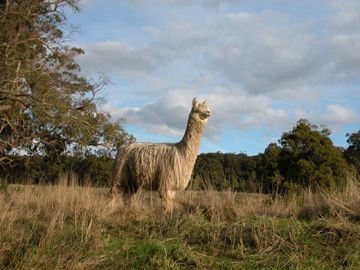
Alpaca
History
Alpaca
In the late 19th century, alpaca was made known in Europe as a luxury fibre by a very important Englishman in the textile business: Sir Titus Salt. Thanks to this man, the word ‘alpaca’ became synonymous with lustre, elegance and softness and has continued that way ever since.
In those early days, the textile industry in Peru, was non-existent. It was merely trade that went on. The trading houses would gather raw material from the Peruvian highlands during the months of October to March and then, ship the fibre to Liverpool on consignment . This went on until 1950 when Mr. Frank Michell, (one of the pioneers of the alpaca industry) realised that in order to make it a business, we had to start processing the fibre and look directly for the final users.
From a historical point of view, it was at this time that the alpaca trade started becoming an industry and it was also at this point where sorting became a key element for business – probably the most important aspect of it.
Gathering and collecting the fibre
The way alpaca fibre is gathered has been largely affected by land tenure systems occurring in the Andes.
Thus, until the late 1960’, before the land reform took place, 25% of all the animals (or clip) were in the hands of a few haciendas and 75% were in the hands of Andean farmers.
Buying fibre from haciendas was quite simple, needing only mutual agreements between the companies and the people who owned the haciendas. Buying from peasant communities was a whole different story and gathering was performed in various ways.
In those days, during the shearing or buying season, there used to be many small ferias where campesinos would take their fibre for sale. It was at this point that middlemen started appearing.
In the beginning, middlemen actually performed a service. They would take sugar, oil, batteries, etc. and trade them for alpaca fibre with the campesinos. In other words, it was all barter trading.
The industry also had its own people on some of these ferias, but as they were so many, they would only attend the most important ones.
In 1972, after land reform, the majority of these haciendas were turned into co-operatives which still held animals and raised them for business. However, many of these co-ops disintegrated rapidly and the alpaca herds were distributed among more farmers than before.
The breaking up of co-ops also brought land fragmentation as campesinos would divide the land and herds among themselves. Little attention was given to herd management and fibre quality deteriorated.
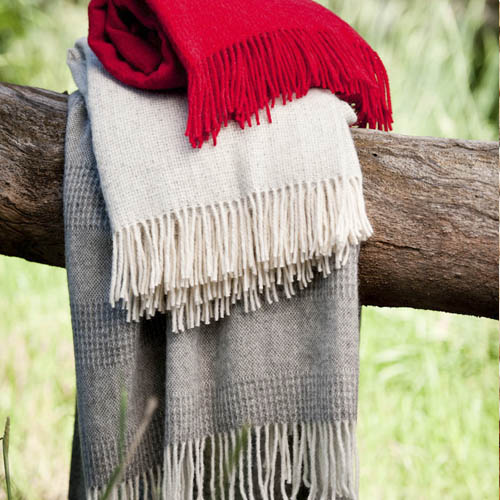
Alpaca Products
Today, no more than 10% of the alpaca population is still left in the hands of the past haciendas or former co-ops and most of the small weekly ferias have disappeared. At the same time, industries that set up offices in the Andes closed down as a result of terrorist groups during the 1980s and early 1990s.
As a result, buying fibre today has become a very complex activity in which middlemen play an important, but not always desired role. Their ability to reach remote places in order to gather very small quantities of fibre, which they stockpile and then sell to the industry, has empowered them even more than before.
Middlemen can have terrible economic effects at both farm and industry levels. Usually, farmers don’t get what they should for their fibre. At the same time, industry is cheated into buying material that does not have the value it should.
Sorting
This is probably the most important area of the alpaca business. At the beginning of the trade in the years of the round lots, all the fibre was exported together.
Then (still before the 1950s) the separation of fibre into various qualities began with the round lots being divided into coarse and fleece. A higher price was paid for fleece than coarse and also a higher price for white over lfs and colours.
As a result, stocks of white animals grew from 20% to 25% of the clip to approximately 60% of the actual alpaca population.
Since white was more expensive, as was fleece, sorting became a critical activity in the business. Frank Michell created the bmn and the bmc colours. These were whites, with shades of brown and shades of black respectively. By sorting these shades, he could recover more white from the clip. Also at this time the quality we know today as baby was created. As it had a better micron reading, it had a higher value than that of the normal fleeces.
The sorting of alpaca is done in an absolutely artesian way, that is to say that no machinery is involved in this process. It is done by ladies who sit on the floor in the sorting sheds. This is an art that is transmitted from mother to daughter, generation after generation.
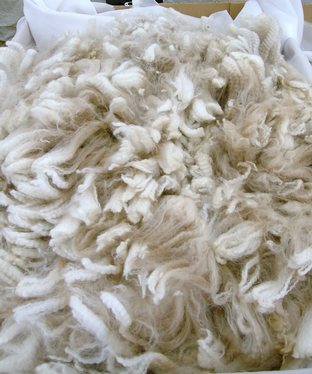
Alpaca Fleece
There are 15 natural shades, most of which belong to brown in all its hues, as well as black and the greys, when black and white are naturally or manually blended.
These colours can, however, be further broken down or blended into 25-30 colour compositions and these blended shades can also be supplied in ‘in-between’ qualities apart from bl, fs, ag, hz, mp.
The most popular of those in between types being bl/2, which has a micron range 23-23.5 and ms, which has a micron range of 27-27.5. You will also find other micron readings required specifically by each client.
These qualities are made up as requested by clients who will take their decisions based on price and quality of the end products they may want to manufacture. By being able to offer a variety of choices to our clientele we make the fibre much more functional and versatile.
Where once we were stuck with five different qualities, today we can do up to 10 different types, which complicates the sorting, but gives more choice to your clientele.
I mentioned sorting as being such an important player in the alpaca textile process because it is at this stage that all the key elements that define the quality of your product come into play. Those key elements are colour, fineness and length.
AUTHOR : Derek Michell



