 Ensure you have the correct sets of printed out cow lists. Enter information directly onto these lists, don’t use a system which involves transferring data from ‘temporary’ or ‘rough’ lists to ‘permanent’ or `good’ records. This will only increase the chance of making errors and require more time. Weighing for weaning weights can (should) be done at the same time. Normally you would tag calves at weaning with a plastic tag. If you particularly wish to guard against lost tags causing identification problems, such as in a bull breeding system, then a brass tag in the opposite ear provides `belts and braces’ identification security.
Choosing a tag
Plastic identification tags should meet the following criteria:
1. Tags must be clearly readable both front and rear from a distance of at least 3 m with numerals (and letters) that are clear, easy to read and do not fade over time.
2. Physically they should be of a design which does not irritate the calf’s ear or pull it out of shape, and does not catch on things like fences, netting or yard rails. They should be available in a wide range of faae¬free colours and made of materials which last at least the lifetime of the calf.
3. The design should ensure they can be inserted with minimal damage to the ear and especially should avoid splitting the ear.
4. Tags should come with clear, readily understood instructions for use, and should be logical, straightforward and safe to apply.
The availability of multicoloured two-part tags offers considerable scope for ensuring the calf carries a range of easily visible information about itself in its ear. Obviously you must develop a consistent, logical system, and ensure you have the correct tags on hand to carry it out.
A simple, commonly used system is as follows:
1. Indicate sex by tagging bulls in the animal’s left ear and heifers in the animal’s right ear. (However, if you are doing a lot of weighing, be aware that it can be more efficient to tag all animals in the same ear — the one that is on the read-out side of the scale). Indicate year born by colour code on the front half of the tag.
2. Situate large print calf number on the front of the tag.
3. Situate smaller print full unique number (calf number plus year born) on the back of the tag.
4. Situate other information such as farm brand or ownership on the back of the tag.
5. Indicate other useful information such as breeding status (foundation stock, first cross, second cross) or parentage (natural mating, AI, ovum transplant) by a second colour on the back of the tag.
6. Cutting notches in tags, or cutting corners off allows other information to be added such as weight rank, or number of calves born. It can also be used for farm management purposes such as indicating culling decisions.
In the yards
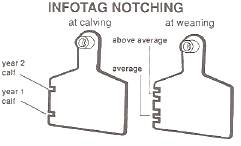
An example of how the Allflex lnfotag can be used to indicate important information about individual beef cattle.
An example of how the Allflex lnfotag can be used to indicate important information about individual beef cattle.
Muster cows and calves into the yards and draft the calves off by sex. First tag all heifer calves. Estimate their age by relating the size of each individual to the average size of all the heifer calves and the known main calving period. (If you are weighing as well this will give you a good base for calculations). If your calving is tight (four to six weeks) then the inaccuracy incurred by wrong birth dates is around 0.8 to 1 kg a day, which is probably an acceptable error. If your calving spread is closer to the normal 12 to 15 weeks then inaccurate birth dates will alter the reliability of recorded weights. Accordingly for this reason we recommend calves should be tagged at birth and birth dates accurately recorded.
Calving date is important because it is a factor in the lifetime production performance of the breeding cow. Cows which fail to get in calf early and consequently calve late, may eventually miss a complete season. This calving interval, calculated from calving dates, is an important performance trait in breeding cows. Overall calving spread for the breeding herd can have a significant effect on farm management and profitability. A tight calving pattern means cow and calf feed needs can be closely matched to pasture availability, and animals reach saleable weights as quickly as possible.
When the heifer calves are tagged turn them out with the cows and allow them to mother up while you take a break. Now bring in the bull calves and tag them. Castrate them at the same time if this is farm practice. Once you are satisfied all the heifer calves have found their mothers, quietly move them out of the yard leaving behind the dams of the bull calves. Now put the bull calves in with their mothers and allow both groups to settle. When all bull calves are mothered up and both mobs are calm move quietly amongst them and record cow-to-calf links. Enter this directly into the computer printout of cow numbers.
Applying tags
Establish a set routine which is as time and motion efficient as possible, and stick to it. A fast, practised routine will reduce stress on both you and the calves. Keep dogs under control and try to prevent unexpected noises, such as shouting, banging gates and tractors revving, from disturbing the calves and cows or workers during tagging. If the yards are dusty, damp them down. Pick a dry, cool day, wet or humid weather can slow the healing process. Dip the applicator with the tags attached into an antiseptic solution before applying the tags. This disinfects the wound and provides lubrication as the tag is applied. Use a nonirritating antiseptic such as Savlon, and change the antiseptic wash frequently.
Use at least two applicators so one is being loaded while the other is in use. Use the correct applicator for cows. Check they are working properly.
Hold the calf firmly during the tagging and apply the tag with a quick positive action. Release the handles rapidly once the tag has been applied to withdraw the applicator pin from the tag stem, avoiding possible ear damage or bending of the applicator pin.
Don’t try to restrain the animal’s head once the applicator is closed and the tags are joined if the calf flicks its head let the applicator go rather than rip an ear.
Calves’ ears have the same fundamental structure as all other animals, with strong ridges which support the ear shape and assist its mechanical function. You must place tags so as to avoid damage to these ridges. The central ear area between these ridges is the ideal site, as it is also relatively free of blood vessels, nerves and hair.
At the start of the job turn out the first 10 calves tagged into a big yard and see how readable the numbers are from a distance. If the tags are difficult to read alter your tagging technique and where the tag is being placed in the ear. Also check that at very close quarters you can read the lag without having to catch the calf and pull or twist its ear.


