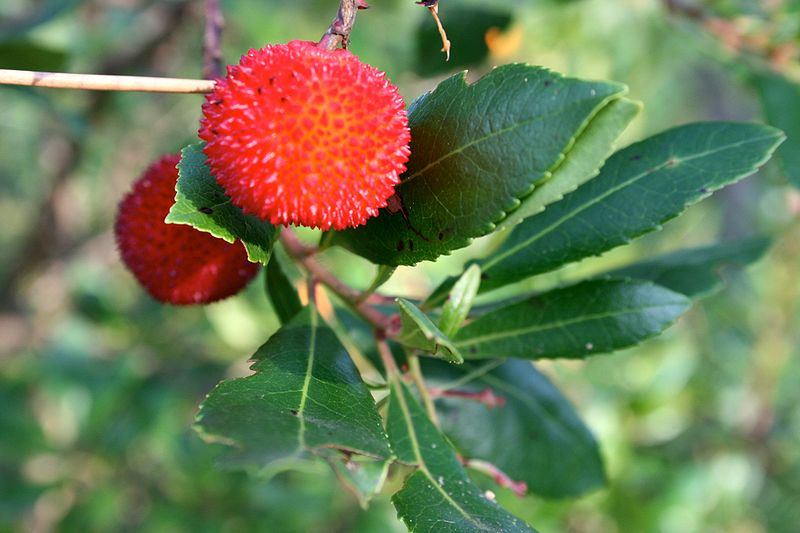
Strawberry Tree Photograph by Mike Peel (www.mikepeel.net).
Arbutus unedo, commonly called Strawberry Tree, Apple of Cain, or Cane Apple, is an evergreen shrub or small tree in the family Ericaceae, native to the Mediterranean region and western Europe north to western France and Ireland. Due to its presence in South West Ireland, it is also known as Irish strawberry tree, and Killarney strawberry tree.
Description
Arbutus unedo, grows to 5-10 m tall, rarely up to 15 m, with a trunk diameter of up to 80 cm. Zone: 7-10 The leaves are dark green and glossy, 5-10 cm long and 2-3 cm broad, with a serrated margin. The hermaphrodite flowers are white (rarely pale pink), bell-shaped, 4-6 mm diameter, produced panicles of 10-30 together in autumn. They are pollinated by bees.
The fruit is a red berry, 1-2 cm diameter, with a rough surface, maturing 12 months at the same time as the next flowering. The fruit is edible, though many people find it bland and mealy; the name ‘unedo’ is explained by Pliny the Elder as being derived from unum edo “I eat one”, which may seem an apt response to the flavour.
Cultivation and uses
Unlike most of the Ericaceae, Arbutus unedo grows well in limy soils. It is best planted in a sheltered position due to its late flowering habit (see first paragraph). When grown as a tree rather than a multi-stemmed shrub, it is important to select one stem that becomes the main trunk, keeping any other basal sprouts pruned off. It prefers well-drained soil and only moderate amounts of water.
Arbutus unedo is naturally adapted to dry summers, though also growing well in the cool, wet summers of western Ireland. It is therefore useful for planting in areas with a dry-summer climate, and has become a very popular garden specimen in California and the rest of the west coast of North America. It is hardy in USDA Hardiness Zones 8 to 10. Pests include Scales and Thrips, and diseases include anthracnose, Phytophthora, root rot, and rust.
The fruit mainly serve as food for birds but in some countries they are used to make jam and liqueurs (such as the Portuguese medronho, a kind of strong brandy).
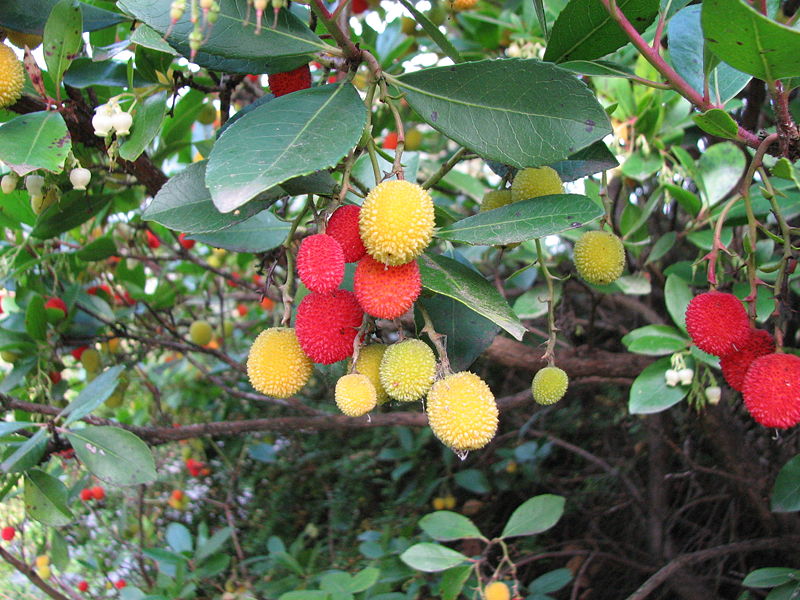
Strawberry tree Author Lordgrunt on Wikimedia Commons
Distribution
The disjunct distribution, with an isolated relict population in southwestern Ireland, notably in Killarney, is a remnant of former broader distribution during the milder climate of the Atlantic period, the warmest and moistest Blytt-Sernander period, when the climate was generally warmer than today. The red-flowered variant, named A. unedo rubra by William Aiton in 1785, was discovered growing wild in Ireland in 1835.
Garden history
Its Mediterranean habitat, elegant details of leaf and habit and dramatic show of fruit with flowers made Arbutus unedo notable in Classical Antiquity, when Pliny thought it should not be planted where bees are kept, for the bitterness it imparts to honey, but the first signs of its importation into northern European gardens was to England from 16th-century Ireland rather than from the Mediterranean basin; in 1586 a correspondent in Ireland sent plants to the Elizabethan courtiers Lord Leicester and Sir Francis Walsingham. An earlier description by Rev. William Turner (The Names of Herbes, 1548) was probably based on hearsay.
The Irish association of Arbutus in English gardens is reflected in the inventory taken in 1649 of Henrietta Maria’s Wimbledon: “one very fayre tree, called the Irish arbutis standing in the midle parte of the sayd kitchin garden, very lovely to look upon” By the 18th century Arbutus unedo was well known enough in English gardens for Batty Langley to make the bold and impractical suggestion that it might be used for hedges, though it “will not admit of being clipped as other evergreens are.”
Symbolic use
The title of The Garden of Earthly Delights, a mysterious painting by Hieronymus Bosch, is a later attribution. It was listed in the inventories of the Spanish Crown as “the picture with the strawberry-tree fruits”.