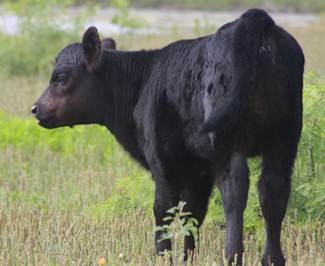
 Step 1 How much pasture is available for cattle to graze
This involves estimating the ‘grazing opportunity’ in kilograms dry matter per hectare (kg/DM/ha) by assessing pasture height and related density using the MLA Pasture Ruler or equivalent measurement tool.
In practice, the conversion of pasture into beef product is greatest when the paddock grazing sequences ensure:
• The most appropriate class of cattle is used to meet production targets;
• Pasture energy supply matches animal energy demand;
• Pasture mass is maintained in a green, leafy and vegetative condition across the paddock between 1,500 kg green DM/ha to 2,500 kg green DM/ha (around 6cm to 12cm high) and with the recommended number of live leaves and tillers for the grazing period.
• The number of animals allocated for grazing enables accurate prediction of the grazing period, while maintaining pasture mass above 1,000 kg green DM/ha (3cm high) to ensure rapid regrowth and to prevent grazing of new growth.
An estimate is needed of how much pasture is wasted through animals trampling and fouling during grazing. Around 20% wastage is a reasonable estimate and is used in the worked examples.
Step 2 What pasture allowance is required for various classes of grazing cattle
Pasture allowance is described as food needed for growth and maintenance of the stock (intake) plus an allowance (20%) for trampling and fouling. Pasture allowance is based on a pasture of at least 10 MJ ME/kg DM, and is not applicable to pastures of lesser quality.
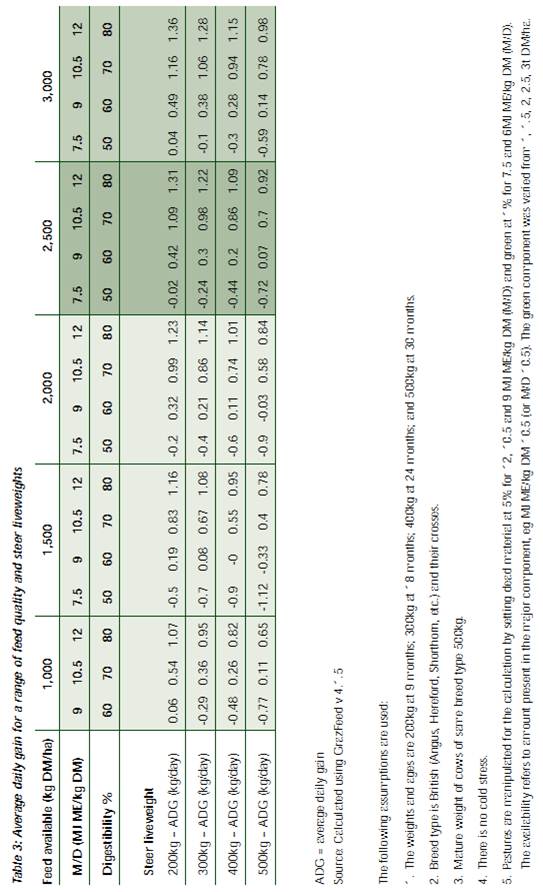
Table 3:Average daily gain for a range of feed quality and deer liveweights
Step 3 Calculate the stocking rate over short grazing periods
Follow the example to calculate the stocking rate for a 2,500kg green DM/ha pasture with a nutritional quality of (ME>10.5 MJ/kg DM) for 300kg steers growing at 1kg/day (see Table 3).
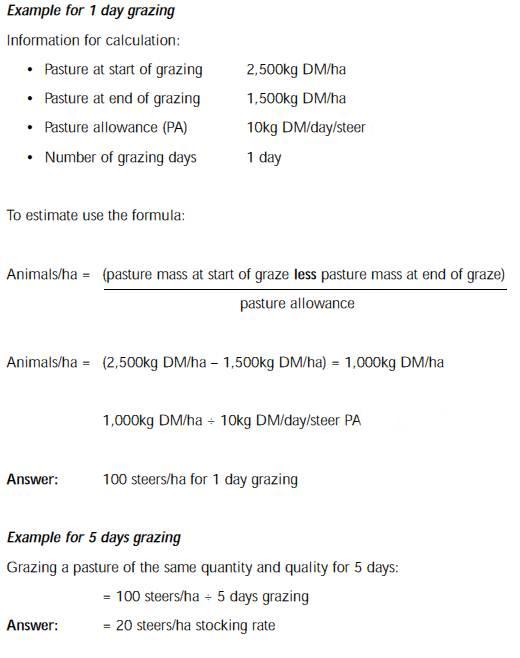
Note: when calculating the short-term stock numbers while using short-term, high density grazing (from 1 to 5 days) there is no need to make an allowance for any pasture growth.
When grazing pasture for longer periods, an allowance needs to be made for the expected pasture growth during the grazing period. As a guide to mid-monthly pasture growth estimates.
Step 4 Determine the stocking rate/hectare over longer grazing periods
The big challenge in grazing management is being able to predict the stocking rate that takes advantage of any period of rapid feed growth. The question to be answered is “How many cattle are required to achieve the combination of productivity and profitability”. A partial budget spreadsheet, ‘The stocking rate calculator’, is provided on the enclosed CD-ROM to help you calculate the appropriate stocking rate for the nominated grazing period.
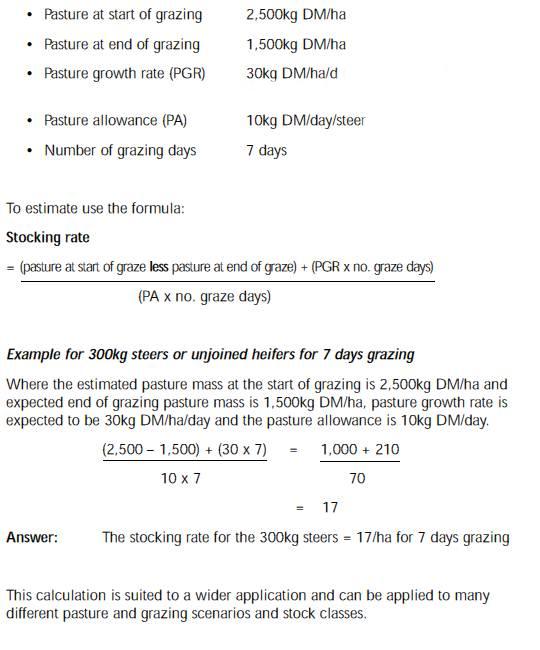
In this example the stocking rate/ha (for no. days grazing) is estimated by the calculation:
(pasture mass at start of graze less pasture mass at end of graze) + (pasture growth rate x no. days intending to graze paddock) ÷ pasture allowance x no. days intending to graze paddock.
Information for calculation:
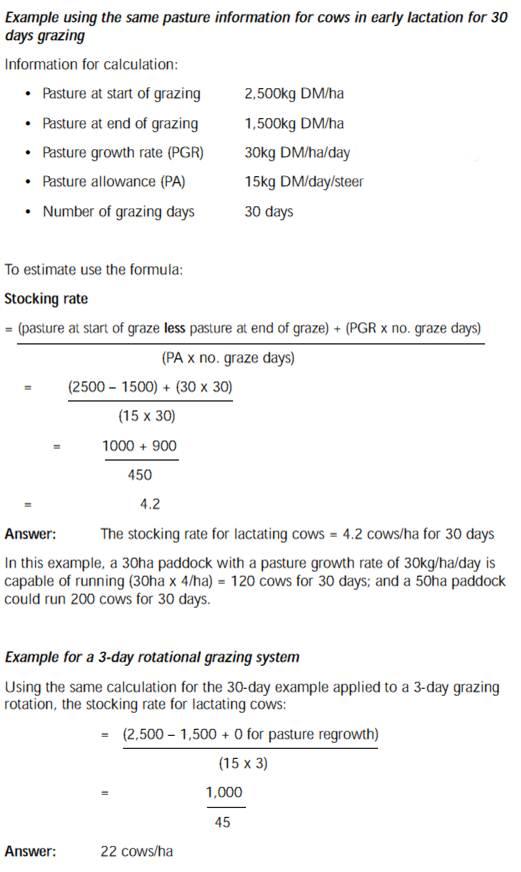
A 10ha paddock is capable of running 220 cows (10ha x 22/ha) for the 3-day grazing period in the rotation.
A 30ha paddock with nil pasture regrowth is capable of running 660 cows (30ha x 22/ha) for 3 days; and a 50ha paddock could run 1,100 cows for 3 days grazing.