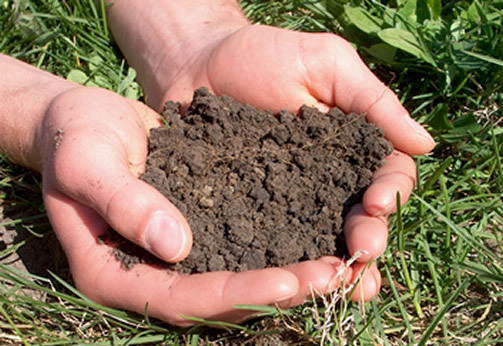
 Whilst the dominant pasture types can indicate the typical productive potential of a site, the level of phosphate (P) in the soil is the key determinant of pasture productivity across most of the Hunter region. It also provides insight on the potential to increase productivity.
Identifying the soil phosphate (P) level is consequently a useful measure for identifying cattle carrying capacity. Checking sulfur levels at the same time can help identify whether a sulfur fortified fertiliser or single superphosphate fertiliser would be the most appropriate.
Soil phosphate originates from the parent rocks and is depleted or leached over time. Hence, most soils within the Hunter region are typically phosphate deficient. However, basalt derived soils in the Upper Hunter may be constrained by sulfur rather than phosphate.
The traditional and most efficient way to increase the productivity of grazing lands (and hence carrying capacity, production options and returns) is by adding superphosphate to increase soil phosphate levels. In the Hunter region, constraints posed by other major nutrients such as nitrogen can be reduced by including nitrogen-fixing legumes in the pasture mix, or by selecting the type of fertiliser.
Since 1990 most of the region has only been fertilised spasmodically, partly due to drought (1990-1991, 1994 and 2001-05) and low cattle prices. Short-term cash flows and taxation provisions, rather than a planned approach to maintaining productivity and economic returns also influenced phosphate applications for many landholders. Irregular phosphate applications result in sub-optimal productivity and poor overall returns on investment. The absence of effective pasture and grazing management, has also contributed to a progressive decline of pastures across much of the region.
With good pasture, grazing and livestock management the sustainable carrying capacity of beef properties in the Hunter region can usually be lifted above historically reported rates (eg from 3 or 4 DSE/ha to 8 DSE/ha). Denser pasture cover can also provide environmental benefits via reduced run off and erosion. Ensuring positive economic returns from pasture improvement, however, requires additional livestock management and marketing. The cost per hectare is also highly dependant on the scale of works undertaken. Significant pasture improvement is unlikely to be economically justified for many smaller holdings (<60ha).
The first step for identifying carrying capacity and estimating the area required for a sustainable cattle operation is to identify the relative level of soil phosphorus using soil test results and Table 1. In the absence of soil tests, classify phosphorus levels for light to medium textured soils as low.
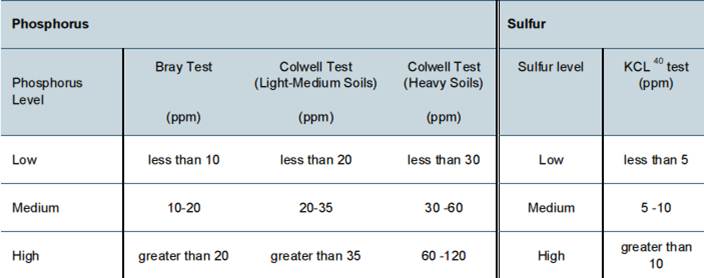
Table 1 Interpreting soil fertility tests
General notes
• ppm is equivalent to mg/kg
• Low = very responsive to subsequent fertiliser application.
• Medium = moderately responsive to subsequent fertiliser application.
• High = marginally responsive to subsequent fertiliser application.
Knowledge of soil texture improves the interpretation of Colwell test response for P.
Notes on using test results to determine fertiliser requirements
• Soil testing laboratories can use different methods to analyse nutrient concentration (eg the Bray or Colwell test for Phosphorous). These methods can give slightly different results so it is important to identify the method used and to compare like with like.
• In NSW the standard test for soil Sulphur levels is the KCL40 test.
• Review soil test results in conjunction with animal enterprise intensity, the responsiveness of dominant pasture species and history of fertiliser applications when deciding fertiliser needs.
• Higher sulfur values are required for optimum production on light textured soils with low
organic matter content, particularly where leaching below the plant root zone is likely.
• Lower sulfur values are required for optimum production where deep-rooted perennials are growing and sulfur reserves exist below sampling depth.
• Irrigation water may increase sulfur levels, depending on the source.
• Because the KCL40 test does not determine elemental sulfur, it may over-predict the pasture response to sulfur if a high analysis product containing elemental sulfur has been used in the previous few years.
• The KCL40 test may also over predict a response to sulfur where pastures do not have an adequate legume component, are in drought or hampered by other nutrient deficiencies.
• Areas close to the coast or with nearby gypsum deposits may not respond as well to sulphur applications as the KCL40 test suggests.