Electric fence
Electric fences are an important tool for protecting sheep from predators such as coyotes, wolves, bears and domestic dogs. Studies have shown a 90 per cent reduction in sheep predation losses, when using electrified pasture fences. Electric fences are easily adapted to most livestock operations, are relatively easy to maintain and are economical to build. However, they require routine inspection and maintenance to ensure proper operation and protection capability. Also, snow and frozen ground in winter can greatly reduce the effectiveness of electric fences for predation control.
Electric fence designs
An effective electric fence for predator control can be constructed with either a multiple of single strand wires or a combination of wire mesh and single strand wires. A mesh-wire fence is more expensive to build than a fence made from single strand wire. However, an electrified mesh-wire fence presents a greater physical barrier to predators and requires less maintenance and fewer electrified wires than a fence using only single-strand wires.
Nine-wire fence
An electric fence made with 9 single strands of 12.5 gauge, high-tensile smooth wire and spaced as shown in Figure 1 provides an effective barrier to predators. The overall height of this fence design is 1.37 m. Wires are alternating, charged (+) and grounded (-), beginning with the bottom wire as a charged wire. The top wire should be charged when cattle or horses are either enclosed or share a fence to prevent them from damaging the upper portions of the fence. Figure 1. Nine-wire fence, viewed from inside the fence
Mesh-wire fence
Galvanized, high-tensile mesh wire should be used for predator control. This wire is more versatile and longer lasting and can be stretched tighter than standard farm mesh wire. The high-tensile mesh wire is reasonably priced and available from fencing suppliers in various heights. Galvanized mesh at least 1.2 m high with predator-proof spacing’s (smaller spacing’s on the bottom section of the mesh than at the top section) is recommended.
To build a new fence, place the mesh wire on the inside of the pasture posts. Pull the mesh taut, position the bottom of the mesh tight to the ground and staple the mesh securely to the posts. The fence wire must be tight to the ground to reduce the chances of a coyote digging under.
If a fence is not taut, the wires will sag and make a space easier for coyotes to penetrate. Single strand, 12.5 gauge high-tensile wires can be placed 15 cm or less apart above the mesh to increase the height of the fence to 137 cm or more.
An existing sheep fence made from mesh and barbed wire can be electrified. The fence must be in good condition, and the wire must be free of rust, undamaged and taut. The spacing in the mesh wire must be no larger than 15 cm by 15 cm, as coyotes, foxes and small domestic dogs may crawl through larger spaces. Fence posts must be sturdy and, to prevent predators from jumping over, tall enough to support a fence of at least 137 cm. If the posts are not tall enough to support the top wires, add extensions to increase fence height to at least 137 cm. To stop predators from digging under the fence, place a charged 12.5 gauge high-tensile wire 10 - 15 cm above ground level and 10 - 20 cm out from the mesh. If the fence posts are 10 cm or more in diameter and the mesh is attached to the inside of the posts, insulators and the charged wire can be attached directly to the outside of the posts. If the fence posts are less than 10 cm in diameter or the mesh is on the outside of the posts, offset brackets will be needed. Brackets can be built or purchased.
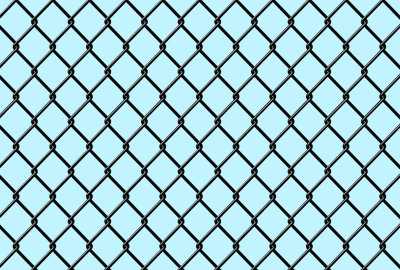
Mesh wire fence
Mesh wire fence
How an electric fence works
Under normal operating conditions, an electric fence functions as an incomplete (open) circuit with repeating pulses of electricity generated by the energizer sent through the charged wires of the fence. When an animal touches a charged wire, it grounds the fence, creating a closed circuit. An electrical pulse travels through the animal and back to the energizer, delivering a shock to the animal. Other objects and materials including vegetation, sticks, fallen trees and non-insulated posts in contact with charged wires can also create a partial or total closed circuit. This partial or closed circuit can result in a reduced electrical charge (voltage) and an inadequate shock to repel predators that contact charged wires of the fence. Fences should be checked and maintained regularly to address this potential problem.
Fence line selection and preparation
Careful planning and proper fence line preparation are important first steps in the construction of an effective fence for predator control. Select the most level ground to run the fence. Do not cross creeks, sloughs, ravines or other unstable and difficult areas if at all possible. Keep the fence line as straight as possible. Clear trees, shrubs and debris from the fence line. Make the fence line wide enough both to prevent trees from falling on the fence and to permit a vehicle to be driven beside it for fence construction, inspection and maintenance.
Coyotes usually penetrate mesh or nine-wire fences by digging or crawling under the bottom wire. So it is extremely important to level the fence line properly. The fence line must be even enough to run a charged wire within 7.5 to 10 cm of the ground. The distance from the bottom wire to ground level may vary a good deal if fence lines are not levelled. An uneven fence line may permit coyotes to get under the wire. If the charged wire touches the soil, the voltage may be inadequate to keep coyotes out.
After completion of the fence, the fence line should be re-seeded to grass to prevent erosion and weed growth. Select a low-growing grass species that will minimize the risk of vegetation grounding the bottom charged wire. Common broad-leaved weeds that cause grounding problems can be controlled with herbicides.
For more information on electric fences see Fencing with Electricity, an Alberta Agriculture, Food and Rural Development publication with detailed information and diagrams explaining how to choose and build the type of electric fence best suited to your needs.
Author: Alberta Agriculture Fact Sheet (Modified by OSMA, 2010)