 Length of the Breeding Season
The breeding season should be managed to tailor the length of lambing season to your management system. For example, if you are lambing once per year, you may wish to limit the breeding season (the time the ewes are exposed to the ram(s)) to six or eight weeks. This will allow ewes to have two complete estrous cycles, and therefore two opportunities to conceive. Maintaining a controlled breeding season will help shorten the length of time spent lambing, to decrease the labour involved and will increase to uniformity of the lamb crop for easier management. For large flocks or if you have limited lambing facilities, you may wish to extend or stagger the breeding season. You may also wish to stagger the breeding period to take advantage of various lamb markets. With accelerated lambing systems, ewes are generally exposed to rams for a single estrous cycle. The ewes that have not conceived are put into the next breeding group.
Breeding
As mentioned earlier, ewes will be receptive to the ram for a period of ~10 hours during estrus. In has been found that optimum conception rates occur when the ewe is bred a number of times during this period. If there are a number of ewes in heat at the same time, this will require the ram to be able to breed multiple times within a short period. Rams are capable of legendary feats regarding the number of ewes bred within a short time period (up to 50 matings on the first day with the ewes have been reported). As a result, courtship behaviour, ejaculation, and the refractory period (time between ejaculations) are relatively brief in sheep.
Marking harnesses can be used to help determine if rams are being effective during the breeding season. Rams may be fitted with a special harness, which holds a marking device under the animal’s brisket. Alternatively, crayon or paint can be applied directly to the brisket of the ram. The marker should be reapplied often to prevent it from fading. As the ram is mounting the ewe, she will be marked by the crayon or paint. Using different colours for each ram will help determine parentage if you are using more than one ram in a group of ewes. If the breeding season is longer than one estrous cycle, changing the colour of the marker every 17 days will help give an estimate of the number of ewes breed on each cycle. If you use this technique be sure to use a light colour during the first cycle.
Using markers is not a guarantee that the ram is breeding. It is advisable to spend some time watching the flock during breeding season, as the ram may be mounting but not actually breeding. It is especially important to watch young, unproven rams for breeding behaviour and to ensure they are not becoming fatigued. Even with older proven rams, recent injuries or other problems may interfere with breeding. Spending some time during the breeding season to ensure that the rams are working will save disappointment at lambing time.
 Ewe: Ram Ratio
The number of ewes that one ram will be able to breed will vary with the production system. For example, if you are synchronizing a large group of ewes, they will be in heat at the same time and more rams will be needed. As fertility and libido are affected by the season, out of season breeding requires a lower ewe: ram ratio. Generally speaking, ram lambs will be able to breed ~25 ewes in their first year and mature rams can typically breed 40-50 ewes within a two month breeding season in autumn.
Gestation Chart:
The following chart lists breeding dates and the corresponding expected lambing date based on a 147 day gestation (gestation can range from ~143-153 days). Using this chart you can roughly gauge when ewes should be bred to produce lambs for particular markets. For instance if you wish to market lamb for Christmas at three months of age, they should be born near September 25th . This places the breeding date around the end of April.
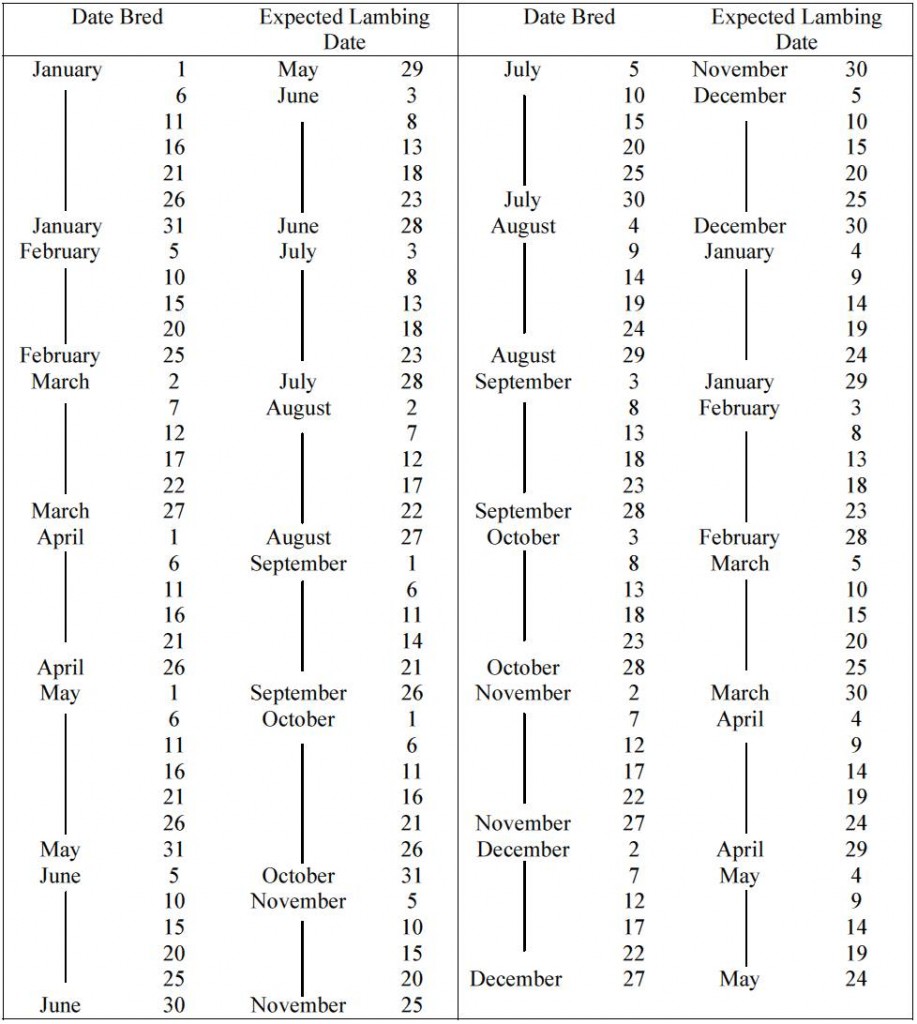
Sheep gestation chart


