 Frequently Asked Questions
These are typically some of the first questions we are asked by people who are interested in beginning a sheep flock.
1. I am interested in the sheep industry; what do I need to know?
This is a big question, the answer to which encompasses learning about marketing opportunities, expected economic returns, and various aspects of sheep husbandry. The vast majority of the sheep operations in Ontario raise lambs for meat production or for replacement breeding stock. Although all sheep produce wool, prices have been low in the recent past, and wool production is not generally a primary source of revenue. There are, however, opportunities for value added wool products. There are a growing number of dairy sheep operations in Ontario, which produce milk primarily for cheese and other dairy products.
Learning as much as you can about different farm types, breeding systems, and reproductive management systems will help give you an overall idea of the structure of the sheep industry in Ontario. In doing this you will be able to determine the type of operation that will be best suited to your goals, labour expectations, and resources.
The type of farm you choose will depend on your current resources, and ultimately, your plans for the future. The farm type dictates how intensively the flock will be managed. In Ontario, most sheep farms are ‘farm flocks’, using a combination of indoor and pasture housing. Total confinement and pasture-based operations are also relatively common and there are increasing opportunities for feedlot and dairy operations.
The breeding system you choose will depend on whether replacement breeding stock or commercial meat lamb production will be your primary goal. Although replacement stock breeders will still market some lambs for meat, a portion of the lamb crop of purebred or first generation crossbred animals will be sold as breeding stock to commercial breeders. Therefore, with commercial lamb production the strengths of various breeds are used to maximize the lamb crop while optimizing lamb quality. Some producers use breeding systems designed to supply their own breeding stock from within their own flock for commercial production.
It is particularly important for commercial operations to have lambs ready to sell when demand is high. We are fortunate to have many different market opportunities throughout the year for our sheep and their products in this province. With a relatively short gestation period, ewes can be bred more than once per year, therefore, producers have several types of reproductive management systems to choose from.
The most common ones are: once a year winter lambing (usually targeting the Easter market for new crop lambs); once a year spring lambing (main goal is to maximize use of pasture for lower feed costs and marketing lambs in September through December); accelerated lambing (either three times in two years or five lambings in 3 years). The focus of accelerated lambing systems is to market lambs on a year round basis, hopefully taking advantage of the lower cost of pasture based systems and hitting the high priced markets during the year.
 2. When is the best time of the year to sell lambs? Are prices always high at Easter?
Lamb sales in Ontario are based on a free market, and prices can fluctuate widely from season to season and week-to-week based on supply and demand. It is important to stay on top of what is happening with the market and spread sales to minimize price fluctuations. Learn about the yearly and seasonal trends and use this information to your advantage when marketing.
When considering what time of the year you want to market your lambs, make sure that you have a good understanding of the advantages of each production system, and which one will best suit your particular situation. For example, with winter lambing, feeding costs are relatively higher and you must market extra lambs to have returns similar to other production systems. Excellent prices are often seen for top quality new crop lambs at Easter, but particularly when supply is heavy, prices can plummet from one week to the next. As well, although price per pound is generally higher for light lambs, the average price per head is typically higher for lambs over 80 lbs live weight. Therefore, the cost involved in raising lambs to a heavier weight must be balanced against potentially greater returns.
3. How much land and what type of barn do I need to raise sheep?
How much land you will need per ewe will depend on many factors, such as whether you wish to grow or buy winter feed, the productivity of the land and how intensively you manage the flock. In most areas of Ontario, an open front pole barn is adequate for ewes lambing in the spring. With winter lambing it is important to have at least part of the barn divided off and insulated (or warmed) during the lambing period. Hypothermia is the main cause of death in newborn lambs in Ontario. Lambing facilities should ensure that the temperature remains above freezing. For all types of housing, there must be adequate floor and feeder space for the number of animals.
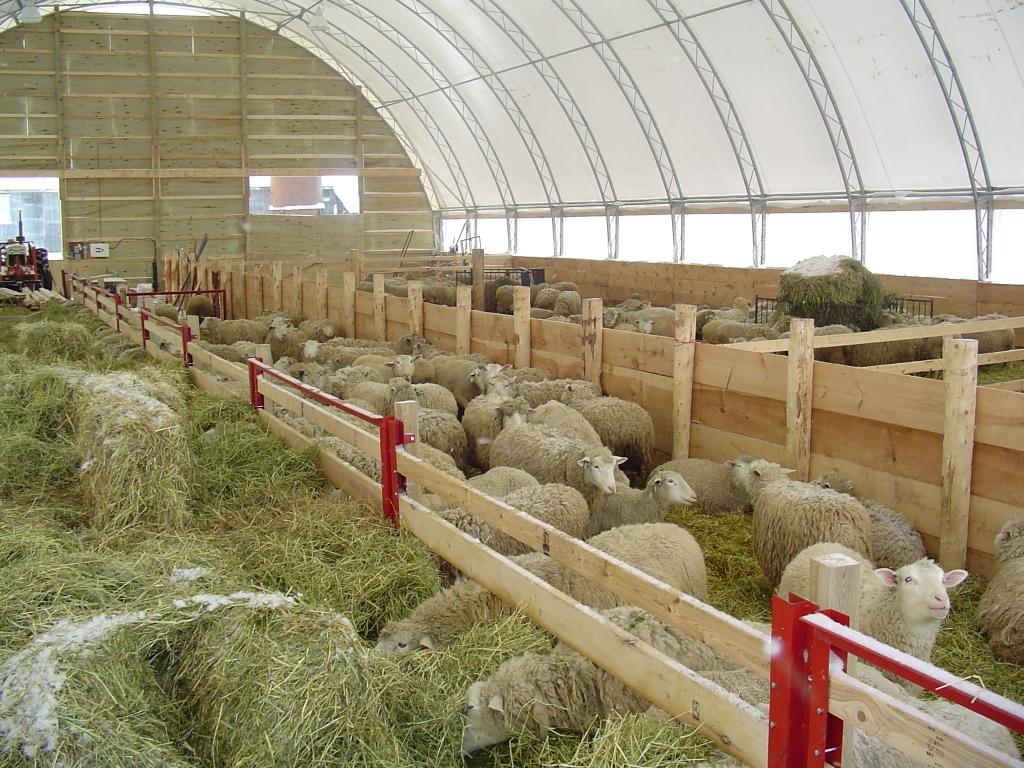
Sheep barn
4. How many sheep do I need to make a living?
Sheep barn
The answer to this depends on the standard of living you want to maintain. Net return per lamb and the number of lambs marketed is more critical than the number of ewes kept. It will also depend on whether you expect the sheep to carry the mortgage for the farm. As general guidelines, you will need to keep a minimum of 300 ewes under an accelerated lambing program, and 600 to 1000 ewes under once a year lambing programs to expect to make a full time living from sheep farming. The majority of sheep producers also have an off-farm income. It is advisable to start with less than these numbers if you have no previous experience raising sheep. Fifty to 100 ewes will provide a good impression as to what is involved, justify any renovations that need to be done to facilities (particularly handling facilities), and provide a good number of lambs to market in your first year. Once you have an idea of the requirements, you will be better able to gauge how large your flock should grow.
5. How much time will I have to invest in the flock?
This again will depend largely on the type of management system that you choose. Generally speaking, the more intensive the system the greater the daily input of time. However, with any system the more time you spend monitoring the health and productivity of your flock, the greater your chances of success. This should involve maintaining a high level of flock health and maintaining records relating to flock production (animal health, lambing percentages, lamb growth rates, etc).
6. What breed of sheep should I get? How should I select breeding stock?
With over 40 breeds in Ontario this may seem to be a daunting decision. It is placed at the end of our list of questions as the decisions that you make regarding marketing and production systems should be considered before choosing the breed. You will also have to decide whether to raise pure-bred or commercial sheep. Once the production system and breeding system are chosen, then selecting a breed will be much easier. Identify the breeds that should do well under your chosen production system and that will help produce lambs for the type of market you wish to supply. Identify as many of the traits that may be critical for success with the system you have chosen. For example, if you want ewes to lamb in the winter or in an accelerated program, choose a breed known for its ability to breed out of season.
Across and within breeds, individual sheep will differ in economically important traits, e.g. milking ability in ewes, lambing percentage, adaptability to specific management conditions, rapid growth in lambs, etc.
 Types of Sheep Farms
The type of sheep farm you choose to operate will largely be determined by the resources available to you (land base, housing, etc.) and by the type of reproductive management system you are interested in developing. The basic types of sheep farming in Ontario are briefly explained below.
1.Farm Flock:
This is the most common type of sheep farm in Ontario. Farm flocks combine pasture grazing for part of the year and indoor or corral housing for the winter. For example, ewes and lambs may be left on pasture until weaning when lambs are moved to feedlot pens for feeding until they are ready for market. Housing requirements for this type of system will vary with the reproductive management system. A wide variety of barns are used for winter housing of ewes including open sided sheds, pole barns, hip barns etc. Generally some type of insulated lambing facility will also be needed, depending when lambing will occur. For producers planning on building a new facility, there are plans available from OMAFRA detailing various types of sheep barns.
2. Pasture-Based:
This type of operation is more common in the Prairies than Ontario. This type of operation generally involves a large flock, requiring a large land base. The system involves spring lambing, pasturing throughout the summer, fall marketing of lambs either as finished lambs or feeders, late fall breeding of ewes, and wintering on pasture with appropriate shelter provided. The main advantages to this system are the low costs involved and given the right circumstances, can be very economical. The buildings, if any, are simple and the sheep graze all year, with supplemental feeding provided in the winter. Drawbacks to this system include the vulnerability of the sheep to predation by animals such as coyotes, wolves, and dogs. Weather in spring can be harmful to new lambs and losses can be high if shelter is minimal.
3. Total Confinement:
As the name suggests, both ewes and lambs are kept in pens year-round and require year-round feeding. Three-sided barns with pens extending to the outside are frequently used with this system. Advantages of intensive management systems are that they do not require a large land base, and fencing costs and predation losses are low. However, feed costs are generally much higher, animal health can be a problem if management is less than excellent, and more labour is generally required. This type of system is not overly common in Ontario and would be found most often with intensively managed accelerated lambing programs and feedlots. A rare variation of total confinement system is controlled environment housing, which is similar to large poultry or swine operations. Producers wishing to manipulate the ewe’s breeding cycle using light control may use this system.

4. Feedlot Lamb Production:
Feedlot operators purchase lambs that have not yet reached the weight at which they will be slaughtered and finish them on high-energy diets. With a relatively low average market weight, this type of operation is relatively uncommon in Ontario, as most sheep breeders hold their lambs until they are market weight. Lamb feedlots are more common in Western Canada, however, and the trend may eventually extend east. Depending on how large of an operation you are considering, feedlots can offer the flexibility of involvement in the sheep industry without having to commit the overhead and time necessary for maintaining a breeding flock.
5. Dairy Production:
Dairy sheep production is relatively new to Ontario, but is well established in other parts of the world. Currently there are a growing number of dairy producers in Ontario. Dairy sheep producers market both lambs and dairy products, with milk being processed into such products as cheese, yoghurt and ice cream.
Operating a dairy flock requires specialized equipment, facilities, and the requirement of attending to milking daily during the season. Depending on your marketing arrangements, the extra overhead and time required may be offset by greater income stability compared to strictly producing market lambs. Contact the Ontario Dairy Sheep Association for details.
Wool Production
With the exception of ‘hair’ sheep, all breeds produce wool and need to be shorn yearly. Wool prices in Canada have been low for a number of years. Generally, prices paid have not been sufficient to cover the cost of shearing. When world stocks of wool decrease, there may be an increase in price. As well, certain breeds of sheep produce wool that is valuable in specialty and niche markets. Depending of the resourcefulness of the shepherd, value added wool products can add substantially to the farm income. However, wool production is not often the primary reason for keeping sheep in Ontario.