 Guidelines for setting the breeding objective
Correct setting of the breeding objective for the market and production system is critical, as this defines the target for genetic improvement that maximises profit for the beef enterprise. If the breeding objective is inappropriate, the wrong amount of emphasis may be placed on traits (such as carcase weight or mature weight versus weaning rate) of animals selected for breeding.
The breeding objective lists the animal traits that impact on enterprise profitability, and give an estimate of the relative importance of each trait (refer to breeding objective). The economic value of changing each important animal trait is calculated from financial and production data, preferably as part of setting the direction, but other approaches can be taken.
Breeding objective
The breeding objective is the ‘ideal’ animal the producer aims to breed.
It is a genetic description that includes all the animal traits affecting profit (such as carcase weight and weaning rate) as well as how important each trait is to achieving a change in profit. The breeding objective will be specific to the market being supplied, to the production and management environment, as well as to the current level of herd performance.
Economic considerations need to include all the factors affecting returns and costs. Returns are affected by the weight and price per unit of beef product sold, and premiums and discounts applying to particular traits. Cost of supplying extra feed, time taken to manage calving heifers and the cost of labour are examples of the costs included.
Using these economic data, the value of one unit of change in each trait (such as 1kg of carcase weight) of the breeding objective is assessed. An example of the traits included in the objective and the economic values of traits is shown in Table 1. Economic values allow for the time taken until traits are expressed (for example, carcase weight of steer progeny occurs sooner than lifetime reproduction occurs in female progeny). The benefits passed on to later generations are also included. Negative values can occur (such as for cow weight) meaning that a 1kg increase will reduce profit (in this case because the extra costs of feeding the cow due to an increase in weight are greater than the extra value of the carcase when the cow is finally culled from the herd).
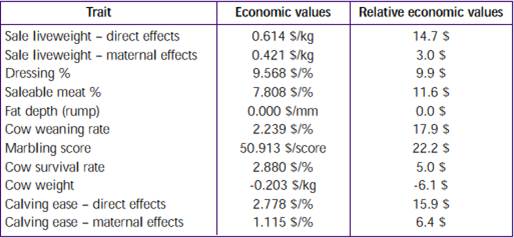
Table 1: Trait values for a Bos Taurus breed supplying the Japanese market
Economic values are shown in the second column of Table 1. These values are explained in an example as follows a bull, we take the dollar value of one unit of change in each trait in the objective (such as one kilogram of carcase weight) and multiply it by the estimated breeding value for the trait in that bull (eg: the estimated breeding value, or EBV, provided by BreedPlan). Adding up these values over all the traits for that bull gives the overall genetic value of that bull for the enterprise.
A similar approach can be used for comparing breeds or crosses by using breed averages instead of EBVs.
Relative economic values are shown in the third column of Table 1. These values give the importance of each trait for breeding for this market, taking into account how much scope there is for genetic improvement (in other words, the heritability). In this example for a Bos taurus breed supplying the Japanese market, marble score is most important, then weaning rate, calving ease and sale weight. Trait importance can change for different production systems and market endpoints. It can also differ among breeds addressing similar markets.
All this information can be combined into one figure, the ‘$ index’, to allow bulls to be ranked and compared on their combined genetic worth for the market and production system under consideration (refer to the BreedObjectTM box over page). This is a useful way of initially ranking bulls, after which you should consider the underlying component traits in any bulls of interest to the breeding program.
BreedObjectTM
BreedObjectTM is a software package that can calculate a $index value for animals specific to the breeding objective for your herd. Using this information you can choose bulls that are the best value for money to suit your herd.
To develop a $index, BreedObjectTM carries out the following processes:
1. Determines the measurements to be taken on the animals that are most closely related to the traits in the breeding objective. Note that they may not be exactly the same. For example, carcase weight will be a trait in the breeding objective, but only liveweight can be measured on the live animal – however these are highly related.
2. Uses the appropriate genetic information (heritabilities and genetic correlations) for the objective traits and the measurements on the animals that go into the index.
3. Calculates the weightings for index measures, so that the correlation between the breeding objective and the index is as close as possible. These are then applied to the measures used to describe each animal’s genetic merit.
As long as you understand and have confidence in what BreedObjectTM does, then the software can do the calculations and rank the bulls for you.
The software allows you to assess the sum worth of each bull as well as how the bull performs for any underlying trait, such as calving ease. In this way you can select from among the best bulls on $index those that you can afford, taking note of how they perform for the traits relevant to your herd.
What to measure and when
An annual check of the relative economic value of all traits used to produce the appropriate selection indexes for the current herd, production environment and target markets.
Software such as BreedObjectTM can be used to do this, but there are also ‘default’ values available for particular markets and breeds that can be used as a starting point.