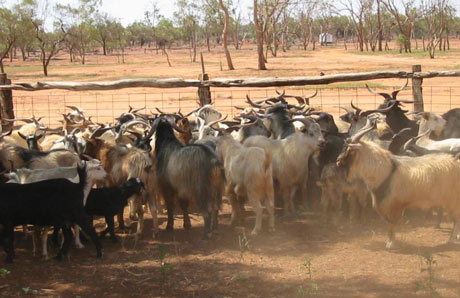
Herd of Feral Goats
Selecting good ferals is very difficult, as they vary so greatly. Quite a number are bought ‘sight unseen’; one simply takes them as they are brought in off the hills.
This is perfectly acceptable if the price is right, as they can be culled, once they have settled down on the farm, for such things as ‘fence bashing’, which would not be evident looking at them in the yards.
Where ferals are being purchased on a farm or at auction, attention can be given to general conformation, feed and udders, age, colour and of course the condition of the fleece.
But conformation does not mean feeling for a layer of fat along the back; in goats any fat reserves are inside around the organs. Size is really the key factor.
The fleece of a good feral, according to the experts, should be ‘soft, not shaggy’, but obviously the important thing is to assess the amount of down in the fleece, remembering that some authorities estimate that at least 30 percent of feral goats produce no cashmere at all.
Cashmere starts growing about the longest day and stops growing around the shortest day, but it is most visible in late autumn/winter. Also bear in mind that pregnancy and lactation can reduce fleece weight by up to 50 percent. Winter is therefore the best time to assess ferals on the basis of fleece.
Eye appraisal of fleece on the live animal is risky; in fact a survey carried out showed here that a majority of those surveyed underestimated diameter and overestimated yield. A more accurate method has been developed by Australian researchers who found that the ratio of cashmere down-length to guard hair-length was indicative of down-weight.
Colour is also significant, but perhaps not as important as the premium paid for white and black ferals would suggest. The white coat-colour gene of the Angora is generally dominant in respect of solid coat colours, so that other colours can usually be eliminated by breeding, but it should be noted that some coat pattern genes will over-rule even white dominance.
.
One colour which is not readily eliminated is ginger, and does of this colour usually go for lower prices. However, a ginger doe will often produce kids without any ginger colouring in them as a result of being mated to a homozygous white buck, so such does need not be entirely disregarded.
One needs to distinguish between ginger guard hairs, which is what are visible, and ginger down or ginger eyebrows, which are far better indicators of the ginger genes the doe is carrying.
Some feral does will weigh as little as 20kg and these are unlikely to improve sufficiently to produce good kids. A good doe should weigh about 30kg and a minimum liveweight of 25kg is desirable. It is unfortunately necessary to sound another warning note about ferals offered for sale.They are often mustered off the hills into a woolshed and held there until the buyer comes to collect them, since the seller rightly fears that, if let out into a paddock, they will escape. But in some cases they will be held in the shed for several days before being loaded into a trailer or truck for transport to the buyer’s farm. Under these circumstances, if they have not been cared for with some expertise, deaths during transport are likely to be high.
Timing of purchase of feral does is important. They need to be on the farm for several months, to undergo training and to then settle down, before mating begins. This means latewinter early-spring purchase, but bear in mind that in winter a doe is likely to be in kid. Those who find it necessary to buy earlier in the year, might do well to remember that mating in the wild mainly occurs between December and May. Therefore, when purchasing does from the wild during this period, one should anticipate a proportion being already in kid to feral bucks. Those grading-up to Angora from feral does sometimes get their vet to abort the does, in order to have the breeding-up programme in place a year earlier than would otherwise be possible. Unfortunately, however, this is likely to reduce kidding percentages among these does to as low as 50 percent. Two-tooth does, if they are available, may be worth the premium usually demanded, as they still have the capacity to take advantage of the good feed conditions on a farm and to grow on.
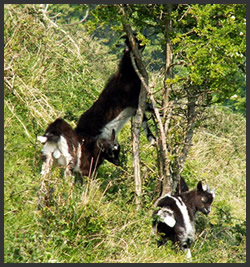
Two Feral Goats Climbing
It is safe to count on eight years as the breeding life of a doe if she is well cared for, and this has to be taken into account when deciding whether the young doe is worth the extra. Where an effort is being made to breed-up for cashmere or cash-gora production, it may be preferable to concentrate on using the female progeny and getting rid of the initial stock.
It should also be borne in mind that cashmere MFD can be expected to coarsen by 1-2 microns from yearling to two-tooth fleece, and thereafter by 1-2 microns during life. Direct comparison Between goats of different ages should take this into account.
Does are often sold as being ‘in kid’ or ‘run with the buck’ (RWB). the latter term may not mean much at all: unscrupulous sellers will simply put an between goats of different ages shouldtake this into account. Does are often sold as being ‘in kid’, or `run with the buck’ (RWB). The latter term may not mean much at all; unscrupulous sellers will simply put an Angora buck in with a mob of does from the bush for the few days during which they wait to go to the saleyards. This does not happen often, but buyers should be aware, and try to make enquiries as to just what is meant by RWB. Pregnancy diagnosis can be important to those wanting to fix values for highquality goats, either to buy or to sell.
There are six different methods of diagnosing pregnancy, but they are generally either inaccurate, or expensive, or are only effective at a late stage in pregnancy when results are of limited use. False oestrus and pseudo-pregnancy can upset physical observation and manipulation can involve some dangers. Kits for biological analysis of milk or blood are not thought to be sufficiently reliable as yet. Laprascopy, laparotomy, radiography and electrocardiography are accurate, but require expensive equipment and skilled techniques. Ultrasound equipment is also expensive and requires skilled application. The doppler principle equipment has difficulty defining multiple pregnancies but the Real Time D Mode scanner can give an accurate diagnosis of singles and multiples from seven weeks. One rather pessimistic point about selection of stock that needs to be made, is that under the present breed-up programme, and the high demand for goats, a proportion of those being sold will be someone else’s culls.
When a farmer decides to get rid of rogues (goats that consistently push through or jump fences), dry dries, goats with poor cashmere content in the fleece, etc., it is human nature for him to get what he can for them. It is a case of ‘caveat emptor’, and farmers have always believed that if a buyer cannot tell a good animal from a cull it is his own lookout. So … look out. It also makes sense for a newcomer to prepare for the business of buying stock. By going around local goat farms, attending field days and suchlike, he/she can begin to get some idea of the difference between good and poor conformation, what under-shot jaw looks like, how the fleece of a good goat should look, etc. The next step might well be to try to induce a goat farmer with experience to come along to the auction and advise on the quality of the stock being offered.
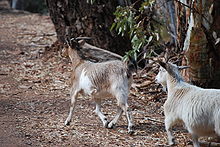
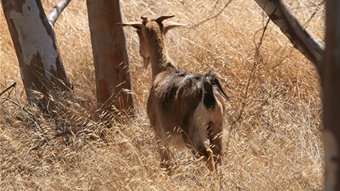
Australia feral Goats
It should also be obvious that stock cannot be judged from the top tier of an auction ring. It is sensible to arrive early and look through the goats, taking a note of ear tags or pen numbers of goats that look to be a reasonable buy. An experienced goat farmer, or a farm consultant specialising in goats, can save a prospective buyer a great deal of money, not only in picking out the culls from the good stock, but also in advising on how to bid.
Prospective buyers may wonder about the significance of horns on goats. Polled goats carry a dominant gene, so progeny will probably be polled as well.
Overseas studies have indicated that polled does are 6-7 percent more prolific than horned does, and there is some evidence that kids from polled does are 5-6 percent heavier than those born to does with horns.
There is also the question of tassles, or wattles, two skin appendages under the neck. These are also the result of a dominant gene, and there is some suggestion that tassled does are more prolific and possibly lactate longer. They are common in milking breeds but rarely found in ferals or Angoras. Once the goats have been purchased and transported to the farm, one of the first tasks will be to brand them. Under present law, goats are ‘noxious’ animals unless they are of the milking or Angora breeds, or are branded under the Animals Act and farmed within fences. Branding can be by earmark (an eartag is not sufficient) or by skin or horn brand. The brand must be registered and must be used in sheep and cattle the earmark or brand must be registered but does not have to be applied.
Temporary identification — Paint or dye may be effective, but there is too great a risk of it downgrading fleeces for it to be used with fibre-producing goats. Neck or horn tags of metal, wood or plastic are preferable, as are eartags on a string. Hospital identification bracelets, or rabbit eartags, are useful for identification of very young kids up to about one month of age.
Permanent identification — Eartags pull out of the soft ears of goats; stud tags near the head on the front of the ear are safer, but can only be read when the goat has been caught. Tattooing is usually adopted for pedigree goats. This can be placed in the ear, but there is a strong possibility of one or two of the letters or numbers becoming illegible. A tattoo on the tail is probably safer. Horn branding is feasible, and ear-marking is fairly permanent.
But branding by fire, caustic or freeze-branding is not possible with fibreproducing goats, and the latter method is too expensive for low-value goats. One point that needs, regretably, to be made, is that high-quality goats may be a target for poachers. The deer farming industry suffered from these thieves for many years and cases of goats being stolen have already been reported. Few would be as ‘fortunate’ as the South Island goat farmer who had an Angora buck returned two years after it was stolen, with a new ear tag indicating the date it was taken and the date returned. The conscience of thieves is not comparable to keeping valuable stock within sight of the home and away from boundary fences accessible from roads or bush country.
..
..