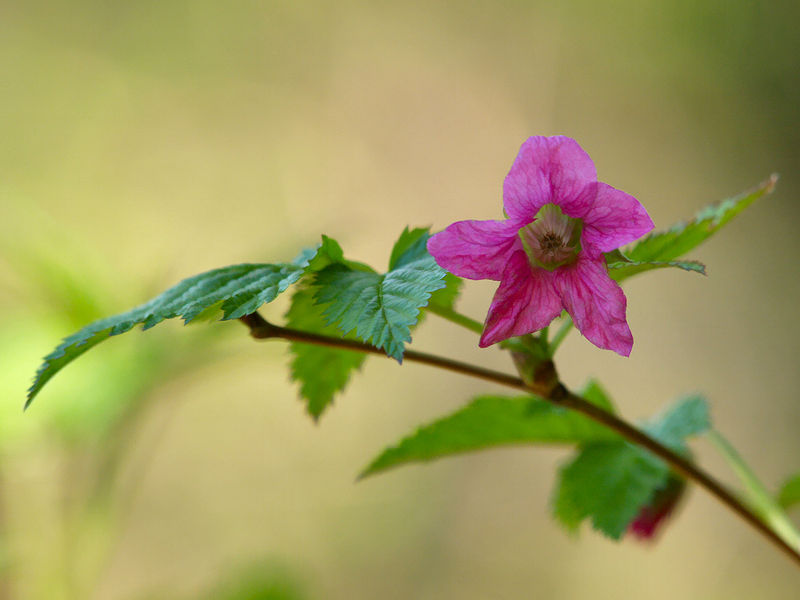
Salmonberry Blossom Photo by David McMaster
Botanical Name: Rubus spectabilis
Contributed By: USDA, NRCS, National Plant Data Center & Oregon Plant Materials Center
Uses
Ethnobotanical: Salmonberry fruits are edible, but are considered too soft to dry. Both the large, raspberry-like fruit and the young shoots were widely eaten by coastal peoples of British Columbia and western Washington. Fruits were an important food source for Native Americans and are still collected today. The berries are among the first to ripen, and are a beautiful salmon color that stand out in the generally rainy weather of spring. Large quantities of fresh berries were picked and were often served at feasts, usually with oil or ooligan grease, said to prevent constipation. Today salmonberries are frozen, canned, or made into jams and jellies.
The young growing sprouts are harvested from April to early June. They are snapped off with the fingers before they become woody, then peeled, and eaten raw or, more commonly cooked by steaming or boiling. Sprouts are also tied in bundles and pitcooked. They were usually eaten with seal oil or ooligan grease, and, more recently, with sugar, often as an accompaniment to dried salmon or meat. Some Nuu-chah-nulth people boiled the leaves with fish as a flavoring. The Kaigani Haida used the leaves to line baskets, wipe fish, and cover food in steaming pits.
The Makah dry and peel a branch of salmonberry, remove the pith, and use it for a pipe stem. The Quileute plug the hair seal float used in whaling with the hollow stem of elderberry wood, then insert a piece of salmonberry wood as a stopper. This salmonberry plug can be removed for further inflation of the float.
Salmonberry has an astringent quality in the bark and leaves. The Quileute chew the leaves and spit them on burns, and in winter when the leaves are not obtainable they use the bark instead. The Makah pound the bark and lay it on an aching tooth or a festering wound to kill the pain. The Quinault boil the bark in seawater, and the brew is drank to lessen labor pains and to clean infected wounds, especially burns.
Wildlife: Salmonberry fruits, ripe from June to August, rank at the very top of foods for wildlife. The early blooming flowers, blossoming from March to June, are an important nectar source for bees, butterflies, various other insects, and hummingbirds. The berries are relished by songbirds, bears, and small mammals a much as they are enjoyed by humans. Leaves, twigs, and stems are grazed by browsers, such as deer, elk, and rabbits. The dense thickets provide excellent escape habitats for birds and small mammals, and nesting sites for songbirds.
Restoration: Salmonberry is a useful shrub in created wetlands because it transplants easily, with good soilbinding qualities once it is established, and is well adapted to eroded or disturbed sites.
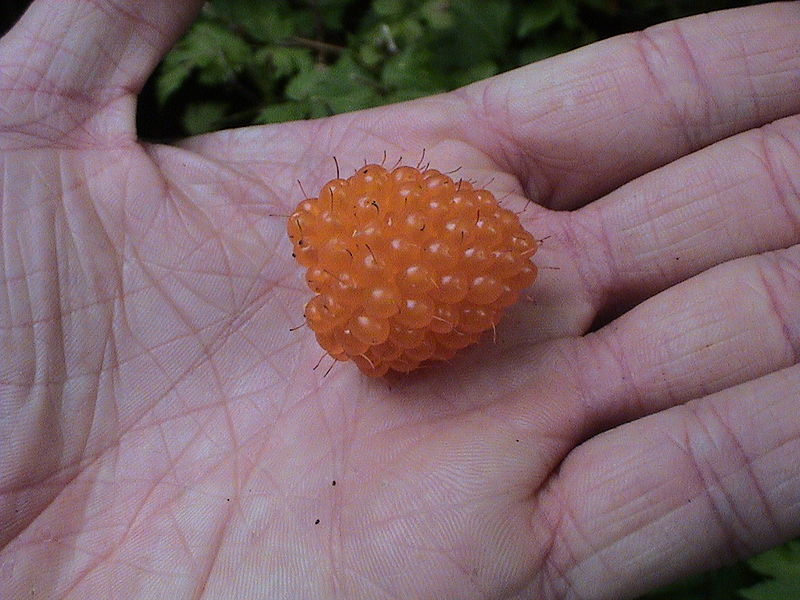
Salmonberry Photo by John Delano (Kalmia) of Hammond, Indiana
Description
General: Rose Family (Rosaceae). Salmonberry is a deciduous rhizomatous shrub, usually 1-4 m tall, with erect or arching stems. The stems are often densely prickly on the upper portions of new growth. The twigs in winter tend to have a distinctive golden brown to rust-red color. The flowers are large (about 1.5 inches across) and borne singly. Salmonberry blooms in early spring with beautiful deep pink rose-like flowers. The leaves are pinnately compound. The fruits are raspberry-like, round, and yellow to orange to deep red.
Distribution
SaSalmonberry grows in moist places and wetlands, and is especially abundant along streamsides and riparian areas at elevations below 1400 m. It can form dense thickets or grow individually. The range is from Alaska south to northwestern California, from the coast to the Cascades.
Establishment
Salmonberry grows well in full or partial shade. Cultivars are available in the horticultural trade. These shrubs are good for stabilizing or restoring degraded sites, and for slope stabilization and erosion control. Salmonberry shrubs may become invasive one they are established. Live Plant Collections: Salmonberry is easily grown from layering, basal sprouting, rhizomes, root cuttings, and hardwood cuttings. Small offshoots growing from the parent plant under four feet tall are easily transplanted. Branches that touch the ground tend to root, and they can be separated from the parent plant. Pull the rooted tips of larger plants and plant into one-gallon pots.
Hardwood cuttings should be 1-2.5 cm in diameter and 45 cm or more in length with at least three nodes. Rooting invariably occurs at the base of a cutting and at nodes with leaf buds. Store hardwood cuttings over winter in damp sawdust of peat moss; this promotes callusing and prevents desiccation. As with hardwood cuttings of other species, vigorous rooting can be enhanced in Rubus species by using a liquid rooting hormone and burying the cuttings in damp wood shavings.
Seed Collections: Salmonberry can be grown from fresh seed. Collect the fruits when ripe (they are orange or red). Generally salmonberry fruits ripen from June through August, and can be collected by hand. Extract seeds by macerating in water and floating off the pulp and empty seeds. Seed should be planted in the fall. If seeds are to be stored, they should be dried. Seeds will keep for several years at 5°C. A warm stratification of 20-30°C is necessary for spring-sown seeds, although fall sowing provides best germination. Germination is improved if seeds are scarified with sulfuric acid for 20-60 minutes or with a 1% solution of sodium hyperchlorite for seven days prior to cold stratification. Seeds need 90 days of cold stratification at 36° - 41°F to break seed dormancy. Sow in ground in drills, cover lightly with soil, and mulch over winter. Seeds per kilogram: 315,255
Management
Traditional Resource Management: This includes the following:
1) Occasional burning to stimulate new growth;
2) pruning the branches after picking the berries to stimulate new growth and fruit production the next growing season;
3) ownership of salmonberry shrubs provides the basis for careful tending and sustainable yield of valued resources.
This plant grows very rapidly in moist, shady conditions. If summer drought occurs, the plants should be watered so roots are kept fairly moist. Cultivars, Improved and Selected Materials (and area of origin)
Prepared By
Michelle Stevens Formerly USDA, NRCS, National Plant Data Center Dale C. Darris USDA, NRCS, Plant Materials Center, Corvallis, Oregon Species Coordinator
M. Kat Anderson USDA, NRCS, National Plant Data Center c/o Environmental Horticulture Department, University of California, Davis, California
NOTE: See source site for references.



