 In most states written approval and tags must be obtained from the state regulatory agency (e.g., Department of Conservation and Natural Resources) before alligators can be harvested.
Some states also have a minimum length requirement (e.g., at least 4 feet, unless the animal dies from natural causes) at harvest.
All alligators must be tagged with tags from the state regulatory agency immediately after slaughter. Alligators can be skinned only at approved sites and by using specific skinning instructions issued by the state agency.
Skinning, scraping and curing must be done carefully to assure quality. Hides that are cut, scratched or stretched, particularly the belly scales, have reduced value. Buyers pay less or “downgrade” for damaged hides.
Many producers chill alligators before skinning. Chilling makes the skinning process easier. Hides are scraped carefully to remove all meat and fat and then washed to remove all blood, etc. Fine grain mixing salt, not rock salt, is used to preserve the hide.
is rubbed thoroughly into the skin, making sure to get salt into all creases and flaps so that curing can begin. Hides are then covered in 1/2 to 1 inch of salt. Hides are tightly rolled and allowed to drain and dry in a well ventilated, cool place.
Hides are checked and resalted as necessary after three to five days.
Producers processing alligator meat must comply with all sanitation requirements of federal, state and local authorities. County or parish health departments can supply guidelines and assistance in complying with sanitation standards.
Specific state laws regulate the size of meat cartons (e.g., not larger than 5 pounds), labelling of the cartons with the names of the seller and buyer, date of sale, and tag number that corresponds to the hide. Average deboned dressout percentages for alligators in the 4- to 6-foot range are given in Table 3.
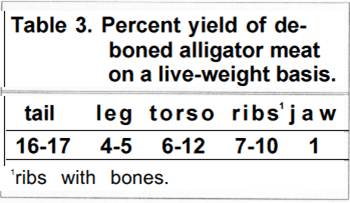
It is interesting to note that while hide prices have fallen, meat prices have remained constant, and the supply of alligator meat is well below market demand.
Stress:
Stress and/or poor water management may lead to brown spot disease. Although sores will heal, the spots are detectable and reduce the value of the skin. Alligators are wild creatures which have been thrust into captivity.
In the wild, alligators are relatively shy and reclusive creatures that do not normally congregate together except during the breeding season. Cultural conditions imposed upon them are unnatural and stressful.
 Alligators crowded into pens appear to be very sensitive to light and sound. Many producers like to keep alligators in the dark, or with very reduced light conditions. They try to locate and insulate facilities to minimize external noise.
Some producers, however, put lights on timers to simulate natural conditions and place radios in the grow-out houses, believing that the animals will grow accustomed to human voices and not be as stressed by daily feeding and cleaning routines.
Some producers believe that alligators recognize individual humans and should be fed and cleaned by the same personnel each day to reduce stress. Signs of stress include piling-up, reduced feeding, stargazing and fighting.
Piling-up usually occurs in the corners of the pens and can lead to suffocation of animals on the bottom of the pile. Reduced feed consumption is a certain sign of problematic stress. Stargazing is, as the name suggests, a position the alligator assumes by rising up on its front feet, arching its back and neck, and pointing its snout into the air.
Stargazing has been related to a vitamin B deficiency and may also be a general sign of stress. Fighting among animals that have been penned together but not overcrowded is a definite sign of stress. Fighting can scar the hide, reducing its quality and value.
Each producer must keep good records on environmental conditions and feed consumption. When signs of stress appear, try to identify the cause and remedy it as soon as possible. Overcrowding, excessive disturbance and poor feeding practices are common causes of stress.
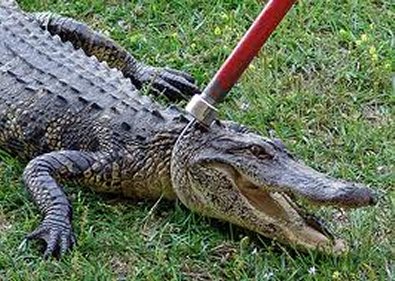
Alligators can be aggressive, particularly if under stress. Therefore, handling alligators must be done with care and with the proper equipment. Handlers should always wear heavy leather boots and gloves. Catch sticks or nooses should be used to get animals under control.
Once under control the alligator’s mouth should be bound, taped or banded shut to prevent biting, The tail can be particularly dangerous and should be held or secured tightly. Claws can also inflict damage. Think safety, take precautions and handle the alligators carefully.
No single publication can provide all the possible information and insights that a prospective producer will need before venturing into a risky alternative agriculture enterprise such as alligator farming.
This publication has attempted to give a prospective producer basic information on which he/she can make informed decisions. Before venturing further into alligator farming, visit a few alligator farms and talk to producers. First hand information is imperative to the decision making process.
Author:
Michael P. Masser


