Red Clover plant
Red Clover plant
Scientific name
Trifolium pratense L
Synonomyns: Trifolium pratense L. var. frigidum auct. non GaudinTrifolium pratense L. var. sativum (Mill.) Schreb
Strengths
- Highly productive and suitable for grazing, silage or hay.
- Can be grown in a short-term pasture mix.
- Stoloniferous varieties have moderate drought tolerance and can maintain populations through the production of daughter plants.
- Provides a valuable source of nitrogen for companion grasses or subsequent crops.
Limitations
- Susceptible to a range of fungal diseases.
- Stock infertility can occur due to oestrogenic compounds present in most cultivars.
- May cause bloat in grazing animals if dominant.
- Relatively poor winter growth.
Plant description
Red Clover plant
Plant:
A herbaceous perennial or biennial legume, 50-75 cm tall with a strong, deep, extensively branched taproot.
Stem:
Erect, hollow, hairy, leafy stems with 4-6 branches originate from a dense crown. Stoloniferous types are more persistent and tolerant of close grazing by sheep.
Leaves:
Trifoliate on a slender stalk, oblong or oval shaped and hairy, with branched veins. Tetraploid types tend to have larger leaves than diploid types.
Flowerhead:
Large spere-shape, many small rose-coloured flowers clustered; brown and papery after seed set.. Egg-shaped pods contain one seed.
Seeds:
Kidney-shaped, can be yellow, brown or purple with a moderate level of hard seed present. ~600,000 seed/kg.
Pasture type and use
Red clover is a most productive, summer-active, forage legume for temperate areas. It is a most nutritous for hay or silage production and well suited to cattle grazing. Associated with high levels of N fixation.
Where it grows
Rainfall
To be persistent and productive red clover requires an annual rainfall of at least 700 mm. Hardier stoloniferous varieties will persist and be productive in areas down to 600 mm annual average rainfall.
Soils
Performs best on well-drained fertile loamy soils of moderate to heavy texture. Tolerant of acid soils, however it performs best in a pH (water) range of 5.5–7.0. Moderate tolerance to soil aluminium. Does not thrive on poorly drained soils. Low tolerance to saline soils.
Field of Red Clover
Temperature
Red clover is can be found growing naturally between latitudes 30°N and 65°N. Tolerance to high or low temperatures reflects origin of parental material.
Optimum growth occurs in the range 20-25°C.
Establishment
Companion species
Compatible with other temperate species, especially short and long rotation ryegrass,chicory. Potential to increase feed quality when sown with summer crops (eg maize).
Sowing/planting rates as single species
5 - 8 kg/ha.
Sowing/planting rates in mixtures
2 - 5 kg/ha.
Sowing time
Can be sown in autumn (early) or spring. There is a risk of frost damage to young plants if sown in autumn.
Inoculation
Should be inoculated and lime pelleted using Group B (TA1) inoculant.
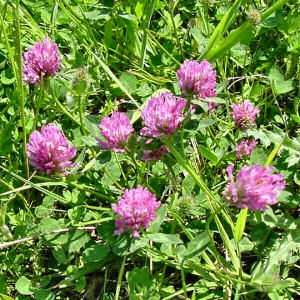
Red clover
Fertiliser
Requires high levels of fertility for best performance. Major nutrient requirements are phosphorous, potassium, sulphur and molybdenum. Soil test results and local knowledge of soil type and fertiliser history should determine rates to be applied at sowing.
Management
Maintenance fertliser
Adequate levels of phosphorous, potassium, sulphur and molybdenum should be maintained for optimum growth.
Grazing/cutting
When grown for hay, cutting red clover at the early flowering stage (¼ to ½ in bloom) maximises the yield and feed value. Generally three cuts (subsequent cuts at (¼ bloom) of hay can be expected per year provided there is adequate fertility and moisture. Lenient grazing in the first year will enhance production and persistence (leave at least 5 cm of growth). Rotational grazing will improve persistence. Red clover is sensitive to set stocking for long periods. Avoid overgrazing in winter, as this will hasten the thinning of stands.
Red Clover seeds
Seed production
Red clover is an out-crossing, insect-pollinated species; isolation is required for seed production areas. Seed yields of up to 800 kg/ha have been achieved, but are more commonly between 250 – 600 kg/ha in specialist seed production paddocks.
Ability to spread
Red clover can spread through the actions of stock passing the hard seed.
Weed potential
Low. Some potential to invade disturbed native vegetation.
Major pests
Red-legged earthmite, Pea aphid, blue oat mite and cut worms. Native bud worms (Heliothis), mirids and thrips can damage seed crops.
Major diseases
Red clover can be susceptible to a number of fungal diseases including root rot (Phytophtora ssp.), clover rot (Sclerotinia ssp.) and crown rot (Fusarium spp.). Rust.Powdery mildew may be a problem in areas with high humidity and rainfall.
Herbicide susceptibility
Red clover is sensitive to commonly used hormone type herbicides such as MCPA and 2,4-D. Herbicides containing 2,4-DB can be used.
Animal production
Clump of Red Clover
Feeding value
High. Intake can still be quite high when digestibility is relatively low at advanced stage of growth Tetraploids generally have higher digestibility and protein levels than diploids.
High nutritive value: silage has a high crude protein content of 16-20% and a ME content of 10-12 MJ/kg DM, depending on the growth stage at harvest.
Palatability
Highly acceptable forage to livestock either as hay, silage or grazed at a young leafy growth stage.
Red clover silage has a higher level of palatability compared to grass silage, allowing for greater animal intake and animal production.
Production potential
Under optimum growing conditions red clover peaks at 70-90 kg dry matter/ha/day in spring and summer, dropping to 5–10 kg dry matter/ha/day in winter.
Livestock disorders/toxicity
High oestrogen levels in some varieties can lead to a reduction in the fertility of stock grazing red clover at mating time.Bloat can be a risk particularly in cattle if grazing pure stands and may cause an increase in urinary calculi (clover stones) in sheep. Occasionally causes problems with red gut in sheep.
Cultivars
| Group | Cultivar | Seed source/Information |
| Early | Grasslands Hamua | Stephen Pasture Seeds |
Grasslands Sensation |
PGG Seeds | |
| Grasslands Colenso |
PGG Seeds | |
| Double Cut | Seed Distributors | |
| PAC194n | AusWest Seeds | |
| Early stoloniferous | Astred(low oestrogen) |
Wrightson Seeds |
| Grasslands Broadway |
AusWest Seeds | |
| Grasslands Crossway |
Plant Breeders Rights databaseEnquire Grasslandz Technology Ltd | |
| Mid | Redquin (low oestrogen) | AusWest Seeds |
| Renegade | Stephen Pasture Seeds | |
| Ceres Claret | Stephen Pasture Seeds | |
| Late | Grasslands Turoa | AusWest Seeds |
| G274N | Enquire Grasslandz Technology Ltd | |
| Grasslands Pawera4N | AusWest Seeds | |
| ? | Red 812 | Upper Murray Seeds |
| USA | AusWest Seeds |
Denotes that this variety is protected by Plant Breeder’s Rights Australia as at the 17th April 2009
4N Tetraploid
Author and date
Eric Hall
27th June 2007
Reviewed by Kevin Reed March 2009


