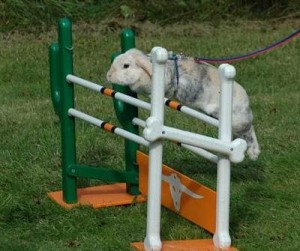
First Rabbit Showjumping event held in Sweden
First Rabbit Showjumping event held in Sweden
Rabbit Showjumping Origins:
Rabbit show jumping (sometimes known as rabbit dressage or rabbit hopping) is a competition in which trained domestic rabbits leap over appropriately sized obstacles. The activity began in the late 1970s in Sweden (where it is known as Kaninhop). It was popularized in the United Kingdom following an appearance on the TV show That’s Life!. There are more than fifty rabbit show jumping clubs throughout Scandinavia.
Some people compare rabbit show jumping to equestrian show jumping. Trainers and devotees can win titles and awards during events sponsored by groups such as the U.S. Rabbit Agility Association, Rabbithopping-USA, the American Association of Sporting Events for Rabbits, 4-H Club fairs, and other venues. Denmark, Sweden, Finland, Norway and the United Kingdom hold local and nationally sanctioned events.
The event depends on the type of rabbit, with separate competitions for small rabbits and larger rabbits. The rules are quite different in all countries except Sweden and Norway, therefore it’s hard to organize an international competition. Rabbit jumping is also an activity in America, but has not gained widespread popularity. The official world record in high jump for rabbits is 995 millimetres (39.17 in), by Tösen & Tine Hygom (Denmark). The official world record in long jump for rabbits is 3000 millimetres (118.11 in), by Yaboo & Maria Jensen (Denmark).
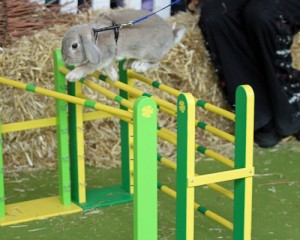
Rabbit Showjumping UK vs Sweden
Rabbit Showjumping UK vs Sweden
Breeds:
All breeds are allowed to compete, however there may be problems with smaller and larger breeds. (Rabbit size is usually determined by weight, small rabbits are considered under 2 kilo/4.4 lbs and giant over 5, 11 lbs) Small rabbits, such as the Polish and Netherland dwarf sometimes have problems jumping over long obstacles due to their size. However, there are examples of small rabbits that still made it to the highest Scandinavian classes. Smaller rabbits can overcome weaknesses through style and will.
Larger rabbits such as the Flemish Giant and French Lop will put a lot of weight on their front legs in the landing while jumping high over higher obstacles, which may cause injury. Generally, long-haired Angora type breeds, if not clipped, are excluded from competing because of the difficulties their coats cause with agility and vision. Neither English Lop should be entered as they risk injury to their ears.
The ideal jumping rabbit has long legs and a long back, which will help it see over longer obstacles and correctly judge the height or length in order to get over. In the case of the Belgian Hare, the legs should be strong and muscular so high jumps will not hurt them. In Scandinavia, where rabbit show jumping has a strong base, most are crossbreeds, bred with good jumpers as parents, similar to the method of breeding show dogs.
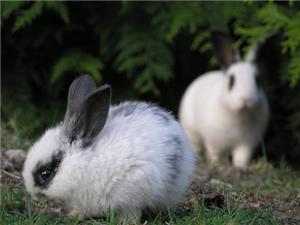
Bunnies Lilac & Bubbles
Bunnies Lilac & Bubbles
Bubbles & Lilac:
A pair of rabbits named Bubbles and Lilac are among the favourites to become Britains most talented pets:
The Telegraph UK News 6:30AM BST 01 May 2009
The hopping, skipping and showjumping rabbits are in training for the finals of a nationwide competition to find the country’s most amazing pets.
Bubbles and Lilac are being coached by owners, twin brothers Mathew and Thomas Haslam, both 15, in the garden of their home in Moorends, Doncaster.
The brothers have set up their own stable of 20 rabbits complete with a show jumping course with different fences to test out the rabbits’ jumping powers.
But Bubbles and Lilac have proved more adept and are having extra coaching to prepare them for their big day in Birmingham on Saturday.
Brenda Haslam, 46, the twins’ brother, said: “I think the whole thing is brilliant, it’s amazing to watch the rabbits jump. Rabbits shouldn’t be kept in hutches all day. They need to have exercise like other pets and they really look as if they are enjoying jumping over the fences.
“The boys love rabbits so we have always kept them and they have been brought up with them. They got the idea from You Tube when they saw film of some rabbits in Sweden jumping over obstacles.”
Mathew added: “We are really excited about the finals, we just hope our rabbits don’t get stage fright on the day. We have got a course of different fences, miniatures of the fences used for horses.
“We spend a lot of time with the rabbits , it takes a lot of patience but they enjoy it , they are very clever animals and they learn very quickly.”