Introduction:
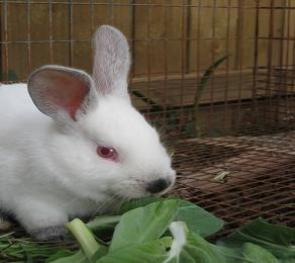 A rabbit’s diet should be made up of good quality pellets, fresh hay (alfalfa, timothy or oat), water and fresh vegetables. Anything beyond that is a “treat” and should be given in limited quantities.
Rabbit Pellets:
Pellets should be fresh, and should be relatively high in fiber (18% minimum fiber). Do not purchase more than 6 weeks worth of feed at a time, as it will become spoiled. Pellets should make up less of a rabbit’s diet as he or she grows older, and hay should be available 24 hours a day.Rabbits are generally fed a pelleted feed available from pet stores, supermarkets, and farm suppliers. Pellets were originally designed for rabbit breeders for the purpose of providing as much food energy and vitamins as inexpensively as possible. This is optimal when the rabbits are being bred for food or for experimentation.
Most sources recommend a minimum of 18% fiber, low protein (14-15%), and less than 1% calcium. Depending on the amount of vegetables available, an adult rabbit should be given between 20 ml to 40 ml per kilogram body weight daily. Pre-adolescent and adolescent rabbits (7 months and younger) can be given as much pelleted diet as they can consume, although additional vegetables are preferable to additional pellets. An older rabbit (over six years) can be given more pellets if they are having difficulty maintaining a steady body weight. Timothy hay-based pellets are great for rabbits that have stopped growing and do not need to gain weight. Alfalfa-based pellets are best only for young, growing rabbits or older rabbits who are under-weight.
Suggested Vegetables:

Rabbit pellets
When shopping for vegetables to feed your rabbit , look for a selection of different veggies-look for both dark leafy veggies and root vegetables, and try to get different colors. Stay away from beans and rhubarb.
Alfalfa, radish & clover sprouts, Baby bok choy, Basil, Beet greens (tops)*, Bok choy, Broccoli (mostly leaves/stems)*, Brussels sprouts,Carrot & carrot tops*, Celery, Chinese celery, Cilantro, Clover, Collard greens*, Dandelion greens and flowers (no pesticides)*, Dwarf choy sum, Endive*, Escarole, Gai long, Green peppers, Kale (!)*, Mint, Mustard greens*, Parsley*, Pea pods (the flat edible kind: snow pea or sugar snap pea)*, Peppermint leaves, Raddichio, Radish tops, Raspberry leaves, Romaine lettuce (no iceberg or light colored leaf)*, Spinach (!)*, Watercress*, Wheat grass, Yu choy.
Select at least three kinds of vegetables daily. A variety is necessary in order to obtain the necessary nutrients, with one each day that contains Vitamin A, indicated by an *. Add one vegetable to the diet at a time. Eliminate if it causes soft stools or diarrhea.(!)=Use sparingly. High in either oxalates or goitrogens and may be toxic in accumulated quantities over a period of time.
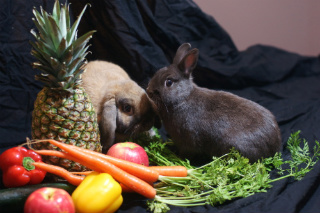
Suggested Fruit:
Apple (remove stem and seeds)
Blueberries
Melon
Orange (without the peel)
Papaya
Peach
Pear
Pineapple
Plums
Raspberries
Strawberries
Sugary fruits such as bananas and grapes should be used only sparingly, as occasional treats. Bunnies have a sweet tooth and if left to their own devices will devour sugary foods to the exclusion of healthful ones.Pineapple, mango, and papaya all contain a natural enzyme which is thought to reduce hairballs.
Fruits or other treats must be given in moderation, as rabbits easily become overweight and suffer health problems. Their diet should consist of no more than half a tablespoon of fruits or treats per day.
Frequently Asked Questions on Feeding Rabbits:
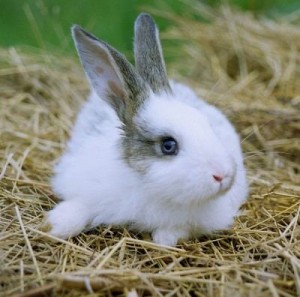
Hay is essential for your rabbit's health
Is feeding hay important?
Hay is essential to a rabbit’s good health, providing roughage which reduces the danger of hairballs and other blockages. Apple tree twigs also provide good roughage.
What quantities of food should I feed babies and “teenagers”?
- Birth to 3 weeks-mother’s milk
- 3 to 4 weeks-mother’s milk, nibbles of alfalfa and pellets
- 4 to 7 weeks-mother’s milk, access to alfalfa and pellets
- 7 weeks to 7 months-unlimited pellets, unlimited hay (plus see 12 weeks below)
- 12 weeks-introduce vegetables (one at a time, quantities under 1/2 oz.)
What quantities of food should I feed young adults? (7 months to 1 year)
- introduce timothy hay, grass hay, and oat hays, decrease alfalfa
- decrease pellets to 1/2 cup per 6 lbs. body weight
 increase daily vegetables gradually
- fruit daily ration no more than 1 oz. to 2 oz. per 6 lbs. body weight (because of calories)
What quantities of food should I feed mature adults? (1 to 5 years)
- Unlimited timothy, grass hay, oat hay, straw
- 1/4 to 1/2 cup pellets per 6 lbs. body weight (depending on metabolism and/or proportionate to veggies)
- Minimum 2 cups chopped vegetables per 6 lbs. body weight
- fruit daily ration no more than 2 oz. (2 TBL) per 6 lbs. body weight.
What quantities of food should I feed senior rabbits? (Over 6 years)
-
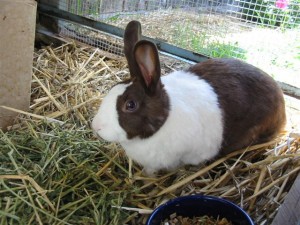
A 6yr old rabbit
If sufficient weight is maintained, continue adult diet
- Frail, older rabbits may need unrestricted pellets to keep weight up. Alfalfa can be given to underweight rabbits, only if calcium levels are normal. Annual blood workups are highly recommended for geriatric rabbits.
If I feed fewer pellets, how do I compensate?
When you feed a lower quantity of pellets, you must replace the nutritional value without the calories, which is done by increasing the vegetables. Also, a variety of hay and straw must be encouraged all day long, we do this by offering fresh hay a couple of times a day.