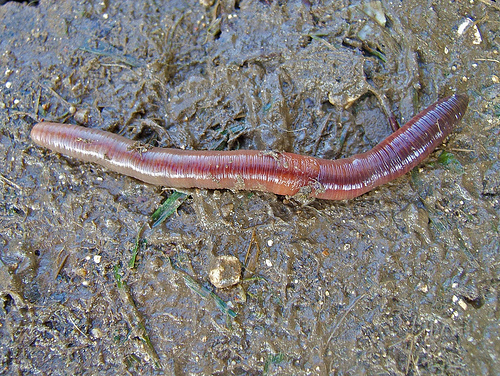
Earthworm in Mud Attribution Squeezyboy
Without argument, the best way to put worms to work in the soil is just to leave them alone, whether in a flower bed, vegetable patch or broad acres. Leave them alone, allow natural feed to develop — you can assist by adding mulch or green manure — and they’ll transform your soil.
Eventually, the need to dig frequently or deeply will be much reduced. If there are weeds you want to be rid of, dig them in and they will become food for the worms. (Naturally, this suggestion does not apply to noxious weeds.)
Herbicides
Manufacturers claim that many modern herbicides will not kill or harm worms (I have found this to be so) and the dead weeds will make good food for them. Moreover, research has shown that following the use of herbicides bacterial action in the soil increases because of the increased availability of food. However, most herbicides are forbidden if you are growing organic foodstuffs. Your state Department of Agriculture will advise on whether you can use any, and if so which ones, if you are a producer of an organic food product.
pH level
It is important to make sure that your soil is suitable for a worm population so you should measure your soil pH. (This is the scale used to measure the degree of acidity or alkalinity in soil.) 0 is extremely acid, 14 extremely alkaline and 7 neutral. You will never find the extremes in soil, although acidity as high as pH 3 has been recorded. Some worms will tolerate extremes of 3.5 or 9, but generally speaking the level preferred by worms will fall between 5.5 and 8.5, with 6.5 the most suitable. The worms become paler in acid beds. Kits for measuring pH can be bought from most plant nurseries and garden suppliers.
Food
If you want worms, you have to provide food for them and the more food you provide, the more worms you will have. If you pick or harvest anything, either flowers or vegetables, don’t pull it out, but cut it off at ground level and leave the roots to decay. With root vegetables, of course, it is the tops you leave behind. Never hesitate to dig in compost and to mulch your soils over. This has the benefit of making your soil more moisture retentive, of protecting the worms from the direct drying rays of the sun and of providing additional worm food.
Introducing new worms to your soil
Introducing New Worms to Your Soil
Don’t make the mistake of adding mature worms to your soil. Worms are creatures of their habitat and if you transfer mature worms from a nutrient-rich environment, such as a breeder bed where they have been fed on materials such as manures, to a relatively nutrient poor environment such as your garden bed, they will die. This was first realised by Thomas Barrett in the 1930s.
He also found that worms hatched in soil from introduced capsules prosper in the environment into which they are born, provided that they find the conditions that particular species of worms like. This means that a sound method of introducing a worm population into your garden or farm is to dig in vermicompost or worm casts containing capsules.
The conditions you need to provide are: pH, on the low side of 7 (opposite); minimal soil disturbance; plenty of food and sufficient moisture. Soils which are poor and non-productive, like clay, free-draining sandy or very stony soils, are not popular with worms and you will have to add a lot of compost (and gypsum for clay) if you want to encourage a build-up of worms. If you can supply these within the necessary limits, you should have no difficulty in establishing a worm population in your soil, quietly and steadily, with more appearing every year.
Given time worms will return to the soil naturally. It is almost as if their capsules are there, lying in the soil, waiting for someone to do the right thing. By way of gratitude, if you do the right thing your worms will reward you many times over. But if you expect to see results overnight you’ll be disappointed. You can accelerate the process by following the rules, but expect the project to take some years. In the end, the wait is worthwhile.


