Pruning:
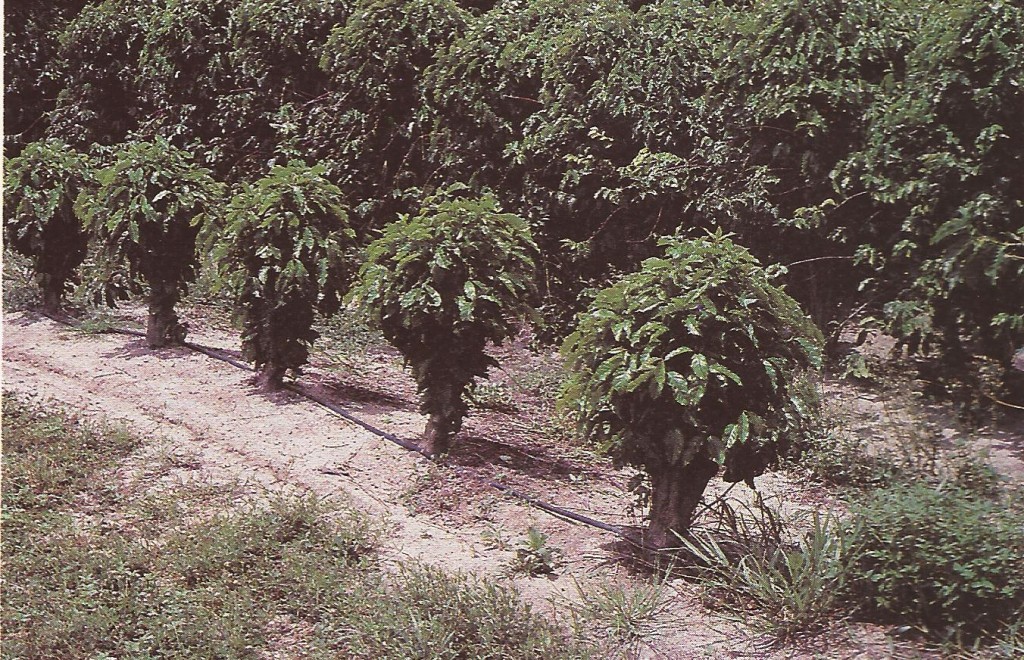
Regrowth 12 weeks after stump pruning at 45cm
Once coffee trees are established into a single stem system and bearing, they require little or no pruning for the first five to eight years. The time to start pruning depends on the cultivar (tall cultivars need pruning sooner than semi-dwarf cultivars) and the location (slower growth rates in cooler climates delay the need for pruning). These factors make tall, vigorous cultivars less suitable for warm climates because of the need to start pruning after only five years. By selecting semi-dwarf cultivars when establishing a plantation, the time interval between prunings can be extended.
Pruning is necessary because yields decrease and trees become too large to machine-harvest successfully. Trees taller than 3.5 metres prevent the shaker mechanism working properly, reducing cherry removal efficiency and harvester selectivity. They can also cause harvester fingers to break. In older trees, branches become long, weak and unproductive, and most of the crop is borne on new growth in the top of the tree. Little sunlight can penetrate the canopy, so fewer flowers develop and less cherry is set. A long term pruning strategy is therefore critical in maintaining a healthy and productive plantation. There are three basic options when it comes time to prune: stumping, hedging and topping, or ploughing out and replanting.
Stumping:
Trees are usually cut 15 to 50 cm above ground level. Research has shown that trees survive best when cut higher, e.g. 45 cm rather 15 cm. Stumps with lower branches left intact regrow faster and are less likely to die. A major problem with stumping is uncontrolled suckering during regrowth (see photo above). The suckers need to be thinned by hand to one or two uprights, which is very labour intensive. Stumping also delays cropping for up to two years and, because the canopy is removed, weed control becomes a major issue again.
Hedging and topping:
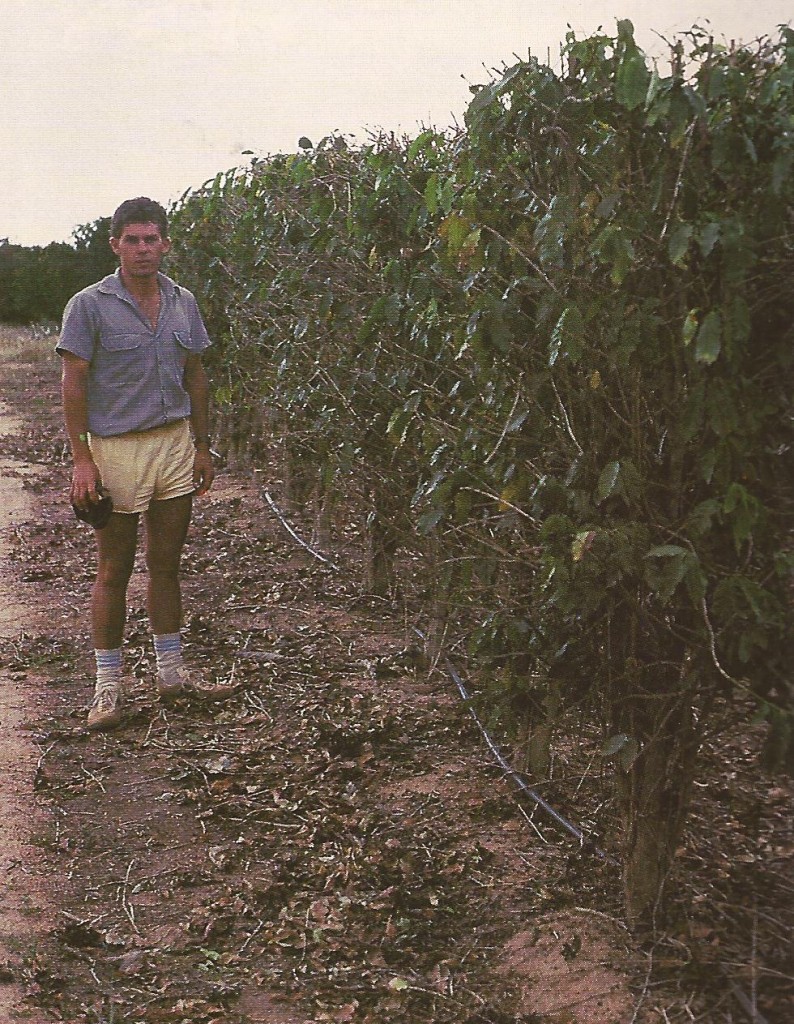
Topping and hedge-pruning mature coffee trees
Research trials have indicated that some form of hedging and topping is the best system of pruning for large plantations relying on machine-harvesting. Yield losses from this pruning system are less than from stumping or replanting.
In the first year after pruning, yield losses are proportional to the amount of wood removed, usually around 25% to 75%. In the second year following pruning, yields are usually equal to or up to 150% greater than unpruned trees. The amount of hedging and topping required depends on the cultivar (tall or dwarf) and the size of the plants before pruning. For large plants of tall cultivars you can achieve good results by topping at 1.5 metres in combination with hedging at one metre (50 cm either side of the main stem) (see photo right). This forms a framework on which strong new branches grow and crop. This framework is also very suitable for machine-harvesting, improving the cherry removal rates because of better contact by the harvester. If hedging is more severe than this, regrowth is slower. If hedging and topping are less severe, trees will require pruning again within a short time which defeats the purpose of pruning. Under good growing conditions where excessive vigour following pruning has proved a problem, semi-dwarf cultivars have responded better to pruning than taller selections.
Pruning an older plantation offers other advantages such as improved yields and cherry quality, and more uniform flower development and cherry maturity. The trees are easier to manage (spraying and controlling flowering) and show renewed health and vigour. Pruning should he carried out immediately following harvesting and, if possible, after a heavy cropping year. This will minimise yield losses because the trees generally bear lightly after a heavy crop. Trees suffering from dieback may not respond as well to pruning as healthy trees. Some trees with dieback may die if severely pruned.
After pruning, trees may grow back vigorously, requiring additional fertiliser and irrigation. If the amount of new growth is excessive some further light hedging and topping (10 to 20 cm) may be required to reduce the bearing capacity of the trees. This is best done in March or April when branch growth is slowing. If additional pruning is not carried out, trees may suffer from over-bearing dieback.
In a large plantation stagger the pruning - perhaps prune 20% of the plantation each year. By doing this you can maintain a reasonably uniform level of production.
Ploughing out and replanting:
This system is practised in many overseas countries but you lose production for two to three years while the new trees grow, and you again have to address the problems associated with tree establishment. The main advantage of replanting is that you can change cultivars, spacings and field layout.
Irrigation:
The peak demand for irrigation is usually attained after trees are three to four years of age. With overhead irrigation the requirement is about 50 mm/week compared with 80 to 140 L/tree for drip irrigation. Irrigation intervals vary between three and seven days, depending on the climate and soil type. In North Queensland three day intervals are the norm; in northern New South Wales seven day intervals are more common. Exact irrigation requirements can be accurately assessed by using tensiometers, a pressure bomb or the evaporation rate and crop factor (see article ‘Management of Young Coffee Trees’ ).
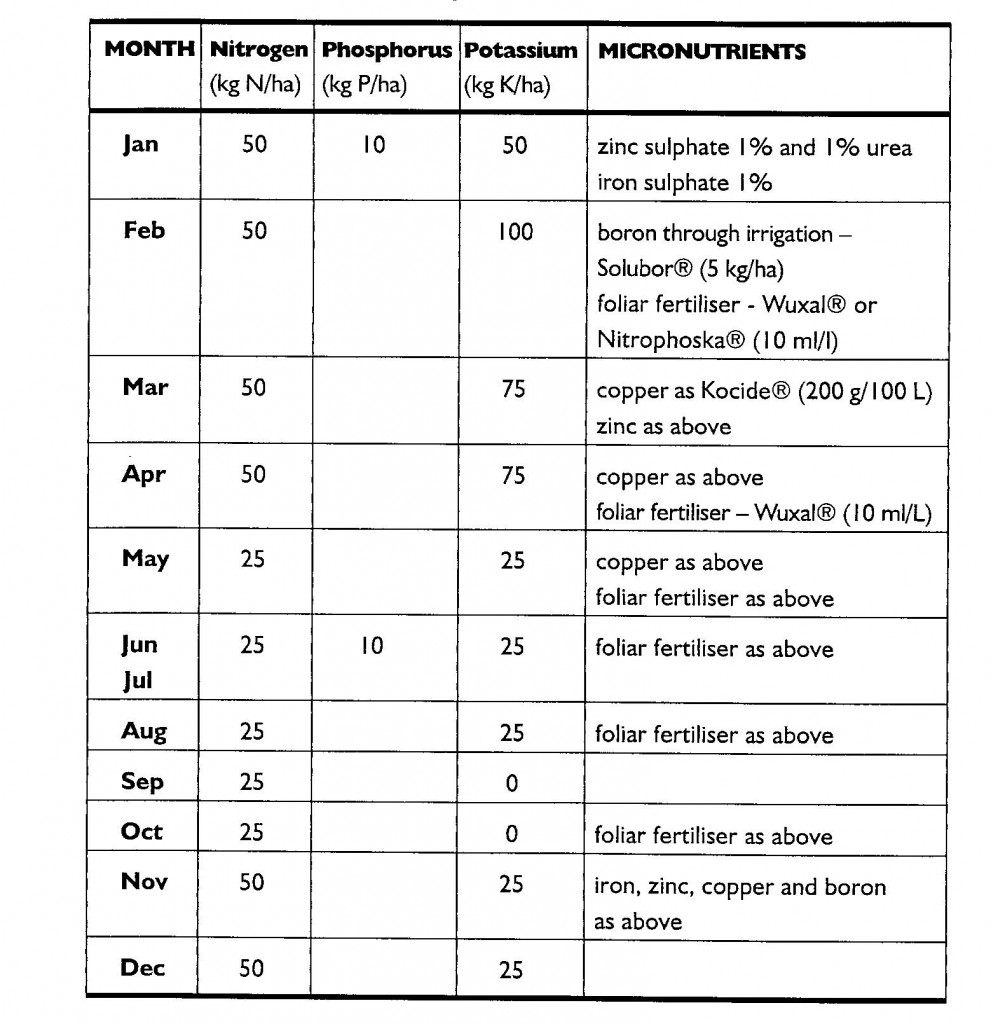
Annual fertilizer program for North Queensland
Critical times for irrigation are during the period of rapid cherry growth (January to March in North Queensland; February to April in northern New South Wales) and during flower initiation (April to October in Queensland and New South Wales, see above Annual Fertiliser Program for North Queenland.)
Source: James Drinnan