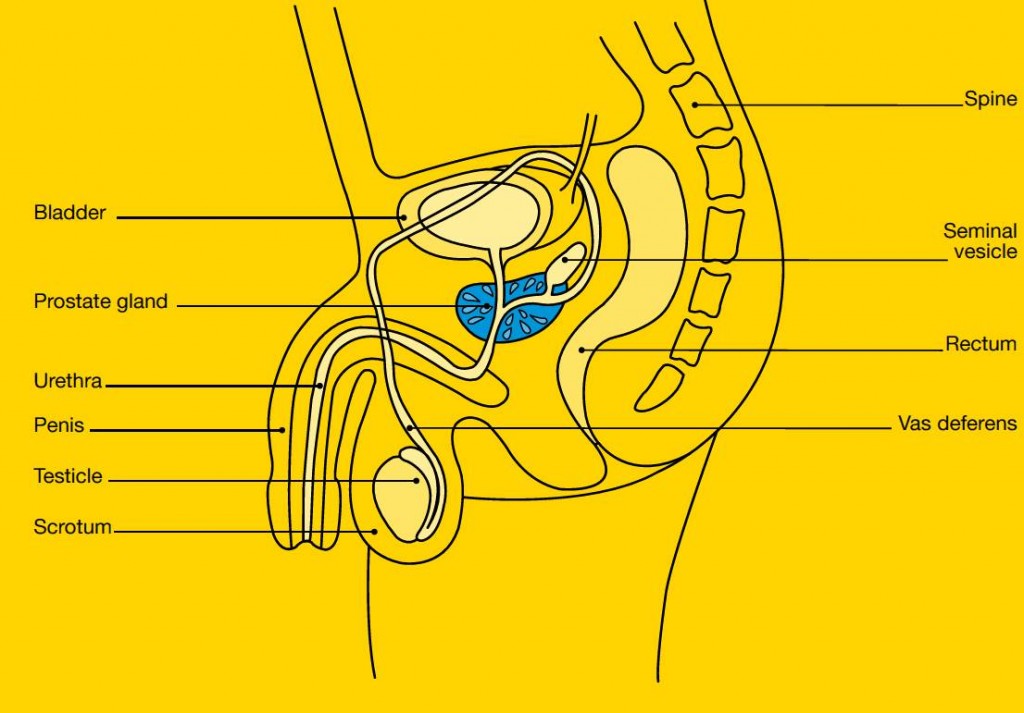
Location of the prostate.
The prostate
The prostate is a small gland that sits below the bladder and is found only in men. A normal prostate is about the size of a walnut and feels rubbery and smooth. The prostate gland produces most of the fluid that makes up semen. It surrounds a tube called the urethra, which carries urine (from the bladder) and semen (from the prostate and other sex glands) through the penis and out of the body.
The prostate normally gets bigger as men grow older. The growth of the prostate depends on the male sex hormone, testosterone, which is made by the testes (testicles). The growing prostate may narrow or block the urethra, which can change urinary patterns. This enlargement is called benign prostate enlargement, but it is not cancer. Benign prostate enlargement usually begins around the urethra deep inside the prostate. It may cause symptoms such as:
- weak urine flow
- frequent urination, especially at night
- an urgent need to urinate
- difficulty starting to urinate
- leaking or dribbling after urinating.
The prostate gland is located near nerves, blood vessels and muscles that are needed to control bladder function and to achieve an erection.
Key questions
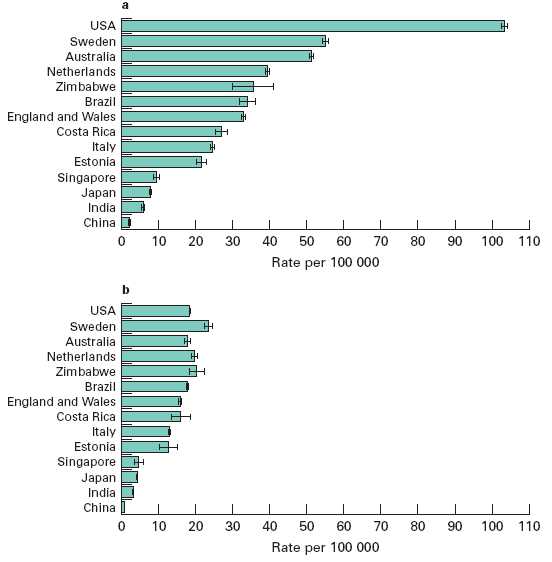
A: Prostate cancer incidence. B: Prostate cancer mortality. M. Quinn and P. Babb, "Patterns and trends in prostate cancer incidence, survival, prevalence and mortality. Part I: international comparisons", BJU International, 90 (2002), 162-174
Q: What is prostate cancer?
Prostate cancer develops when the cells in the prostate gland grow more quickly than in a normal prostate, forming a malignant tumour. Most prostate cancers grow slower than other types of cancer. Early (or localised) prostate cancer means cancer cells have grown, but they have not spread beyond the prostate. Some prostate cancers may spread to other parts of the body, such as the bones and lymph nodes. This is called advanced prostate cancer.
Q: What are the symptoms?
Early prostate cancer rarely causes symptoms. This is because the cancer is not large enough to put pressure on the urethra. If the cancer grows and spreads beyond the prostate (advanced cancer), it may cause
- pain or burning when urinating
- increased frequency or difficulty urinating
- blood in the urine or semen
- pain in the lower back, hips or upper thighs.
These symptoms are common to other conditions and may not be a sign of advanced prostate cancer. If you are concerned about cancer and/or are experiencing any of these symptoms, speak to your general practitioner (GP).
Q: What are the causes?
While the causes of prostate cancer are unknown, the chance of developing prostate cancer increases:
- as you get older – it mainly affects men over 65
- if your father or brother has had prostate cancer
- if you have a strong family history of breast cancer.
In 5–10% of men with prostate cancer, their family medical history may indicate they have an inherited gene that contributed to the cancer’s development. You may have an inherited prostate cancer gene if you have:
- multiple relatives with prostate cancer or breast cancer on the same side of the family (either the mother’s or father’s side)
- younger male relatives (under 50) with prostate cancer.
If you are concerned about your family history of prostate cancer, you may wish to ask your doctor for a referral to a family cancer clinic or a urologist to advise you on suitable testing for you and your family.
Q: How common is it?
Prostate cancer is the most common cancer in Australian men. There are about 6,600 new cases in NSW every year. According to recent statistics, one in seven men in NSW will develop prostate cancer by the age of 75, and one in four men will be affected by the age of 85. It is less common in men under 50 unless they have a family history of prostate cancer.


