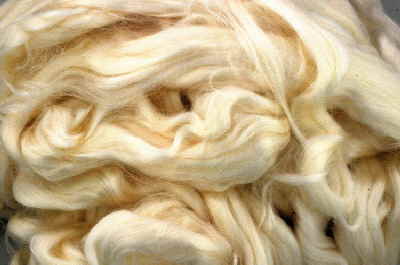
Bamboo Fibre
Bamboo fibre is a regenerated cellulosic fibre produced from bamboo. Starchy pulp is produced from bamboo stems and leaves through a process of alkaline hydrolysis and multi-phase bleaching. Further chemical processes produce bamboo fibre.
Repeated technological analysis has proved that this kind of fibre has a thinness degree and whiteness degree close to normal finely bleached viscose and has a strong durability, stability and tenacity.
Bamboo fibre fabric is made of 100% bamboo pulp fibre. It is characterized by its good hygroscopicity, excellent permeability, soft feel, easiness to straighten and dye and splendid color effect of pigmentation.
Features
- Softer than cotton, with a texture similar to a blend of cashmere and silk.
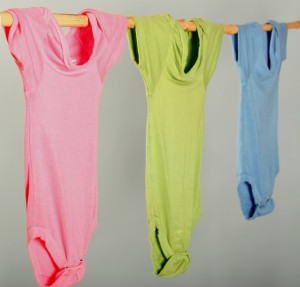
Baby clothes made from Bamboo fibre
- Because the cross-section of the fibre is filled with various micro-gaps and micro-holes, it has much better moisture absorption and ventilation.Moisture absorbency is twice than that of cotton with extraordinary soil release.
- Natural antibacterial elements (bio-agent “bamboo kun”) in bamboo fibre keep bacteria away from bamboo fabrics.
- Garment of bamboo fibre can absorb and evaporate human sweat in a split of second just like breathing. Such a garment makes people feel extremely cool, comfortable and never sticking to skin even hot summer.
- 100% bamboo yarns show a great elasticity i.e. nearly 20%. Even in 100% bamboo woven fabrics a remarkable elasticity can be obtained wherein the use of elastomeric fibres like elastanes may be eliminated.
- Bamboo fabrics need less dyestuff than cotton, modal or viscose. It seems that the absorption of dyestuffs is remarkably better. Bamboo absorbs the dyestuffs faster and shows the colors better.
- Anti-ultraviolet nature of bamboo fibre has made it suitable for summer clothing, especially for the protection of pregnant ladies and children from the effect of ultraviolet radiation.
- Product of bamboo fibre is eco-friendly and bio-degradable.
End-use
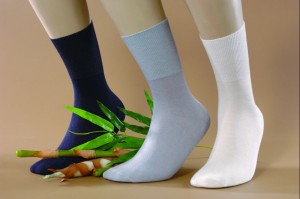
- Intimate apparels include sweaters, bath-suits, underwear, tight t-shirt, socks.
- Due to its anti-bacterial nature, non-woven fabric has wide prospects in the field of hygiene materials such as sanitary napkin, masks, mattress,food-packing,bags.
- Sanitary materials: bandage, mask, surgical clothes, nurses wears and so on. It has incomparably wide foreground on application in sanitary material such as sanitary towel, gauze mask, absorbent pads, and food packing.
- Decorating items: curtain, television cover, wall-paper and sofa slipcover.
- Bathroom products: towel and bath robe.
Author
Dr. Subrata Das
E-mail : drsubratadas2000@gmail.com


