Dairy Goats being Milked
All hair should be clipped closely on the udder and flank area for cleanliness and health reasons. Also, milk taken from such animals is easier to keep clean.
Herds should be checked for brucellosis and tuberculosis to insure that these potential human pathogens are not present. If these diseases are discovered the animals should be removed from the herd.
Milking Procedures
The milking procedures should follow recommended sanitation practices whether it is hand or machine milking.The udder and particularly the teats should be washed with warm water (110 degrees F) that contains an appropriate sanitizer.
This not only stimulates the animal for milking, but also has the potential of destroying organisms on the teat that might contaminate the milk. The first few strips of milk from each teat should be examined for abnormalities with a strip plate.
Milking, whether by machine or hand, should begin within 2-3 minutes of washing the udder. If milking is done by hand, special precautions should be taken to prevent contamination of the milk. A hooded pail is an asset for hand milking. After milking it is desirable to dip each teat in a dairy teat dip. Teat dips have proven quite successful in the prevention and reduction of mastitis.
Milk should be filtered through commercial filters and cooled immediately. If commercial milk cooling equipment is available, the milk should be cooled to 35 degrees F as quickly as possible. However, if this is not available, milk will cool much more rapidly if it is placed in circulating cold water than if it is immediately placed in a refrigerator.
Care of Milking Equipment
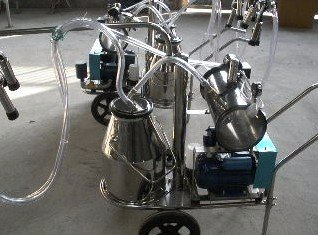
Portable Milking Machine
The production of high quality milk requires strict cleaning and sanitizing procedures for all equipment that comes in contact with milk.
Cleaning and sanitization can be done manually or mechanically depending on the type of equipment used on the farm.
The basic steps in cleaning and sanitization are as follows:
1. Immediately after milking, or removal of milk from equipment, rinse the equipment with lukewarm water before the milk dries on the surface.
2. Prepare a detergent solution according to manufacturers’ specifications making sure the water temperature meets or exceeds the minimum recommended temperature.
If manual cleaning is employed, brush all milk contact surfaces thoroughly. All milk contact surfaces that are not cleaned by mechanical cleaning or circulation cleaning must be brushed.
3. Rinse detergent from tank with tap water. Preferably, an acidified rinse should be used to prevent the accumulation of milkstone.
4. Drain rinse water from all equipment
5. Immediately before using the equipment sanitize with an approved dairy sanitizer. Either chlorine or iodine can be used at concentrations of 200 and 25 ppm respectively.
..
..



