Background information
Management of ewes for their next joining starts at weaning or with maiden ewes the previous winter. Important management tactics include:
- Careful management of ewe nutrition after weaning to maximise condition score at joining.
- Reviewing the previous year’s management calendar to identify any potential improvements to the management program.
Assess the condition of ewes at weaning and allocate feed resources depending on condition score. This simple management strategy will lead to naturally weaning more lambs. It is also the most economical way to ensure ewes are in good condition by next joining. Maintaining condition is the most efficient use of feed, as allowing sheep to lose weight and then having to feed supplements to regain condition requires three times more feed. Cull any ewes with reproductive faults and determine the number of replacement sheep required for the next breeding season. This process may be influenced by planning for the future sheep enterprise mix between meat and wool production.
Key decisions, critical actions and benchmarks
Maximise ewe condition score at the next joining
Wean lambs 14 weeks after lambing began.
This will ensure ewes are able to regain liveweight and body condition after weaning while pasture quality is at a satisfactory level. Table 10.3 presents trial results that demonstrate the range in animal performance achieved between variable years with weaning at 12 weeks of age compared with 18 weeks.
Condition score ewes and draft into groups at weaning
At weaning use tool 10.1 to separate ewes into management groups with the lower condition score groups being allocated the best available pasture. This is a relatively simple, low cost/high benefit management strategy that is worth the investment of your time. Ewes in low conditionscore will rapidly gain weight when grazing green feed. But ewes in low condition cost more to supplementary feed once pasture quality deteriorates. They will also have poorer reproductive performance and are at higher risk of losing their lambs at birth.
Selecting replacement adult ewes
Selection for age
While reproductive performance is still acceptable in older ewes, death rates may be higher and fleece values lower. The optimum sale age for old ewes is between 4 and 6 years old depending on flock structure, management plans and relative livestock values. In terminal sire breeding flocks the cost of replacement ewes influences the age of the breeding flock. Meat breed ewes are normally kept for 1-2 years longer than Merinos.
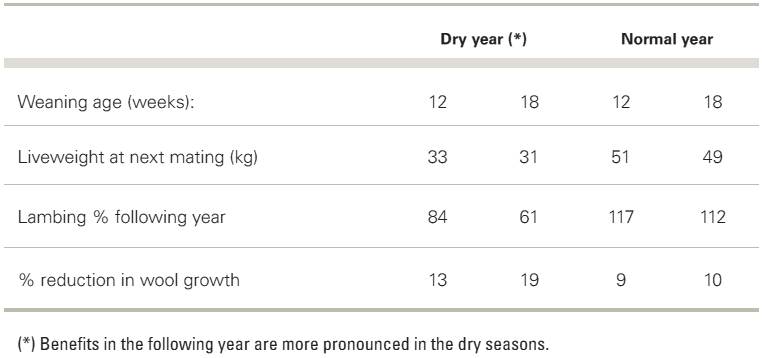
Table 10.3 Animal performance
Select for rearing ability
Table 10.3 Animal performance
Small, but consistent, gains can be made towards weaning more lambs by culling those ewes which lamb, but fail to rear their young. The ‘wet and dry’ technique (stripping fluid from the udder at lamb marking) is used to identify ewes that are either rearing a lamb or have lambed and lost. Ewes not rearing a lamb have some udder development but tend to have clear fluid and teats that are dirty.
Dry ewes have no birth stain on the breech and little udder development. The progressive gains from culling maidens that fail to rear a lamb include:
- Ewes that reared as maidens rear 10% more lambs at subsequent lambing.
- The ability to rear a lamb is passed on to subsequent generations, especially if ram selection includes maternal rearing ability.
Genetic selection for reproductive performance
Reproductive traits have low heritability so genetic gains are slow. Ewe liveweight is correlated with reproductive performance. Scrotal circumference in rams is correlated with ovulation rate in ewes. In terminal sire breeding flocks where ewe replacements are purchased, consider freedom from disease and genetic merit when determining the purchase price. Use all the genetic information available from ewe and ram databases (from LAMBPLAN ASBVs) to make decisions when purchasing replacement ewes.
 Signposts
Read
Planning for Profit – A practical guide to assist woolgrowers recover from drought. Order your free copy from AWI by:
- Calling: 1800 070 099
- Downloading the document from: www.wool.com.au/Publications/Managing_drought/page__7134.aspx
View
Dynamic dams for lamb production: More $$$ from crossbred ewes with the right genetics – results and take-home messages from the combined analysis of the maternal sire central progeny test, along with implications for the various sectors of the lamb industry. Download a free copy at: www.agric.nsw.gov.au/reader/sheep-meat/dynamic-dams.html
Analysis of the profitability of wool and meat enterprises Final Report 1.2.6 – guidelines (biological and economic) for sheep producers to optimise profit and minimise risk, which can be adapted to suit a range of environments. Visit: www.sheepcrc.org.au/images/pdfs/CRC1/CRC1_Wool/GrassGro/GrassGro_Resultsfinalv2.pdf


