 BENEFITS OF KEEPING POULTRY
Eggs are a high protein, nutritious food with very little waste. When properly managed 10 hens may produce:
2000 eggs/year
= 40 eggs /week
= 2kg of eggs at a cost of less than $2/dozen or $3/kg.
As a bonus, they generate more than 100kg per year of good quality organic fertiliser.
Other advantages include:
- the satisfaction of producing something for yourself,
- independence/self sufficiency,
- fresh eggs every day,
- recycling of household scraps – poultry are good scavengers,
- poultry can enrich your life with their beauty and behaviour,
- children enjoy observing and feeding hens and collecting eggs.
FLOCK ESTABLISHMENT.
There are two alternatives for flock establishment. You can either rear day-old chickens or buy started pullets.
Rearing day-old chickens.
You can buy day-old chicks to rear, or breed your own chickens. If you buy, the chicks must be vaccinated against Mareks disease.
While breeding may may appear cheaper it involves:
- one rooster to 8-10 hens,
- crossbreds are best for egg or meat,
- purebreds are best for beauty and exhibition.
Hatching.
- use a broody hen for natural hatching – black, red or bantam hens, or
- use a small incubator - but you need to control ventilation, temperature and humidity.
In either case, chickens require 21 days of incubation before they hatch. Other poultry take longer.
Brooding.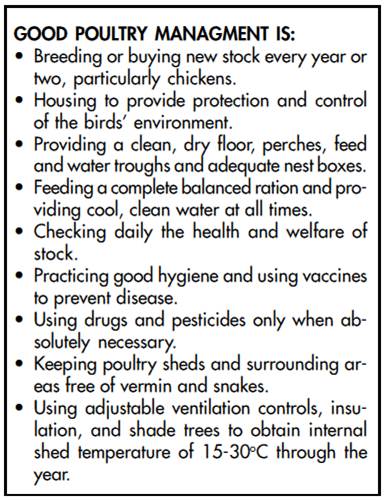
- If an incubator is used for hatching eggs - or day old chicks are bought - then a brooder is required to provide warmth for the chicks.
- Heat should be 30oC at day old, gradually dropping to 20oC at 5-6 weeks old when fully feathered.
Rearing.
- While mixed age groups are common in backyards, if possible keep different age groups separate.
Provide at least 10cm of water trough space and 5cm of feed trough space per young bird, and 1m2 of floor space per five birds from 5-18 weeks of age*
- Vaccination is recommended.
Buying Started Pullets.
Obtain vaccinated started pullets 16-18 weeks of age from a reputable hatchery/grower (see section on Vaccination, page 3). Started pullets are a higher initial cost, but it is simpler and easier than rearing your own chickens. May be cheaper in the long run as birds should have already been vaccinated and will be fully feathered.
For high egg production or growth rate ask for commercial strains of layer or meat chicken.
Replacement pullets may be susceptible to diseases new to them that may be existing in the new pen. Watch them carefully and seek veterinary advice if necessary. This may especially be the case if pullets were raised off the ground - for example, on wire or slatted floors.
LAYING FLOCK REPLACEMENT.
Normally hens come into lay at 18-22 weeks of age. They lay for 12-14 months, moult and rest for two months - in autumn-winter - and then lay again for another 10-12 months before going into another moult, and so on.
HOUSING.
Concept: These include intensive deep litter (hens confined) or semi-intensive. The birds need protection from wind, rain, heat, cold, draughts, wild birds and foxes. A yard for ranging in good weather is needed. Consideration of the person looking after the poultry should include outside access to nest boxes and for servicing drinkers and feeders.
Site: This should be elevated, well drained, with no seepage. The open side should face north to north-east. Alternative yards allowing rotation of birds are a good idea, if you have the area. Provide shade during hot weather.
Materials: Can include corrugated iron or plastic roof - painted white to reflect heat - and placed over foil insulation. Walls may be mud brick, timber, iron or fibro walls. A consolidated earth or concrete floor raised 10cm above the surrounding ground avoids water running in. Use a 10cm layer of softwood shavings, chopped straw or rice hulls to form a deep litter.
SPACE AND EQUIPMENT.
Floor in the shed should provide space for three layers/m2* on 10cm deep litter.
Perches should be 75mm wide x 50mm deep hardwood and provide 18cm of space per bird. The best perch is one that allows the bird to grasp it with half retracted toes. Perches should be positioned to avoid draughts and minimise fouling of birds, or feed and water, below.
Nest boxes should be about 25cm x 30cm x 30cm with 1-2 nest box per five birds. The box base should be filled with 10cm of deep litter material, sand or shellgrit.
Feed troughs should provide 10cm/bird or more. Hanging adjustable feeders are ideal for up to 20 birds/feeder.
Water troughs should provide 10cm per adult bird. Automatic troughs, cups or nipples are ideal. For bell drinkers, less than 20 birds per bell drinker is recommended.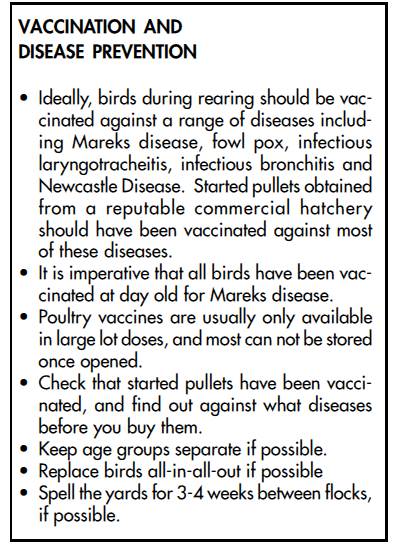
All woodwork should be inspected for parasites such as mites, and treated with an approved pesticide.
* The Model Code of Practice for the Welfare of Animals – Domestic Poultry 4th Edition recommends a maximum stocking density of 30kg/m2of floor space for non-cage type systems.
FEEDING.
Rations. Things to consider when feeding:
- Buy ready mixed mash, pellets or crumble, or mix your own feed, or feed free-choice.
- Use grains, meatmeal, oilseed oils, vitamins, and minerals to provide a balanced diet.
- Layers require added calcium such as limestone chips or oyster grit, if not already included in the ready mixed feed.
- Provide as much as the birds will eat by giving birds access to food at all times.
- Position feeders so that rain and droppings will not get into the feed.
- Layers average feed consumption is 1kg/ bird/week, depending on the nutritional value of the feed, temperature and confinement.
- Supplement with green feed, scraps, scratch grain, coarse sand and shellgrit.
- Feed should not be stored for longer than three months, and should be stored in a cool sheltered place.
Cost. Buying feed in larger amounts, such as 40kg bags, may be cheaper than buying in smaller quantities.
Water. Provide clean, cool water at all times. Avoid sunlight on pipes and storage tanks, which will cause drinking water to heat up.
HEALTH.
Sanitation. Clean the shed by removing litter and nest box material and scraping surfaces free of manure, etc. Wash the shed with water and an approved detergent/disinfectant. Spray with an approved insecticide if necessary. Spell the yards from birds, if possible.
Medication. Use only if/when necessary, and get veterinary advice. Most medications are not registered for use for layers in production. Follow label directions.
Medicate chickens for worms at 5, 10 and 18 weeks of age through their drinking water or individually. A follow up treatment may be necessary.
Dust, spray or dip the birds for body lice and mite if necessary, using an approved pesticides only.
External parasites such as lice and mite need retreatment within 10-14days to break the lifecycle and prevent reinfestation. For effective mite and some lice treatment, housing must be cleaned and sprayed with an approved pesticide.
HUSBANDRY.
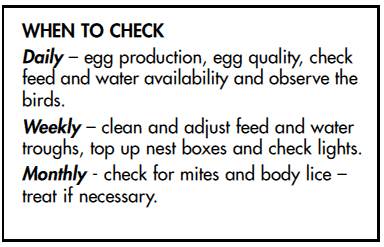
Lighting. To maximise egg production, regulate day length with supplementary light in autumn and winter. Use an automatic timer and a 60 watt bulb for each 3m2.
Aim for constant 15-16 hour day length. Lighting programs are available from your NSW Agriculture poultry officer.
Culling. Remove sick layers. Dry ‘powdery’ or blue combs and/or a ‘dull’ eye give a clue.
Check width of pin bones in laying hens - there should be at least a 50-60mm gap. The texture of the abdomen should be soft and not overly fat or hard. Do not confuse the appearance of the abdomen during moulting, with a hen that does not lay eggs permanently - birds in moult will not be laying.
OTHER SPECIES WORTH CONSIDERING.
Most of the following are hardier than the chicken and do not require vaccination. Because their intensity of lay is not as high as the chicken, their productive life is usually longer than the chickens.
Ducks (egg production) – Khaki Campbell and Indian Runner. Sometimes very high production but not as economical as hens.
Ducks (meat production) – Pekin/Aylesbury cross, Rouen, Muscovy, Mallard. Fast growing but high feed consumption.
Geese – Emden or Chinese are hardy. Seasonal breeders - spring/summer - and poor egg producers at 30-60 eggs/year.
Guinea Fowl –Attractive pearl or lavender colours, a good game flavour to the meat.
Turkeys – Australian White or Bronze, difficult to buy poults.
Japanese Quail – for egg or meat production. Easy to rear in small space.
Pheasants – Ringneck or Ornamental, a challenge for the enthusiast.
Squab pigeons – special breeds and strains have been developed for squab meat.
Author.
Gerry Bolla, Suzanne Robinson and George Arzey.



