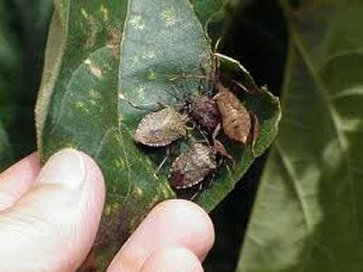
 Research was conducted in North Carolina and Virginia from 2006 to 2008 to determine if the sunken lesions found on the outside of cotton bolls caused by stink bug feeding (hereafter referred to as “external lesions”) could be used to rapidly and accurately estimate the number of bolls with internal feeding damage.
This approach is one possible solution to the perception among scouts that determining the percentage of bolls with internal damage is excessively time consuming.
External lesions were defined as circular, concave black areas with a diameter of approximately 1/16 inch on the external boll wall.
Internal damage was defined as the presence of one or more warts on the inside of the boll wall, damaged seed, or stained lint. Results in 2006 showed a moderately strong correlation between external lesions and internal damage.
Furthermore, the probability of internal damage increased as the number of external lesions increased.
The strength of this correlation increased sharply as the number of external lesions per boll increased, with four or more indicating the probability of internal damage with 90 percent accuracy.
Conversely, increasing the external lesion threshold for classifying a boll as damaged will increase the number of bolls falsely classified as undamaged. It is also possible to have internal damage without apparent external lesions present.
Using this information, we developed a stink bug sampling method based on counting external lesions. In 2007 and 2008, this method was compared to the standard practice of examining bolls for internal damage.
During 2007, 10 field sites with at least 20 percent of bolls with internal damage, as determined by assessing a large random sample of bolls, were selected in northeastern North Carolina and southeastern Virginia. Each field (ranging in size from 25 acres to 45 acres) was premarked with 10 sampling areas spread in a typical scouting pattern.
Scouting trips through the field using external and internal scouting methods were conducted separately. For the external sampling method, 10 quarter-sized soft bolls were examined for external lesions at each of the 10 sample areas, for a total of 100 bolls per field.
The percentage of bolls with one or more external lesions was recorded, and the time required to take the sample was recorded. Techniques were similar for the internal method, except that bolls were cracked and those with internal damage were recorded.
During 2008, the experiment was repeated at 15 field sites – ranging in size from about 25 acres to 45 acres – with some modifications. First, the number of sample areas was reduced to five per field, but the total number of bolls examined for external lesions was increased to 20 per sample area (100 bolls external and 50 bolls internal, per field).
In order to determine how much experience an individual would require to effectively use the external sampling method, the efficiency differences between cotton- field scouts were compared among three levels of expertise: Low – no experience in cotton fields or in 1.
recognizing insect damage to cotton bolls Moderate – some experience, i.e., had confidence in recognizing stink bug damage to bolls, but not used to sampling large fields or large numbers of fields in a day High – professional cotton scouts.
These results indicated no differences in the mean percentage of bolls with feeding symptoms (external lesions vs. internal damage) detected by either the external or internal sampling method. Furthermore, increasing the external lesion sample size from 10 to 20 bolls per sample reduced the variability between the two sampling methods.
These results demonstrated that scouts could achieve similar levels of accuracy, regardless of sampling method. However, the external sampling method significantly reduced sampling time.
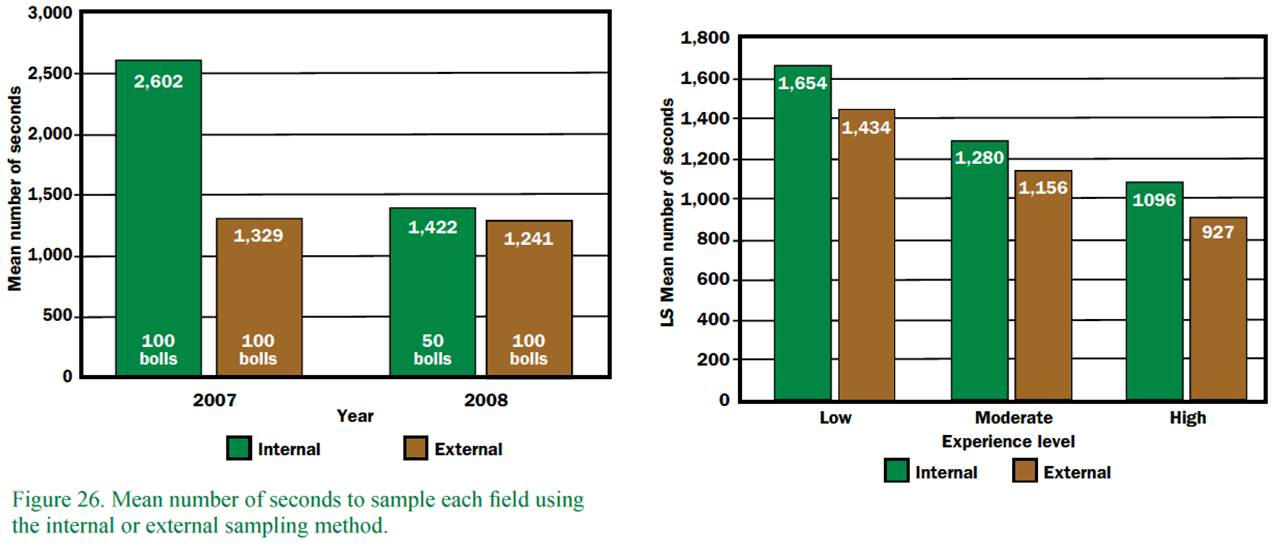
Previous experience clearly influenced the total amount of time required to scout the fields, regardless of sampling method. Those with little experience were significantly slower than the scouts with moderate and high expertise levels, which were not different from one another.
This result was expected, as experienced scouts are more comfortable moving across rows and uneven terrain while rapidly locating soft, quarter-sized bolls on plants of variable maturity. All scouts required less time when using the external sampling method compared to the internal sampling method.
The external sampling method – where bolls were classified using concave black lesions with a diameter of approximately 1/16 inch on the external boll wall – significantly reduced sampling time and was equally effective as the internal sampling method for detecting stink-bug-damaged bolls.
However, the correlation between external lesions and internal damage is not perfect, and use of the external boll-sampling method appears to be more applicable when overall boll damage in a field is low, i.e., less than 20 percent.
The authors are considering the practicality of a hybrid sampling method whereby bolls are considered damaged when they have three or more clearly defined external sunken lesions, but must be manually dissected when there are two or fewer external lesions.
Consultants could begin sampling fields using the external method and consider a field safe – below an action threshold – if overall damage is less than 20 percent. If a field is found to have 20 percent or more external damage, consultants would shift to the internal sampling method.
This hybrid approach would save time compared to the internal sampling method, it would yield accurate results, and it would allow consultants to scout more acres, increase their boll sample number, and reduce finger and hand fatigue from cracking bolls. More work is planned to further refine and field validate these results.
Information Sourced From:


