Dieback from over-bearing:
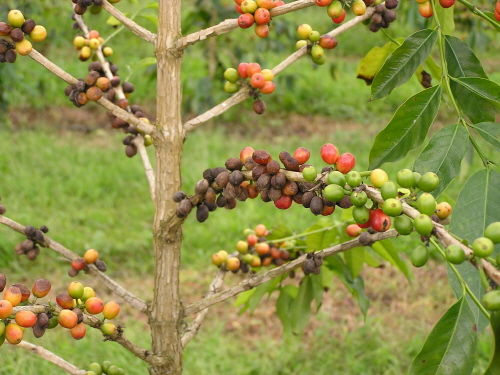
Young tree with severe over-bearing dieback, a result of poor management during cherry growth
Dieback has been a serious problem in many coffee plantations in North Queensland and northern New South Wales. It is usually associated with the production of heavy crops where water and nutrients are insufficient, and is more prevalent in marginal growing conditions.
Dieback occurs when the tree’s demand for carbohydrates is greater than the supply. Heavy cropping can lead to complete exhaustion of a tree’s carbohydrate reserves. Dieback tends to be cyclic because of the close association between branch growth and cherry growth. In heavy cropping years the trees use all their reserves to support cherry growth; if water or nutrients are in short supply, branch growth suffers and the trees die back. The following year little crop is set because there was little branch growth the previous season, so there are plenty of reserves available for branch growth. Vigorous branch growth leads to heavy flowering and cropping in the following year, again leading to over-bearing dieback. In this way a cycle biennial bearing and over-bearing dieback is established if irrigation and fertiliser supplies do not match crop requirements.
Experience suggests that dieback is most serious on sites marginal for coffee cultivation and which have poor, shallow soils. Maintaining good leaf cover, irrigation and nutrition (especially nitrogen and potassium - see Nutrition below) throughout the year, and using foliar fertiliser during periods of rapid branch and cherry growth will minimise dieback. Removal of cherry young trees may help develop stronger root systems and reduce the potential for dieback.
Pests and Diseases:
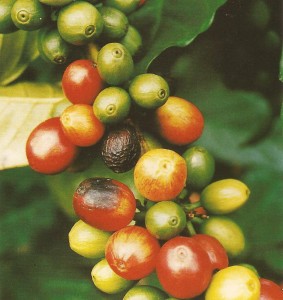
Cercospora on coffee cherry
Mature, bearing coffee trees suffer from the same pests and diseases as younger trees, with cercospora leaf spot also attacking cherry mature trees. Cercospora causes lesions on the cherry and premature ripening, leading to quality problems and reduced yields. It occurs around March to May in North Queensland, when the weather is wet and hot and trees are weak from carrying a heavy crop. Control the disease by applying foliar copper oxychloride (4 g/L). It is especially important to control cercospora leaf spot in bearing trees because it can cause excessive leaf fall, leading to over-bearing dieback as explained above.
Cercospora is nearly always associated with trees in poor health, especially those suffering nutritional deficiencies, so the best method of control is to correct nutritional deficiencies (see below).
Nutrition:
As coffee trees start to crop they need much greater quantities of nutrients, and the proportions of these nutrients change. Bearing trees need more nitrogen and potassium relative to phosphorus than do non-bearing trees. They need nitrogen for branch growth and potassium for cherry growth. Trial results in North Queensland show that mature, bearing trees require 300 to 400 kg/ha of nitrogen and potassium and 20 kg/ha of phosphorus per year. This level of inputs should support yields of 2 t/ha of green bean. Nutrition studies have allowed the fertiliser program described in Table 5:1 to be developed.
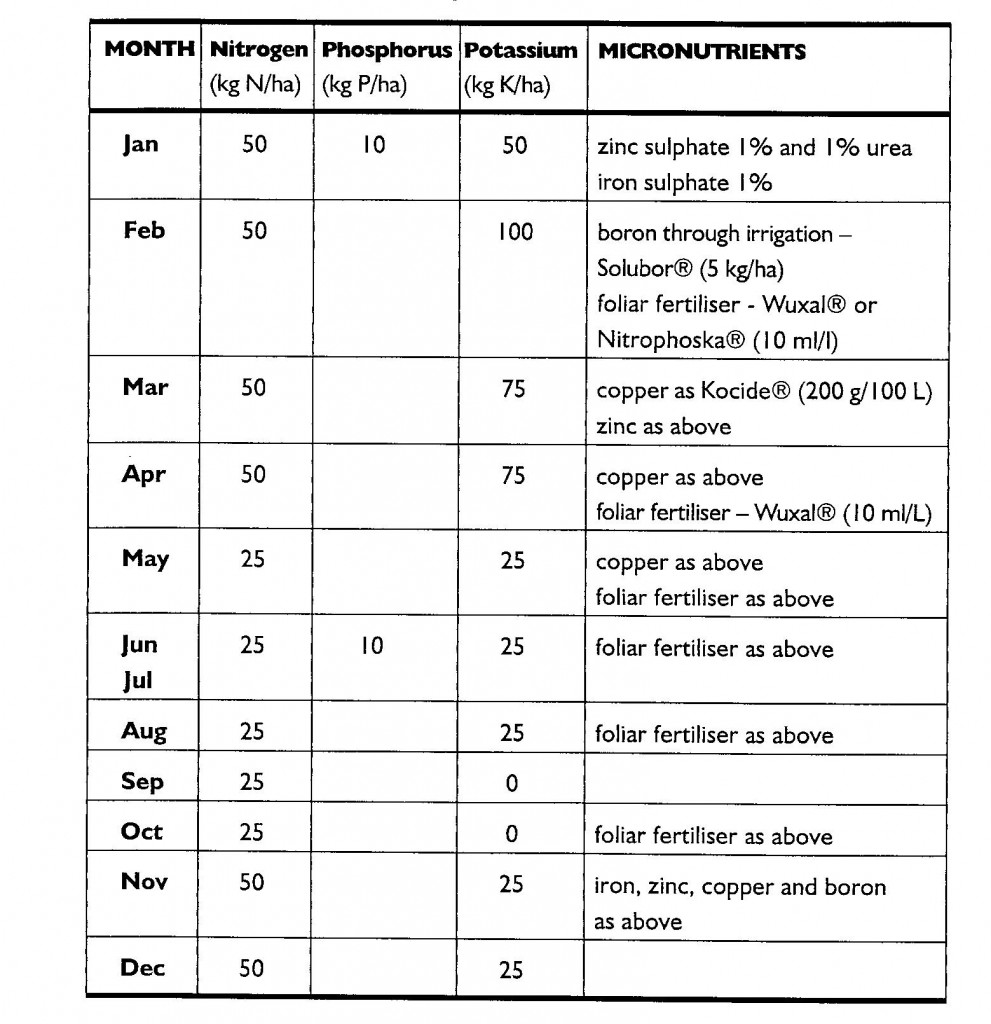
Annual fertilizer program for North Queensland
As this table shows, the highest levels of nitrogen are applied during the summer flush between November and April, and the highest levels of potassium during rapid cherry growth between January and April. Urea (46% N) is usually used to supply nitrogen as it is the cheapest form, but you can also use ammonium nitrate (34% N) or potassium nitrate (13% N). Don’t use sulphate forms of nitrogen on sandy soils in areas with intense rainfall because they will reduce soil pH. A soil pH of 5.5-6.0 is best for coffee trees.
You may need to apply dolomite or lime every few years depending on the results of annual soil tests to maintain this pH level. Muriate of potash (50% K) is normally used to supply potassium but you can also use sulphate of potash (41% K) or potassium nitrate (38% K). Phosphorus is usually applied as superphosphate (8% P). Q5 (9% P) can also be used.
Foliar Fertiliser:
Use foliar fertiliser (Wuxal® or Nitrophoska® 10 ml/L) after harvesting and before water-stressing. When used after harvest, it can help the trees recover quickly from the stresses of harvesting. When used before stressing, it can help the trees cope better with water stress. Foliar fertiliser can also be useful while the cherry is growing rapidly and there is a lot of branch growth (around February), and just before the cherry starts to ripen and trees tend to dieback (April and May). Use repeat sprays every few weeks.
Trace elements:
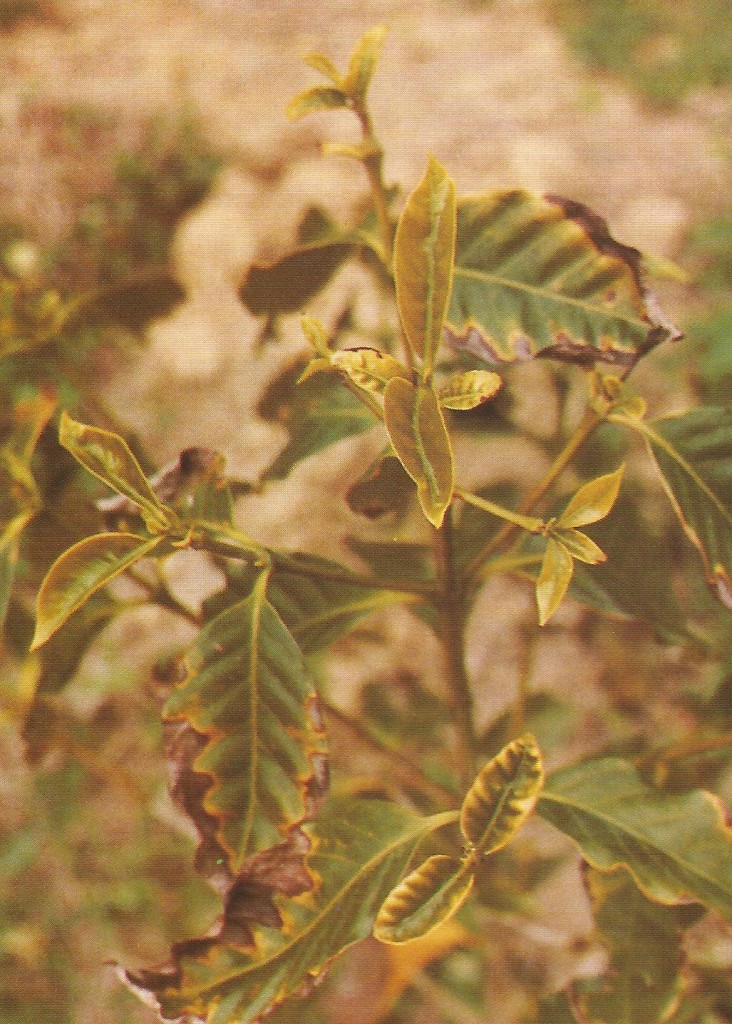
Hot-cold syndrome in coffee tree
Symptoms of iron and zinc deficiency are observed frequently when trees are growing very quickly between November and February. This is usually a short term deficiency caused when plant uptake of these nutrients cannot keep up with demand. Correct the deficiencies by foliar applications of zinc and iron (zinc sulphate or iron sulphate at 0.5%-1.0%). Urea (1%) is sometimes added to the spray tank to help nutrient uptake. You can also apply copper sulphate (5 kg/treated ha) and zinc sulphate (25 kg/treated ha) to the soil to alleviate deficiencies.
One problem often wrongly associated with nutrient deficiency is hotcold syndrome. When day and night temperatures vary by more than 15°C 20°C new growth is often discoloured and distorted and mistakenly linked with nutrient deficiency (see Plate 5:5). The syndrome usually occurs in spring when nights are cold and days are hot. Symptoms are exaggerated if the plants are suffering nutrient stress. The plants quickly grow out of the condition as the temperature range narrows.
Source: James Drinnan