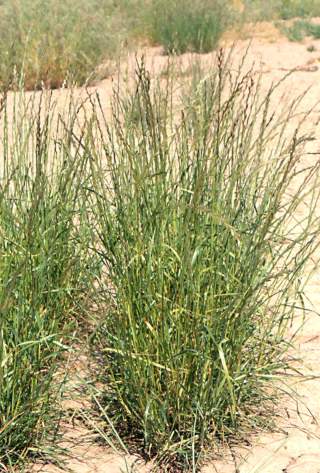
Perennial ryegrass plant
Scientific name
Perennial ryegrass plant
Lolium perenne (Table 1)Lolium x boucheanum Kunth (Table 2) - Refer Hybrid ryegrass fact sheet for details re description etc.
Strengths
Easily established, highly productive and nutritious under grazing, moderate winter and summer growth, rapid regrowth from cutting/grazing; regenerate well from self-sown seed if allowed to seed.
Limitations
Requires moderate to high soil fertility. Does not withstand heavy grazing pressure through drought. Susceptible to cockchafer and cricket damage.
Plant description
Plant:
Densely tufted, multi-tillered perennial with fibrous root system.
Stems:
30-90 cm
Leaves:
Fine (~7 mm), dark green, hairless, under surface shiny, blade folded about mid-rib in young shoot, leaf-base usually dark red.
Flowering spikelet
Seedhead:
Spike ~20 cm, spikelet usually <10 florets/spikelet; awnless lemma.
Seeds:
Fawn, flat, awnless, ~6mm long. Approx. ~520,000/kg (diploid cvv) or ~350,000/kg (tetraploid cvv).
Tetraploid cvv.:
These have double the number of chromosomes, larger cells, leaves and seed. Compatability with clover maybe enhanced.
Pasture type and use
Grazing and fodder conservation. Most widely sown pasture grass in temperate regions.
Where it grows
Rainfall
> 650 mm; >500 mm re South coast WA.
Soils
Medium-heavy texture, moderate-high fertility (eg Olsen P >12, 0-10 cm). Tolerates slight salinity.
Temperature
Cold and frost tolerant, growth constrained by high temperature, mild summer desirable.
Establishment
Field of Perennial ryegrass
Companion species
Grasses: Phalaris, cocksfoot Legumes: white clover and sub clover.
Sowing/planting rates as single species
7-20 kg/ha
Sowing/planting rates in mixtures
3-10 kg/ha
Sowing time
Autumn and spring.
Inoculation
Not applicable.
Fertiliser
P & possibly N at sowing.
Management
Maintenance fertliser
Perennial ryegrass requires fertile soil to persist. ~10 kg P/ha. Monitor S, K, Cu especially. Supply N by clover/fertiliser. Maintain Colwell P ~30 (WA), Olsen P >12.
Flowering Perennial ryegrass
Grazing/cutting
Tolerates close, continuous grazing - except if drought-stressed. Graze at 3-leaf stage to optimise yield under rotational grazing. Well suited to hay/silage.
Seed production
Prolific seeder; commercial yields up to 2 t/ha.
Ability to spread
Will spread on fertile soil if allowed to seed.
Weed potential
Widely naturalised on fertile soils in temperate Australia.
Major pests
Red and black-headed cockchafer, black field cricket, white-fringed weevil, African black beetle, corbies, underground grass caterpillar.
Major diseases
Crown rust, stem rust, barley yellow dwarf virus, ryegrass mosaic virus.
Herbicide susceptibility
A wide range of weeds may be encountered. In selecting selective herbicides consider the stage of growth of the ryegrass and what non-target companion species are present. For detailed information consult local weed agronomists or visit NSW DPI - Weed control in Lucerne and Pastures 2007.
Animal production
Ryegrass seedheads
Feeding value
High nutritive value.
Palatability
Palatable.
Production potential
High yields; highly responsive to fertiliser and irrigation.
Livestock disorders/toxicity
Cultivars with wild endophyte can cause perennial ryegrass toxicosis and ill-thrift. Bacterial infection of seedhead can occasionally occur and result in ergot poisoning.
Cultivars
Table 1 - Perennial ryegrass cultivars.
| Flowering group2 | Cultivar | Origin of germplasm | Endophyte options | Seed Source/Information |
| Very early | Boomer |
NSW | Low3 | Valley Seeds |
| Skippy | NSW | Wild | VicSeeds | |
| Early | Everlast |
NSW | Wild | Seed Distributors |
| Fitzroy |
NSW | Wild | Wrightson Seeds | |
| Meridian |
NZ x NSW | AR1 | Heritage Seeds | |
| Roper |
NSW | Low | Valley Seeds | |
| Early-Mid | Bolton |
Victoria | Wild | VicSeeds |
| Drylander | Victoria | Wild | Seed Distributors | |
| Victorian | Victoria | Wild | Australian Herbage Plant CultivarsVicSeeds | |
| Mid | AusVic |
Victoria | Low | VicSeeds |
| Bronsyn |
NZ | AR1 | Specialty Seeds | |
| Camel |
Mediterranean | Low | Valley Seeds | |
| Ceres Cannon |
NZ | Wild/Low | PGG Seeds | |
| Ceres Kingston |
NZ | Wild/Low | PGG Seeds | |
| Extreme | NZ | AR6/AR1/AR37 | AusWest Seeds | |
| Grasslands Commando | NZ | Wild/AR1/AR37 | PGG Seeds | |
| Grasslands Lincoln |
NZ x Spanish x Italian | Wild/Low | Wrightson Seeds | |
| Grasslands Nui | NZ | Wild | Australian Herbage Plant CultivarsSpecialty Seeds | |
| LM9928C | Low | Valley Seeds | ||
| Prolong |
NZ x NSW | Low | Valley Seeds | |
| Rich | Specialty Seeds | |||
| Tomson | NZ | Wild | Seed Distributors | |
| Mid - Late | Arrow | NZ | AR1 | Heritage Seeds |
| Avalon |
Victoria | Wild | Australian Herbage Plant CultivarsVicSeeds | |
| Grasslands Samson |
NZ | Wild/AR1/AR37 | PGG Seeds | |
| Jackaroo |
Tasmania | Wild | Wrightson Seeds | |
| Victoca |
Victoria | Wild | TasGlobal Seeds | |
| Wintas | Spanish | Wild | TasGlobal Seeds | |
| Late | Aberdart | Europe | AR1 | Specialty Seeds |
| Alto |
NZ | AR1 | Pasture species database - University of Melbourne Heritage Seeds |
|
| one-50 |
NZ x Spanish | Wild/AR1 | PGG Seeds | |
| Optima (4n) | Denmark | Low | Seed Distributors | |
| Sierra (4n) | Spanish | Low | Pasture species database - University of Melbourne | |
| Very Late | Bealey(4n) |
NZ | Advanced | Pasture species database - University of Melbourne Heritage Seeds |
| Grazmore (4n) | NZ | Low | - | |
| Quartet(4n) |
NZ | Wild/AR1 | Wrightson Seeds |
Table 2. Relatively persistent/”long rotation” hybrid ryegrass cultivars.
| Flowering group | Cultivar | Origin of germplasm | Endophyte options | Seed source/Information |
| Medium | G5. Ohau 4 (4n) |
NZ | AR1/Low3 | PGG Wrightson |
| Horizon (4n) |
NZ | Wild | PGG Seeds | |
| Late | G. Supreme |
NZ | Low | AusWest Seeds |
| G. SupremePLUS |
NZ | AR1/Low | PGG Seeds | |
| G. Impact |
NZ x Spanish | AR1 | Heritage Seeds | |
| G. Sterling (4n) |
NZ | Wild/AR1 | PGG Seeds | |
| Blitz (4n) | ? | Not given | Specialty Seeds | |
| Banquet (4n) |
NZ x Spanish | Wild | Wrightson Seeds | |
| Banquet II (4n) |
NZ x Spanish | AR5 | Wrightson Seeds | |
| Matrix5 |
? | Wild/Low | Cropmark Seeds NZ | |
| Revolution5 |
? | AR1 | Cropmark Seeds NZ |
Author and date
KFM Reed
7th August 2008


