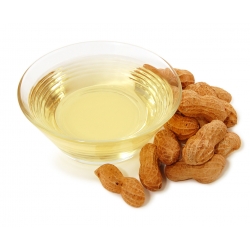
 Oil Extraction
Oil contains high amounts of energy and fat-soluble vitamins (A, D, E, and K) and essential fatty acids. The oil content of the kernels is between 45% and 55%.
The peanuts are prepared for the oil extraction process by being shelled and cleaned. Oil production requires some type of press with which to extract the oil form the groundnuts and filtering equipment.
Practical Action has developed a simple manual screw press that would be suitable for extracting oil from peanuts, as well as many other agricultural crops.
There are quite a number of presses of very similar design, they are simple to make, except for the screw which would have to be machined. For more information see the Practical Action South Asia Technical Brief Principles of Oil Extraction.
Peanut Oil Uses
It is often used in Chinese, South Asian and Southeast Asian cuisine. Peanut oil is known for its high smoke point relative to many other cooking oils. Its major component fatty acids are oleic acid (46.8% as olein), linoleic acid (33.4% as linolein), and palmitic acid (10.0% as palmitin). The oil also contains some stearic acid, arachidic acid, arachidonic acid, behenic acid, lignoceric acid and other fatty acids.
At the 1900 Paris Exhibition, the Otto Company, at the request of the French government, demonstrated that peanut oil could be used as a source of fuel for the diesel engine.
 It is also used as the main ingredient in some earwax removing products along with almond oil. Peanut oil is also used as a fecal softener.
Peanut oil is most commonly used when frying foods, particularly french fries and chicken.
“Groundnut oil” can be mistaken for peanut oil as peanuts are a type of groundnut. In the UK groundnut oil is a neutral tasting and less expensive frying oil than peanut oil.
Most highly refined peanut oils remove the peanut allergens and have been shown to be safe for “the vast majority of peanut-allergic individuals”, but cold-pressed peanut oils may not remove the allergens and can be highly dangerous to allergic individuals. However, since the degree of processing is often unclear, “avoidance is prudent”.
Peanut oil can also be used to make soap in a process called saponification. The soap produced is soft and stable.
..
..