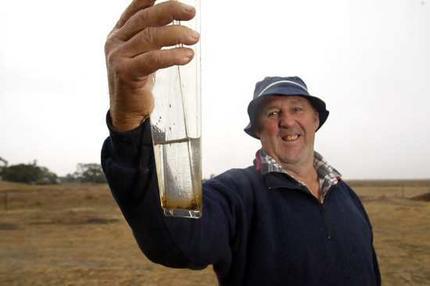
 Collecting rainfall data is the single most important piece of information that you can gather about your land. And it’s probably the cheapest to collect!!!
Most farmers in Australia have at least one calibrated rain gauge on their farm and check the gauge first thing every morning (usually between brushing their teeth and eating breakfast).
Most farmers then write the information down in a pocket notebook or on a card supplied by the local Stock and Station Agency that sits on top of the fridge or on the mantlepiece by the kitchen stove.
Most Australian farmers collect this information themselves because the nearest Long Term Weather Station collecting rainfall data can be over 100 kilometers from the property and in many cases not bear much relationship to the rainfall patterns on the property.
In New Zealand, in my experience, there is less collection of rainfall data by individual farmers, but there has always been good rainfall data collection by NZ Forest Service, the Meterological Service or NIWA (the NZ Government Climate Data Service) and weather Stations have been established in a much closer network than in Australia and for longer periods.
You should try and empty your rain gauge at the same time each day (if required because of rainfall in the previous twenty-four hours).
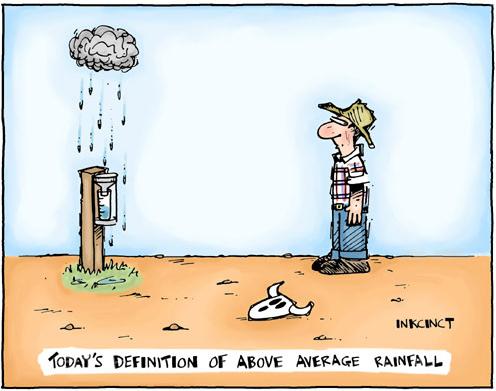 During heavy intensity rainfalls, I often hear of farmers standing out in the rainfall, emptying their gauges every hour in order to get an idea of the intensity of the rainfall event. Measuring rainfall intensity tells the farmer how much soil erosion he can expect from sheet and rill erosion caused by heavy intensity rainfall events. The intensity of the rainfall event also has implications for how much of the moisture is absorbed into the soil and how much runs off the surface and causes flooding of streams and rivers.
Although most farmers appreciate the value of good rainfall records and religiously collect the data and write it down somewhere, most do not take the important next step to unlock the power of this data and turn it into useful information.
It used to be a very laborious job, writing all the rainfall records out into a tabular format and then trying to compare between weeks, months and years and to identify extreme events (wet and dry) so most farmers used to baulk at tackling this job at home in the evenings when other diversions such as partners, family, hobbies, sport and drink intervened!
Nowadays, computers and spreadsheets are readily available and keyboard and programming skills are easily learnt so we have the tools to unlock the power of this data and convert it into a farming smarter outcome. You can easily design a Excel Spreadsheet Template that records rainfall records.
Please note that it should cover at least 35 years of rainfall records to be useful but if you are lucky enough to have a longer record than this,its a relatively simple process to add further columns to accommodate these.
Another useful piece of information is that for converting points of rainfall into millimetres, which is the standard unit used nowadays. The conversion factor is 100 points equals 2.540mm.
Sources of Rainfall Data
 If you are unable to obtain any rainfall data relating to your own property, then you need to contact the organisation in your country responsible for collection and distribution of this information.
In Australia, you need to go to the Bureau of Meteorology (BOM) website to locate this information. There are a number of useful tools that can assist you to
(a) Locate the long term weather station nearest to your property.
(b) Identify the length of time that the station has been open, the quality and completeness of the rainfall record and whether the Long Term Weather Station (LTWS) records other climatic data rather than just rainfall.
In New Zealand, you need to contact either the Met Service for current rainfall data or more likely, the National Institute for Water and Atmospheric Research (NIWA) for copies of long-term rainfall records.
For other countries, I suggest you initially search on Google using the search words “rainfall records [Name of Country]” to identify the organisation responsible for collection and dissemination of this data in relation to your own land.
Other websites with access to many climate stations and their data are: World Wide Weather Station List and World Wide Weather Links.
Organising your rainfall data
There are some general principles you should follow when organising weather information, including rainfall data:
- Depending on the time of year, try and order rainfall data up to the latest possible calendar year.
- To get the LTWS rainfall data, email the BOM in Australia (or the appropriate organisation in your country) and request daily rainfall data (and daily temperature data if required) from all surrounding rainfall stations rather than just for one. This is because, until you analyse the data and compare it with your own data for the same period, you won’t have any clue as to the best LTWS to use.
- Remember to include the station numbers!! In Australia, the cost is seventeen dollars per data request, so order more than enough data and cut out the data not needed!! If you don’t order the full records then it costs more to extract the part that you do want!
- Try and also get a couple of daily rainfall data sets to create a comparison and rainfall gradient.
When I ask many farmers what their annual rainfall is, they proudly say “oh about 850mm per year!! (or whatever the figure is!)” But when I ask what the range of annual rainfalls are at the property, they generally either say that they don’t know or provide a guess at best. And how important is this piece of information?
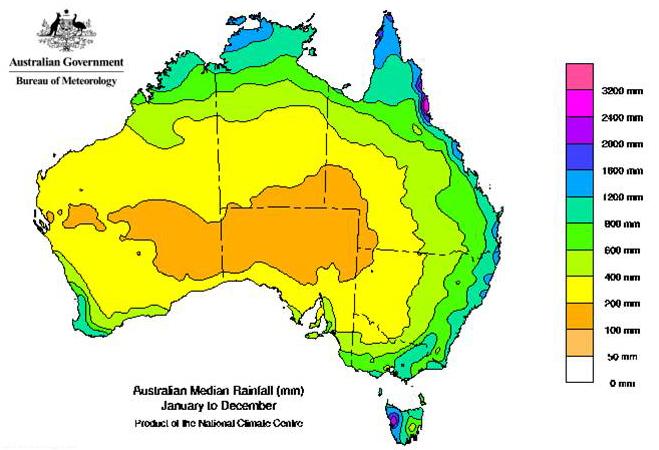
When you look at the Median Annual rainfall for Australia in the map above, there appears to be a well-defined pattern with the wet tropics and eastern coastal rainfalls fading off into the arid central Australian desert where very little annual rainfall is received.
However, when you look at the range of Annual rainfalls received across Australia, a totally different and much more complicated picture emerges.
The fact is that Australia almost never receives the median annual rainfall. Different parts of Australia always have annual rainfalls that fall somewhere along the continuum between the two extremes of lowest and highest. Thus, while WA may be having one of its driest years, there may be a series of heavy rainfall events and flooding in Queensland.
The Australian Bureau of Meteorology (BOM) produced a large wall chart a few years ago with the average annual Australian rainfalls in map form for every year between 1901 and 2000.(100 maps of Australia on one wall chart). When I studied this chart closely, over the entire twentieth century, no two years had exactly the same annual rainfall pattern for Australia. And none of them looked remotely like the Median Annual rainfall depicted in the middle of these three maps!
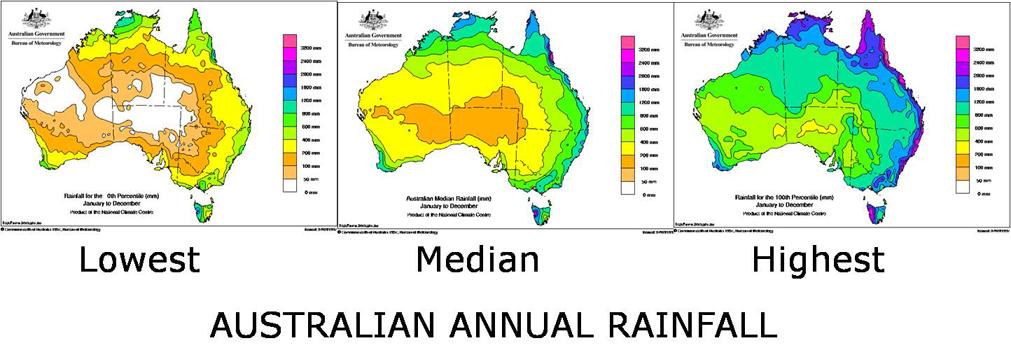 Knowing the range of rainfall patterns, whether it is annually, seasonally or month by month is far more important than knowing a Median figure. Rainfalls in places like Australia can vary enormously from year to year, from season to season and even from month to month (and when compared against the same monthly rainfalls from other years).
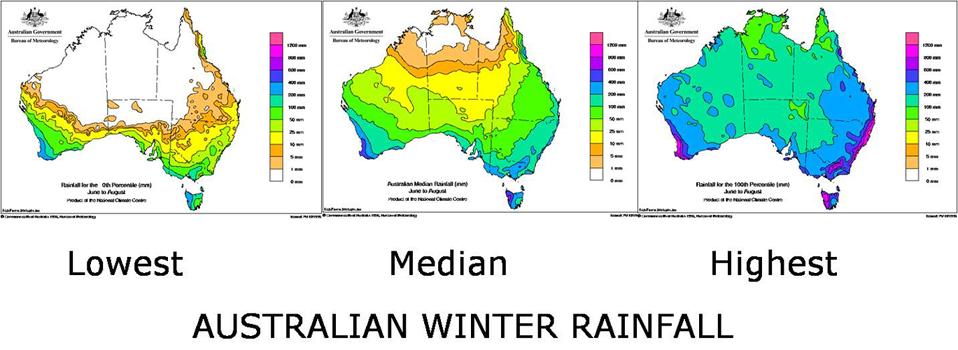
This variability clearly shows in these three maps which show the range of winter rainfall patterns across Australia.
This map shows the location (shown as yellow crosses) of all known Long Term Climate Stations throughout the world.
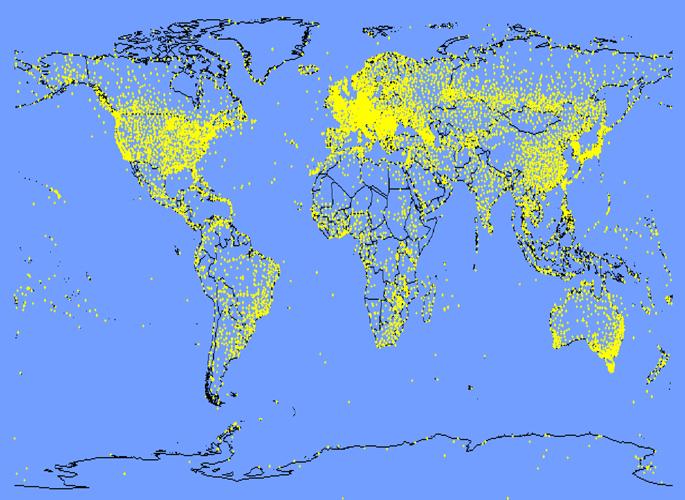
Clearly there is a concentration of data collecting in developed countries, but most inhabited areas of the earth do have some sort of climate data available to them.
This network of LTWS is important to your production process because access to this data makes it possible to identify places throughout the world with a similar climate to your place. If you then study what plants and crops do well in those other sites, it can provide you with some strong indications of what could potentially grow on your property.
Analysing your rainfall records can be a powerful tool. There are two case studies showing examples of rainfall analysis and it’s usefullness, on this website.
Rainfall Data Analysis in Wilga, WA.
Longterm Rainfall patterns in Hampton and surrounds, Queensland.
For proffessional assistance in analysing your rainfall data, and the presentation of it into a user friendly format, please contact Topoclimate at Topoclimate.com, or myself, Gary Hutchinson at garyh@topoclimate.com


