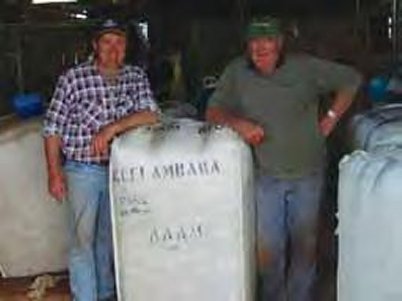
Don macdonald and Cliff mcNaught with bales of wool at keelambara
WOOL PRODUCTION
Don macdonald and Cliff mcNaught with bales of wool at keelambara
Don Macdonald has had many years experience in the wool industry, both as a broker at Lanoc Wool in Dubbo and also as a woolgrower at Dubbo and at Keelambara at Tilpa in the far northwest corner of New South Wales. He runs 10,000 sheep on the 40,000 hectare property and traditionally reliance on chemicals has been minimal. He has commenced towards certification and is currently in conversion with NASAA.
Don’s farming philosophy suits him to organic production and he can also see potential for a niche market in organic wool. Don maintains that the traditional problems of lice, worms and blowfly can be managed organically, especially in his relatively dry area of the state, and he can see a future where mulesing isn’t necessary. However Don is concerned that the increased labour costs associated with crutching sheep and chipping weeds such as bathurst burr and noogoora burr could make the organic venture unviable unless there is a premium price for the product.
Don suggests a few practical considerations for those interested in organic wool production:
• Manage shearing, marking and lambing so that you avoid times of possible flystrike: don’t mark or mules in mid March or mid October.
• Be aware that wool which is well nourished and contains a higher grease content is less likely to retain moisture and so less likely to attract flies.
• Sell-off in dry times rather than spend money and time on hand feeding. The low stocking rate in the rangelands is a benefit in dry times.
• Get the most benefit from your paddocks by rotational grazing where possible and carefully monitoring the feed in each paddock. Mitchell grass, old man saltbush, bluebush and other native grasses supply most of the feed at Keelambara’s rangeland paddocks.
• Be aware that sheep need access to as many watering points as possible to minimise grazing pressure.
• If you cell graze, plan to have enough paddocks so that pastures recover before further grazing.
• Discuss the state of old sheep yards and shearing sheds with your certifier before you commit to organic production. You may have to remove dust from an old shearing shed (to remove traces of arsenic) and you may have to remove topsoil from sheep yards and cover with a road base if residual chemicals are in the soil.
Don says that the records and other paperwork necessary for certification, although time consuming, are part of good management practice for any enterprise.
WOOL PROCESSING
Craig French is the Export Manager?Wooltops at Fletcher International Exports Pty. Ltd at Dubbo, the only wool processor in Australia now that others have closed or moved offshore. It follows that they are also the only processor of organic wool in Australia. The company is certified by NASAA for organic wooltop processing and also for slaughtering, boning and packing organic meat.
There are currently about 50 organic wool (and meat) suppliers to Fletchers but more have indicated an interest in changing to organic production. Craig believes that the future for organic wool is in a niche market for clients who:
• Want a textile free from artificial chemicals in all stages of production: growing, processing and storage. Customers could include people who seek chemical-free products for babies and children and people with allergies to chemicals.
• Prefer bedding (blankets, doona) free from artificial chemicals.
• Are interested in the environment and value the philosophy of organic production.
• Seek cosmetic products based on organic lanolin.
Craig has advice for anyone interested in growing organic wool:
• Stay in touch with your processor. The processor is in touch with spinners who, in turn, are in touch with customers. This is the chain of communication that gives customers confidence in the product. A certificate of compliance is sent to buyers.
• Growers who have a production problem can usually find a solution. For example, burred wool could be separated out at the wool shed and sold separately on the conventional market.
The special procedures for processing organic wool are:
• Use of a natural detergent, approved by the certifier.
• Removing conventional wool from all parts of the plant where organic wool is stored or processed.
• Cleaning of all parts of the plant where organic wool is stored or processed.
• Storing and labelling the organic wool in its special area.
• Placing signs in the plant to clearly state processing organic wool.
• Supplying the certifier with a list of all the organic wool processed and the quantity of each lot.


