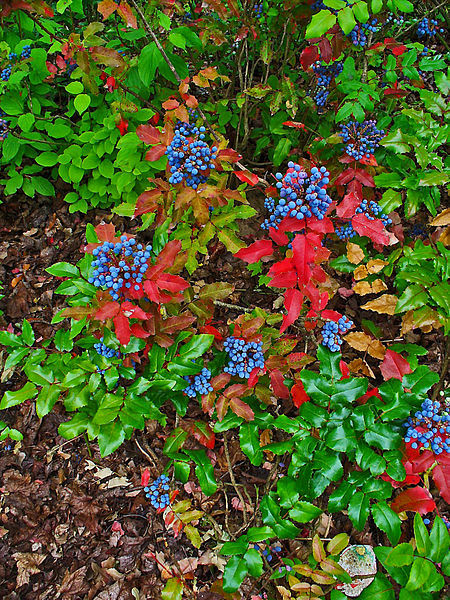
Oregon Grape Photo by H. Zell on Wikimedia Commons
Mahonia aquifolium
Common Name: Oregon Grape
Family: Berberidaceae
Synonyms: Berberis aquifolium.
Known Hazards: None known.
Habitats: Mixed coniferous woods to 2000 metres. It is found in woods and hedgerows in Britain.
Range: Western N. America. Naturalized in Britain.
Summary
Evergreen, upright or spreading, to 2-10 ft. Inner bark and roots bright Yellow. Pinnately compund leaves with 5-11 shiny, green, hollylike leaflets. Leathery, oblong leaflets flat to strongly wavy with sharp, spine-tipped teeth. Yellow flowers in dense racemes at branch tips. Sour Dark bluish berries covered with white film.
Physical Characteristics
Mahonia aquifolium is an evergreen Shrub growing to 2 m (6ft) by 1.5 m (5ft). It is hardy to zone 5. It is in leaf 12-Jan It is in flower from Jan to May, and the seeds ripen from Aug to September. The flowers are hermaphrodite (have both male and female organs) and are pollinated by insects.The plant is self-fertile.
The plant prefers light (sandy), medium (loamy) and heavy (clay) soils and can grow in heavy clay soil.The plant prefers acid, neutral and basic (alkaline) soils..It can grow in full shade (deep woodland) semi-shade (light woodland) or no shade.It requires dry or moist soil.
Mahonia aquifolium Oregon Grape
Habitats
Woodland Garden Sunny Edge; Dappled Shade; Shady Edge; not Deep Shade; Ground Cover; Hedge;
Edible Uses
Edible Parts: Drink; Flowers; Fruit.
Fruit - raw or cooked. The fruit is almost as large as a blackcurrant and is produced in large bunches so it is easy to harvest. It has an acid flavour, but it is rather nice raw and is especially good when added to a porridge or muesli. Unfortunately, there is relatively little flesh and a lot of seeds, though some plants have larger and juicier fruits. The cooked fruit tastes somewhat like blackcurrants. The fruit can also be dried and stored for later use. Flowers - raw. They can also be used to make a lemonade-like drink.
Medicinal Uses
Plants For A Future can not take any responsibility for any adverse effects from the use of plants. Always seek advice from a professional before using a plant medicinally.
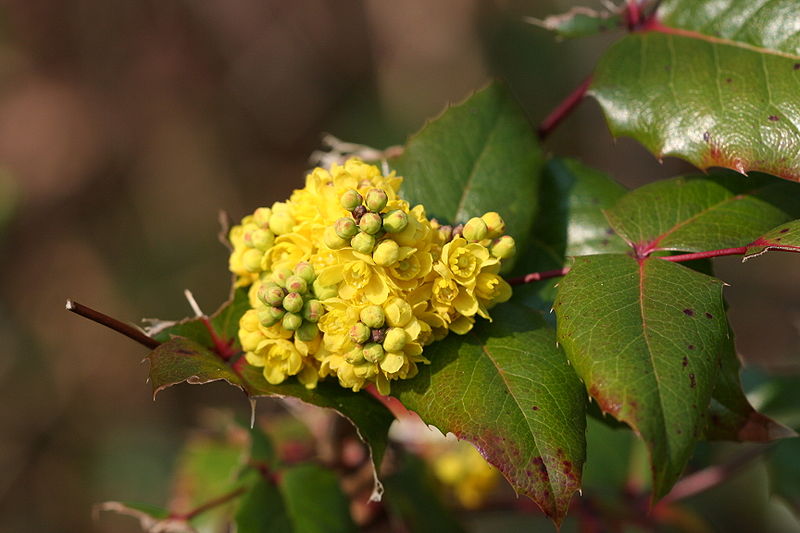
Oregon Grape Flower Photo by Svdmolen on Wikimedia Commons
Actions: Alterative; Antibacterial; Antitumor; Blood tonic; Cholagogue; Diuretic; Laxative; Ophthalmic; Tonic.
Oregon grape was often used by several native North American Indian tribes to treat loss of appetite and debility. Its current herbal use is mainly in the treatment of gastritis and general digestive weakness, to stimulate the kidney and gallbladder function and to reduce catarrhal problems.
The root and root bark is alterative, blood tonic, cholagogue, diuretic, laxative and tonic. It improves the digestion and absorption and is taken internally in the treatment of psoriasis, syphilis, haemorrhages, stomach complaints and impure blood conditions. Externally, it has been used as a gargle for sore throats and as a wash for blurry or bloodshot eyes.
The roots are harvested in late autumn or early spring and dried for later use[238]. The fruit is an excellent gentle and safe laxative. Berberine, universally present in rhizomes of Mahonia species, has marked antibacterial effects and is used as a bitter tonic. Since it is not appreciably absorbed by the body, it is used orally in the treatment of various enteric infections, especially bacterial dysentery. It should not be used with Glycyrrhiza species (Liquorice) because this nullifies the effects of the berberine. Berberine has also shown antitumour activity. The root and root bark are best harvested in the autumn.
Other Uses
Dye; Ground cover; Hedge; Hedge.
A yellow dye is obtained from the inner bark of the stem and roots. It is green according to another report. Dark green, violet and dark blue-purple dyes are obtained from the fruit. A green dye is obtained from the leaves. This species can be grown as a low hedge and does not need trimming. Because of its suckering habit, it also makes a good dense ground cover plant though it can be slow to become established.
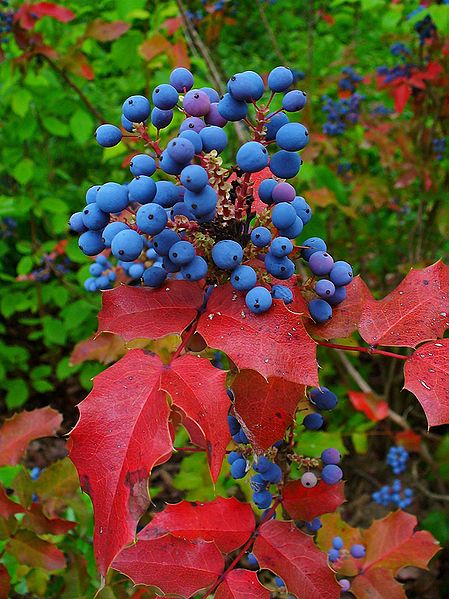
Oregon Grape Fruit Author H. Zell
Cultivation
A very easy plant to grow, thriving in any good garden soil and tolerating dense shade under trees. It grows well in heavy clay soils and also succeeds in dry soils if it is given a good mulch annually. It dislikes exposure to strong winds. Plants are hardy to about -20°c. Very tolerant of pruning, plants can be cut back into old wood if they grow too large and straggly. Spring is the best time to do this.
Suckers are fairly freely produced, with established plants forming dense thickets. Most plants grown under this name are casual hybrids with M. repens. This species is easily confused with M. pinnata, with which it also hybridizes. The flowers are delicately scented. A number of named forms have been developed for their ornamental value. This species is notably resistant to honey fungus. This plant is the state flower of Oregon.
Propagation
Seed - best sown as soon as it is ripe in a cold frame. It usually germinates in the spring. ‘Green’ seed (harvested when the embryo has fully developed but before the seed case has dried) should be sown as soon as it is harvested and germinates within 6 weeks. Stored seed should be sown as soon as possible in late winter or spring. 3 weeks cold stratification will improve its germination, which should take place in 3 - 6 months at 10°c.
Prick out the seedlings when they are large enough to handle and grow them on in a cold frame for at least their first winter. Plant them out in late spring or early summer. Division of suckers in spring. Whilst they can be placed direct into their permanent positions, better results are achieved if they are potted up and placed in a frame until established.