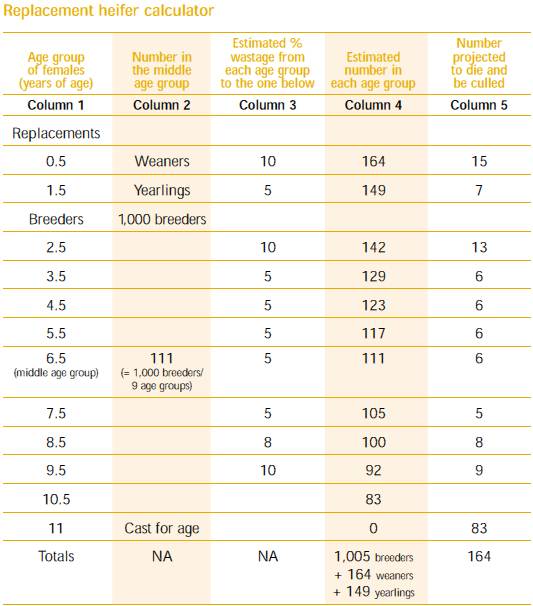
 This is a ‘best estimate’ approach, assuming you are looking at long-run averages with your herd at equilibrium. The following instructions provide a step-by-step guide to filling in the Replacement heifer calculator:
• The first step is to lay out the herd age structure you want.
• The next step, if you want to estimate your herd structure ‘on average’, is to estimate the average number of breeding cows in the middle age group of breeders as your starting point – in this case, using a herd size of 1,000 breeders with nine age groups from 2.5–10.5 years old (yo), this gives 111 in the 6.5 yo group (ie 111 = 1,000/9 – column 2).
• Then you need to estimate, or preferably use your own figures, for the losses that occur between one age group and the next (column 3). This is made up of deaths (2% used here for mature cows) and culling (eg 3% used here for the 6.5 yo group) giving losses of 5% in total for this group. Higher figures were used here for weaners, first calf cows and older cows to allow for assumed greater wastage in these age groups. Use your own figures if you have them.
• Then calculate upwards and downwards away from the middle group (ie 111 of the 6.5 yo here) to get the numbers that should be in each other age group on average (column 4). So for example for 5.5 yo we have 111 + 5% of 111 = 111 + 5.6 = 116.6, rounded up to 117 here. And for the 7.5 yo group we have 111 – 6 = 105, and so on.
• In column 5 the actual number lost between each age group is given, calculated as above, with the total equalling the number of replacement weaners needed, as is also given in column 4 of the weaner row as the number needed. All 11 yo cows are cast for age in this example. (You could also work out the estimated number of animals culled versus those that died, to project your annual sale numbers of females in each group by using the same approach, but using only the % culled in each age group.)
• Note that the total herd size of breeders at the bottom of column 4 is 1,005, not 1,000 as we originally set, which means that this rule of thumb is 0.5% out for this example due to rounding errors, but close enough for most purposes.
If you know the current age structure of your herd, and you want to estimate replacement numbers in the current year:
• Skip column 2 and go straight to filling in information in columns 1 and 3 for all age groups, and column 4 for breeders and yearlings.
• Then use the approach outlined above to calculate the number of replacement weaners required at the top of column 4, and the number of animals lost from the herd in column 5.
• In this case, because your herd structure is likely to be less even than in the example above, especially if it is not at equilibrium due to a drought for example, the number of weaner replacements you calculate at the top of column 4 may not equal the sum of those lost at the bottom of column 5. In this event the sum of column 5 is the figure to use.