Rainfall is the key driver of pasture growth and the major factor behind variation in pasture growth rates between locations. A sound knowledge of the normal seasonal trends, and the extent of year to year variability within seasons or months, is essential to designing a pasture mix across grazed land that will optimise the seasonal growth and quality of pasture. Until tools become available to allow producers to better analyse historical trends in plant available water, the best indicator to use is still monthly rainfall patterns.
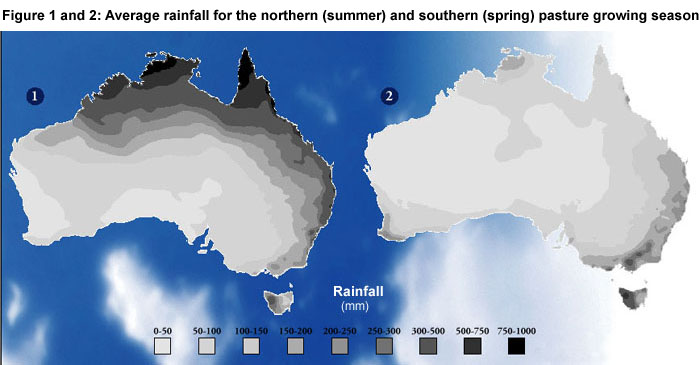 Producers are advised to look for either raw data, such as locally based historical rainfall records, or professionally developed data software such as RainmanTM. Local sources include:
• On property records, if they go back at least 30 years;
• The records of neighbours – most are very willing to share such information;
• The nearest meteorological station records;
• Your local newspaper may periodically publish records.
Once you have a complete set of records, calculate both average monthly rainfall and plot on a graph. Perform a more complex analysis if you have access to a computer spreadsheet program.
As an alternative, producers may consider obtaining a copy of Rainman. This provides historical data from 3,800 locations around Australia and will analyse chosen data sets to produce seasonal monthly and daily patterns in rainfall. Other features include information on stream flows and seasonal forecasts based on the El Nino phenomenon. Rainman is available on a CD-ROM which can be obtained from Land and Water Australia, GPO Box 2182, Canberra. ACT 2601, or online from www.lwa.gov.au/products.asp.
Using the information on rainfall
Look for patterns in seasonal or monthly distribution that provide guidance to the optimisation of pasture growth.
• Determine the normal start and end of your main growing season. Remembering that temperature is also an important factor, discount summer rainfall due to the higher evapotranspiration rates. Winter rainfall may not produce much growth but does fill the soil profile for pasture growth in spring. Excessive winter rainfall may result in waterlogging of some areas.
• Use knowledge of your growing season to assess likely feed supply and quality. Use this information to determine the most appropriate herd structure and stocking rates.
• Look for out-of-season weather that may present unique opportunities – eg growing specialty fodder such as lucerne or chicory to take advantage of deeper soil moisture reserves from summer storms.
Examine the extent of variation from normal patterns. Monthly averages may disguise high variability that needs to be taken into account in feed supply budgeting. It can also be important in deciding when to perform certain pasture operations such as re-seeding and fodder conservation.